Bunk Bed Pods — Capsule Bunk Beds for Hostels, Dorms & Hotels
Capsule bunk beds combine the density of a bunk bed with the privacy of a sleeping pod. The right format for hostels, dorms, backpacker stays and budget hotels in India.
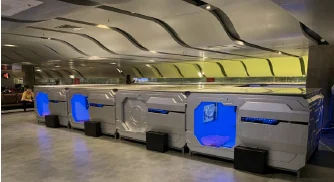
Common challenges this solves
- Traditional bunk beds offer zero privacy — guests reject open dorms in favour of private alternatives
- Hostels need 2× the bed density of single rooms but can't compromise on guest experience or security
- Single sleeping pods don't scale density enough for dorm-style projects
- Hostel operators want a clear comparison between traditional bunks, capsule bunk beds and capsule pods
Real-use context
Built for daily commercial use
BIDUA Pods can be planned around the way guests, staff and operators actually use the space: privacy, quick cleaning, secure rest, compact layout and predictable maintenance.
Why BIDUA Pods is the right fit
- Horizontal double bunk pods stack two private capsules per footprint — 2× density vs single pods
- Vertical bunk pods (Cosmos series) fit dorm rooms with low ceiling clearance
- Each pod has individual light, fan/AC, charging, locker and lockable entry — full privacy at bunk density
- Made-in-India FRP option for budget hostel projects; imported ABS for premium backpacker brands
- Hostel-tested durability — designed for high-turnover dorm use
Business case
- Bunk pod density: 14–20 pods per 600 sq ft dorm room — comparable to traditional bunks
- Average per-night rate uplift: 30–60% vs equivalent traditional bunk hostel
- Guest experience uplift: privacy, lockable storage and individual climate drive 4.5+ review scores
- Strong fit: backpacker hostels, premium youth hostels, university dorms, training campuses, religious tourism dorms
Bunk bed pods, also called capsule bunk beds, combine the bed density of a traditional bunk bed with the privacy and amenity of a sleeping pod. Each unit stacks two fully enclosed capsules in the same footprint as a traditional bunk frame — but each capsule has its own light, fan or AC duct, charging points, storage shelf and lockable entry. The format is the dominant choice for premium hostels, dorm-style stays and high-density hospitality projects in Japan, Singapore, Hong Kong, Korea and increasingly India.
The advantage over traditional bunk beds is significant. Hostels using open bunks see steadily declining demand as guests increasingly refuse zero-privacy accommodation; review scores on Booking.com and Hostelworld trend toward 3.0–3.8. Hostels that switch to capsule bunk pods routinely command 30–60% higher per-night rates and score 4.5+ on the same platforms. The same applies to university hostels, training campuses and any project where bed density is required but privacy is non-negotiable.
BIDUA Pods supplies two main bunk pod configurations: horizontal double bunks (Galaxy series — upper and lower berths stacked with side entry) and vertical bunk pods (Cosmos series — designed for dorm rooms with low ceiling clearance). Both are available in imported ABS for premium projects and Made-in-India FRP for budget hostel and dorm builds. Wooden bunk capsules are also available for premium backpacker brands that want a warmer, natural aesthetic.
Density planning is straightforward. A typical 600 sq ft dorm room fits 7–10 bunk pod units, giving 14–20 private berths with aisles and shared lockers. A 1,000 sq ft dorm room fits 12–16 units (24–32 berths). Ceiling height needs to be 2.4 metres minimum for horizontal double bunks; vertical bunks (Cosmos) work in slightly lower clearances. BIDUA can produce a layout for your specific dorm dimensions.
Pricing is competitive with — and often below — the cost of equivalent traditional bunk beds plus the lockable storage, individual lighting and ventilation that hostel guests now expect as a baseline. Made-in-India FRP bunk pods start around ₹2.2–₹2.8 lakh per unit (two berths). Imported ABS horizontal double bunks (Galaxy) and vertical bunks (Cosmos) range ₹2.4–₹3.8 lakh per unit. All prices exclude 18% GST and final transport; bulk pricing applies above 10 units.
Beyond hostels, bunk pods are increasingly used in university and college hostels (capacity uplift without new construction), training campuses, defence and paramilitary accommodation, religious tourism dorms (pilgrim rest at scale), and construction labour camps. Each use case is covered in a dedicated guide on this site. To get a layout, capex estimate and product shortlist for your project, contact BIDUA Pods via the form on this page.
Recommended imported products
Premium imported capsule bed options commonly used for commercial projects that need a flagship finish, ABS shell quality and faster buyer confidence.
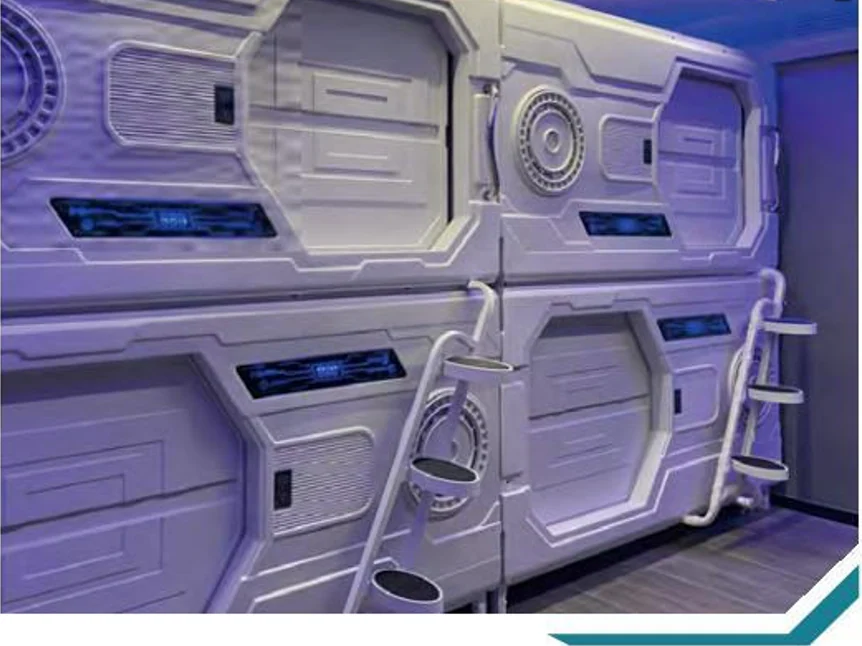
GALAXY Series - Horizontal Double
Spacious double variant with all premium GALAXY features, designed for couples or guests requiring extra space in commercial facilities.
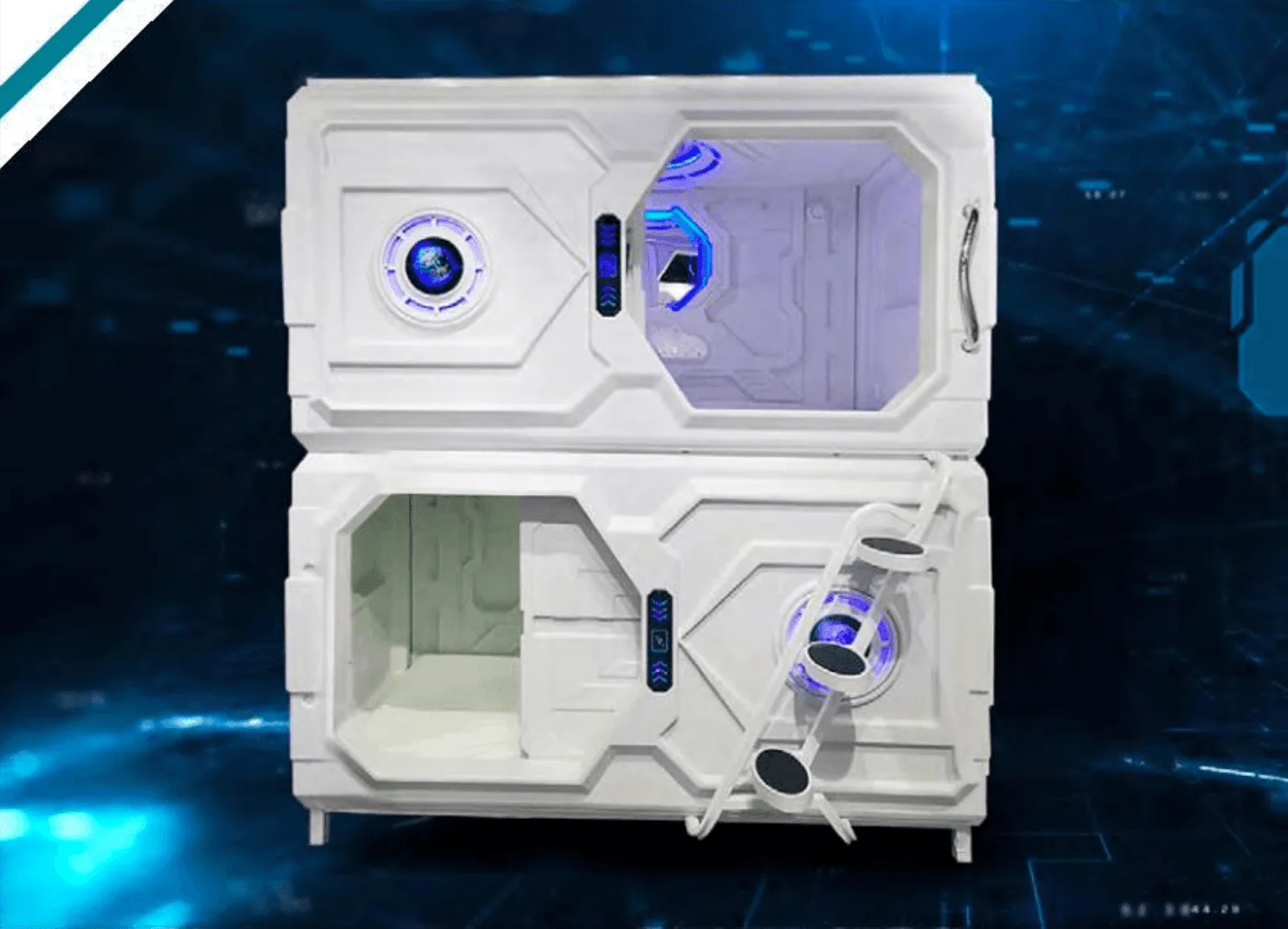
COSMOS Series - Vertical Single
Innovative vertical design with ABS + metal construction, featuring sliding door, ladder, TV slot, and mirror panel for space-efficient installations.
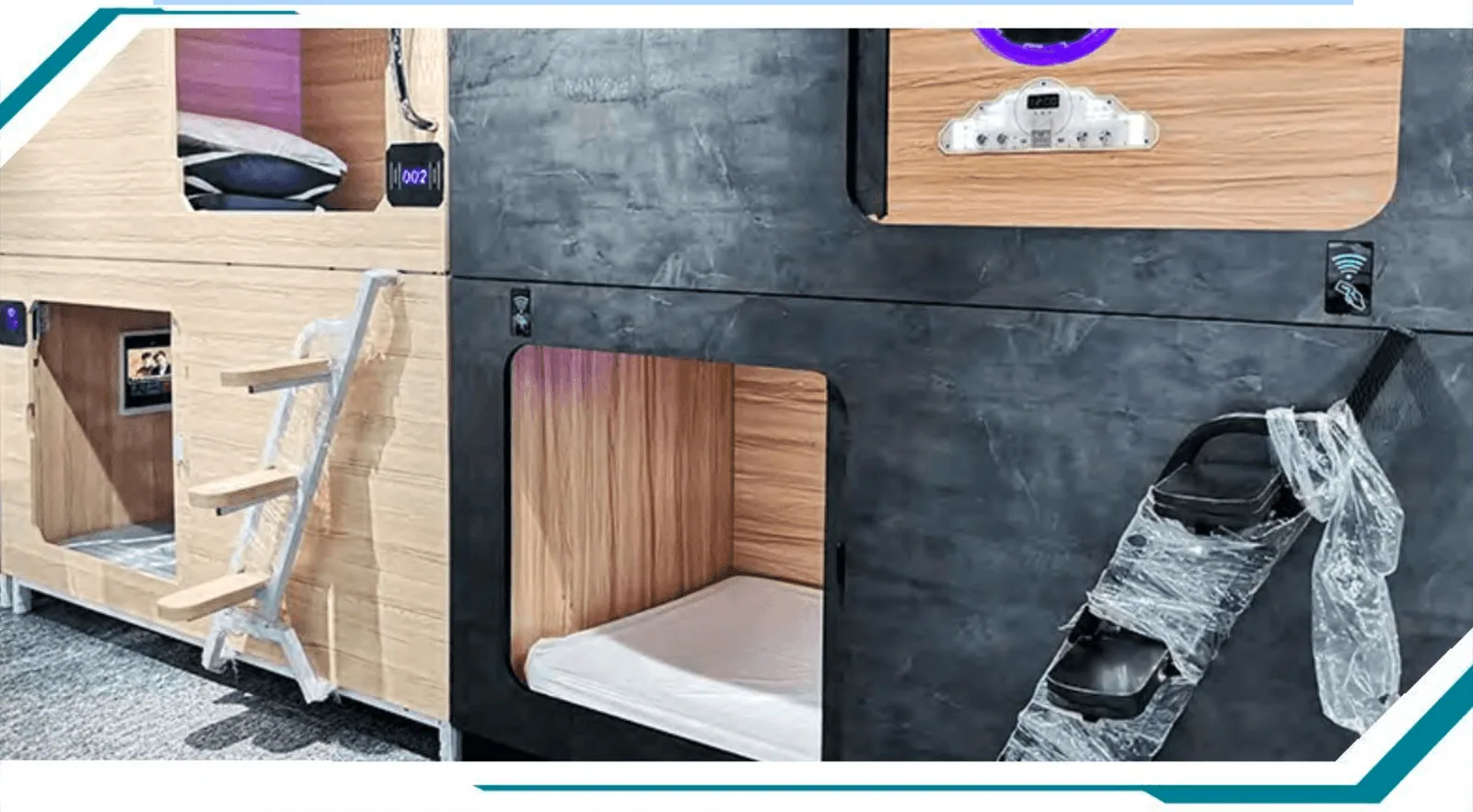
Wooden Series - Horizontal Single
Premium eco multi-layer board construction with metal frame, offering natural wood-grain aesthetics while maintaining all essential capsule bed features.
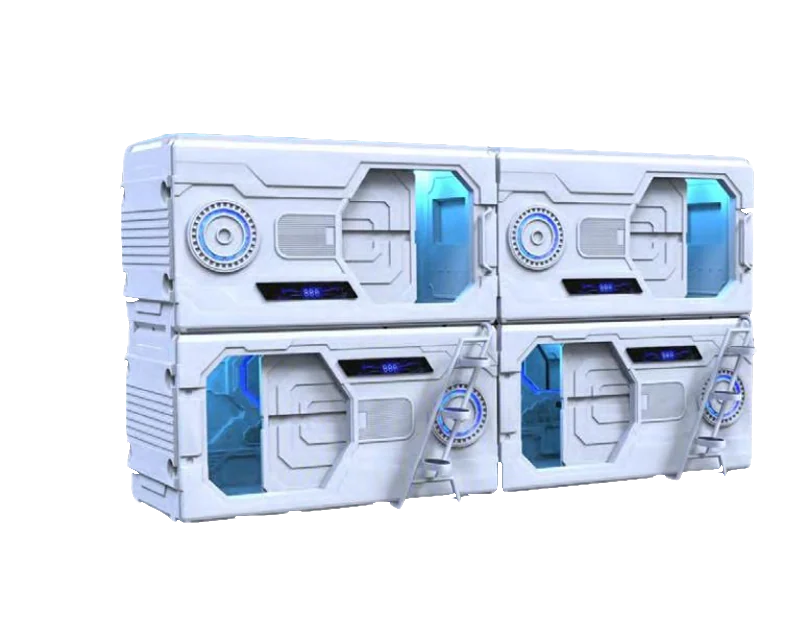
GALAXY Series - Horizontal Single
Standard ABS shell with metal frame featuring TV slot, security sliding door, and ergonomic non-slip ladder. Perfect for hotels, airports, and commercial applications.
Frequently asked questions
What is a bunk bed pod?+
A bunk bed pod (or capsule bunk bed) is a sleeping pod configured in a stacked, two-tier layout — upper and lower private capsules sharing the same footprint as a traditional bunk bed. Each capsule is fully enclosed with its own light, fan or AC duct, charging points, storage and lockable entry, giving guests the privacy of a private room at the density of a bunk.
How is a bunk bed pod different from a traditional bunk bed?+
A traditional bunk bed is just two beds stacked on a frame — fully open, no privacy, no individual controls. A bunk bed pod gives each tier a fully enclosed shell, individual lights and AC, a lockable door, charging, and a small storage shelf. Guests get the same density as a bunk but with the privacy and security of a private room.
How much does a bunk bed pod cost in India?+
Made-in-India FRP bunk pods start around ₹2.2–₹2.8 lakh per unit (two berths). Imported ABS horizontal double bunks (Galaxy series) range ₹2.5–₹3.8 lakh per unit. Vertical bunk pods (Cosmos series) range ₹2.4–₹3.4 lakh. Pricing excludes 18% GST and final transport. Bulk pricing applies above 10 units.
How many bunk pods fit in a hostel dorm room?+
A typical 600 sq ft dorm room comfortably fits 7–10 bunk pod units (14–20 berths) with aisles and lockers. Density depends on ceiling height, aisle width and washroom ratio. BIDUA can suggest a layout based on your room dimensions.
Are bunk pods suitable for hostels?+
Yes — capsule bunk beds are the dominant format for premium and upper-mid hostels in Japan, Singapore, Hong Kong and Korea, and adoption is growing in India. Hostels using bunk pods routinely score 4.5+ on Booking.com and Hostelworld due to privacy and lockable storage.
Are bunk pods used in places other than hostels?+
Yes — bunk pods are used in university and college hostels, training campuses, defence/paramilitary accommodation, religious tourism dorms, construction labour camps, and budget hotel pod zones. Any project that needs high bed density with privacy is a candidate.
Can guests with claustrophobia use bunk pods?+
Bunk pods are larger than a single bed and have ventilation, light controls and an entry that the guest controls. Most guests including first-timers report no claustrophobia issues. Operators that worry about this can offer a sample pod walk-through at booking.
Explore more
Ready to plan your project?
Get a free site layout, indicative pricing and product recommendations within 24 hours.