Tier 3 pilgrim market · Hindu · Himachal Pradesh
Jwala Ji Pilgrimage – Modern Sleeping Pods for Devotees
Jwala Devi, the fierce aspect of Shakti, is worshipped at the Jwalamukhi temple in Himachal Pradesh, a premier Shakti Pitha and one of the most iconic flame‑bearing shrines in North India.
Annual pilgrim footfall
Approximately 12‑15 lakh pilgrims visit Jwala Ji each year, with daily footfall soaring to 30‑40 k during the Navratri and Chaitra months.
Peak seasons
Spring (March‑May), Monsoon (July‑September), Winter (December‑January)
Deity & tradition
Shakti — Hindu. Pilgrims are largely middle‑class families and devotees from nearby hill districts; existing dharamshalas overflow on peak days, leaving many to sleep on temple grounds or roadside benches.
Around Jwala Ji
The shrine, ghats and circuit sights that drive year-round pilgrim footfall at Jwala Ji.

force-refresh
Why Jwala Ji matters
Jwala Devi, the fierce aspect of Shakti, is worshipped at the Jwalamukhi temple in Himachal Pradesh, a premier Shakti Pitha and one of the most iconic flame‑bearing shrines in North India.
History & heritage
The site dates back to at least the 7th century when Chinese travelers recorded its fiery springs, and it gained prominence in the 14th century after Sultan Firuz Shah Tughlaq’s visit. The present temple, built in a modern Muslim style with a golden dome, crowns a natural gas fissure that fuels an eternal flame, symbolising the goddess’s mouth.
Why a pod hotel works at Jwala Ji
During Navratri the existing dharamshalas reach 95 % occupancy, forcing pilgrims to camp on the temple premises or sleep on crowded bus stations. Private hotels are scarce and priced above the average pilgrim budget, creating a clear need for affordable, hygienic, 24‑hour stay options.
Most devotees travel by road from Shimla (≈150 km) or Dharamshala (≈120 km) via state highways; a modest bus hub at Jawalamukhi connects to major towns, while the nearest railhead is at Pathankot (≈80 km) and the closest airport is Gaggal (≈140 km). The shrine forms a key stop on the Himachal pilgrimage circuit that includes Kangra and Chamba.
Best ways to use pods here
- Budget capsule stay for families arriving early for Navratri darshan queues
- Mid‑range pod rooms for senior devotees seeking quiet after long road journeys
- Rapid‑turnover single pods for day‑travellers from Pathankot seeking a rest before the evening aarti
- Family pods with adjoining units for groups from Himachal districts during winter festivals
- Premium vertical pods with charging stations for tech‑savvy youth pilgrims during monsoon pilgrimages
Where the pilgrim demand sits
Transit & arrival
- •Pathankot Railway Station – 80 km
- •Gaggal Airport – 140 km
- •Shimla‑Kangra State Highway – direct access road
On the yatra route
- •Jwala Ji Dharmashala Complex
- •Kangra Temple Registration Centre
- •Chamba Pilgrims’ Union Office
Nearby shrines & circuit
- •Kangra Vajreshwari – sister Shakti shrine with historic murals
- •Chamba Chamunda – famed for its night‑time fire rituals
- •Mata Mansa Devi, Kangra – popular for family pilgrimages
Major festivals & melas
- •Navratri – nine nights of fire rituals and massive crowds
- •Maha Shivaratri – night‑long vigils at the flame
- •Baisakhi – regional fair attracting families and traders
Profit & ROI projection at Jwala Ji
A starter model based on a minimum 50 pods at 70% occupancy and an indicative ₹800/pod/night. Costs use the same itemised basis as our full ROI calculator — pods, add-ons, 18% GST, transport, fit-out and full monthly running cost.
Important: this is only an ASSUMPTION-based projection — not an accurate quote or a guarantee.
Real cost, occupancy, pricing and profit change with your exact location, property rent, yatra season, festival peaks and competition. Treat these as a planning estimate only. For real numbers, use the full calculator or get a custom quote from BIDUA.
Total investment
₹79.7 lakh
50 pods + add-ons + GST + fit-out
Monthly revenue
₹8.4 lakh
35 of 50 pods filled/night
Monthly net profit
₹3.8 lakh
45% margin after all costs
Payback
~21 mo
57% annual ROI
Break-even occupancy ≈ 29% — you only need this much filled to cover all costs; everything above is profit. Festival & yatra peaks routinely push pilgrim-town occupancy far higher.
| 50 pods (BIDUA mix) | ₹40,30,000 |
| Add-ons (mattress, bedding, panels, safe lock, table) | ₹16,25,200 |
| GST @ 18% (pods + add-ons) | ₹10,17,936 |
| Transport (warehouse → site) | ₹4,00,000 |
| Fit-out, AC, reception, branding + rent deposit | ₹9,00,000 |
| Total investment | ₹79,73,136 |
| Revenue (50 × 70% × ₹800 × 30) | ₹8,40,000 |
| Fixed costs (rent, staff, power, housekeeping…) | – ₹2,67,000 |
| Variable (OTA + marketing + gateway, 23%) | – ₹1,93,200 |
| Net profit / month | ₹3,79,800 |
| Net profit / year | ₹45,57,600 |
Indicative ROI inputs based on tier benchmarks; not a guarantee — adjust to your specific lease and ADR. Figures are indicative estimates, not guarantees.
Also planning standalone rooms?
Consider prefab Capsule Houses for outdoor accommodation in Jwala Ji
Sleeping pods maximise indoor bed capacity. Capsule houses solve a different need: detached, self-contained guest rooms for resorts, scenic plots and destination stays.
Jwala Ji pilgrim pod-hotel business plan & study
A step-by-step plan to launch a capsule / sleeping-pod hotel for pilgrims at Jwala Ji — from picking a spot near the shrine to licences, setup, pricing and reaching profitable occupancy through yatra and festival peaks.
Demand drivers
12+
transit, yatra-route, circuit & festival footfall points
Space needed (50 pods)
2250–2750 sq ft
single rented floor + reception & washrooms
Break-even occupancy
29%
fill above this and you are in profit
Indicative payback
~21 months
on ₹79.7 lakh all-in setup
1. Pick the right location
Target a floor close to Jwala Ji Dharmashala Complex or Pathankot Railway Station – 80 km, within walking or short-shuttle distance of the shrine. Best opening use-case: Budget capsule stay for families arriving early for Navratri darshan queues.
2. Plan investment & funding
Budget about ₹79.7 lakh all-in for 50 pods (pods + add-ons + 18% GST + transport + fit-out & deposit). Many operators fund this with own capital plus a small business/MSME loan against projected yatra-season cash flow.
3. Licences & compliance
Arrange a municipal trade licence, GST registration, fire safety NOC, police/guest verification, and any temple-town/local authority approvals before launch.
4. Build & launch
BIDUA shares a free 3D layout, then delivers and helps install the pods. Civil, electrical, AC and reception fit-out typically takes ~30–45 days, so you can open before the next big festival.
5. Pricing & operations
Start at ~₹800/pod/night, flex up sharply during Spring (March‑May), and add hourly slots for darshan-queue rest. Keep pods clean, private and secure to win repeat pilgrim stays.
6. Marketing & occupancy
List on OTAs (MakeMyTrip, Booking.com, Goibibo) + Google Business Profile, and tie up with tour operators, yatra package agents and local pandas/priests to push occupancy past the 29% break-even.
Recommended pod setup for Jwala Ji
A single‑floor pod complex of ~4,800 sq ft with 60 horizontal singles, 20 vertical singles and 10 family pods offers optimal capacity for peak demand.

GALAXY Series - Horizontal Single
Standard ABS shell with metal frame featuring TV slot, security sliding door, and ergonomic non-slip ladder. Perfect for hotels, airports, and commercial applications.
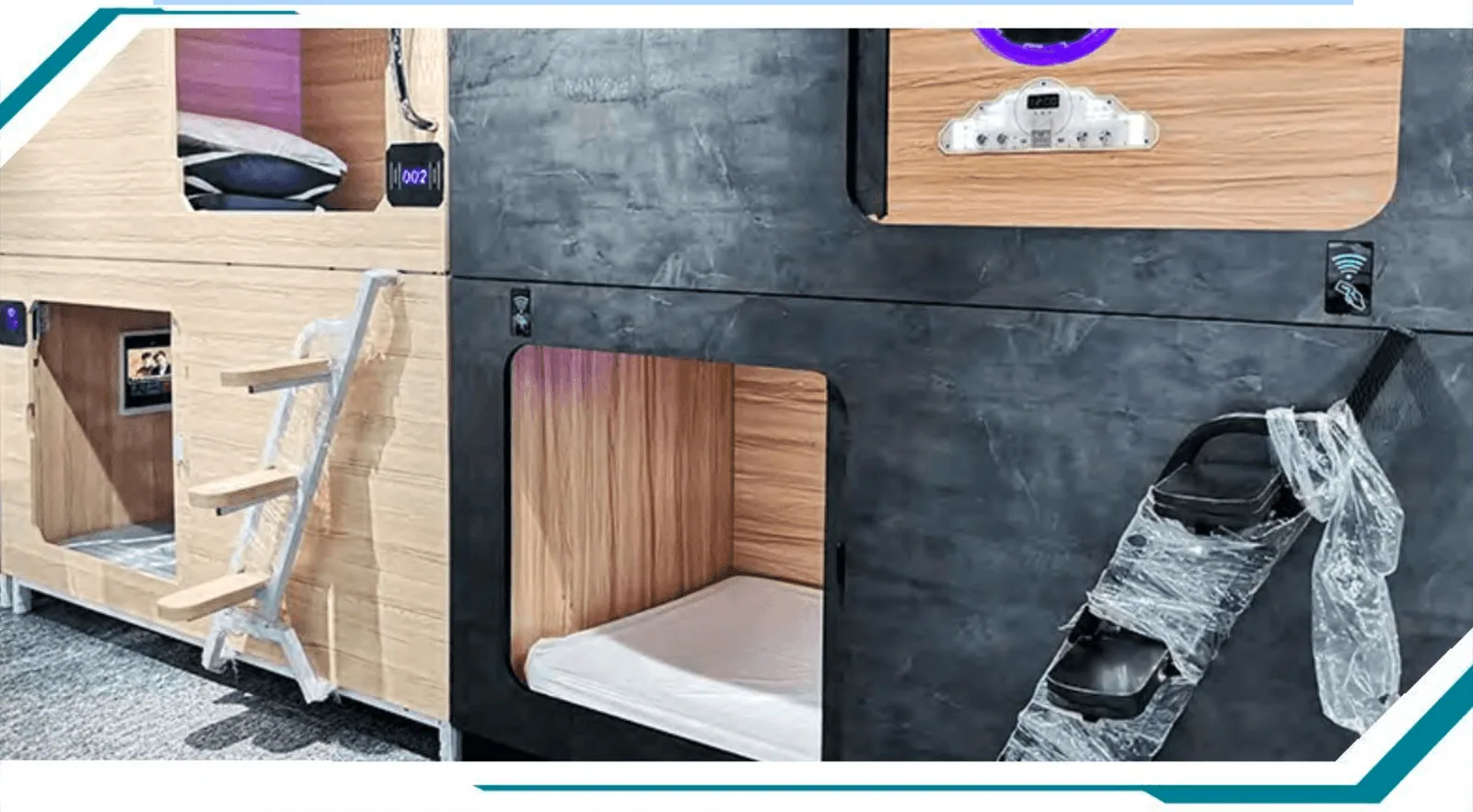
Wooden Series - Horizontal Single
Premium eco multi-layer board construction with metal frame, offering natural wood-grain aesthetics while maintaining all essential capsule bed features.
Pilgrim-market deep-dive
The Jwala Ji pilgrim pod-hotel opportunity
Jwala Ji, perched in the rugged hills of Himachal Pradesh, venerates Goddess Jwala Devi, the fiery embodiment of Shakti. Recognised as a major Shakti Pitha, the temple’s hallmark is an eternal flame that erupts from a natural fissure, drawing worshippers from across northern India and beyond. Its blend of ancient myth and modern Muslim‑style architecture makes it a distinctive pilgrimage destination.
Each year, roughly 12‑15 lakh devotees converge on Jwala Ji, with pilgrim traffic peaking during Navratri, Maha Shivaratri and the spring Baisakhi fair. During these festivals, daily arrivals can exceed 40,000, creating massive queues for darshan and overwhelming the limited lodging infrastructure. The influx is further amplified by regional pilgrims who travel from nearby hill districts, making the site a bustling hub of devotion.
On the ground, accommodation is a chronic challenge. Existing dharamshalas fill up within hours of festival openings, and private hotels are either fully booked or priced beyond the reach of average pilgrims. Consequently, many resort to sleeping on temple grounds, bus stations, or makeshift camps, compromising comfort and hygiene. This accommodation gap not only strains pilgrim satisfaction but also limits the shrine’s capacity to host larger gatherings.
BIDUA Pods offers a perfect solution: modular, low‑cost capsule hotels that blend seamlessly with the sacred environment. Their compact design maximizes land use, provides hygienic private spaces, and can be scaled quickly to meet seasonal demand. For operators, the Jwala Ji circuit presents a high‑yield opportunity—steady pilgrim flow, limited competition, and strong community support for modern yet respectful lodging.
Jwala Ji pod hotel — FAQs
What is a sleeping pod and how does it suit Jwala Ji pilgrims?+
A sleeping pod is a compact, lockable capsule that provides a clean bed, privacy and basic amenities; it lets pilgrims rest comfortably after long treks to Jwala Ji without the high cost of hotels.
Are capsule hotels allowed near the Jwala Devi shrine?+
Yes, the Himachal tourism department encourages modern, low‑impact lodging such as capsule hotels within the designated pilgrim zone, provided they follow fire‑safety and local architectural guidelines.
Can I book a pod for a single night during Navratri?+
Absolutely – the pod facility operates 24 hours and offers day‑rate bookings, ideal for those who need a quick rest before joining the night‑long aarti.
Do the pods provide prayer space?+
Each pod floor includes a small communal prayer alcove and a dedicated prayer corner, allowing devotees to observe daily rituals without leaving the premises.
How is security handled for sleeping pods at Jwala Ji?+
The complex is monitored by CCTV, staffed security guards, and each pod has an electronic lock with a personal PIN, ensuring safety for all pilgrims.
What amenities are included in the capsule hotel?+
Pods feature a comfortable mattress, reading light, power outlet, Wi‑Fi, attached bathroom facilities on the same floor, and a shared lounge with tea/coffee service.
Start your Jwala Ji pilgrim pod hotel with BIDUA
Sign up to design your space in 3D, build a presentation, and get a quotation + ROI from one dashboard — or talk to our team for a custom Jwala Ji plan.