Tier 3 pod-hotel market · Uttar Pradesh
Pod Hotel in Sambhal — Affordable Sleeping Pods for Pilgrims, Craft Traders & Rail Travellers
High population density, a large rural hinterland funnelling into 2-3 small towns for healthcare, rail travel and trade, and rising pilgrim traffic to Kalki Dham together create strong short-stay rest demand year-round — an ideal profile for affordable sleeping pods.

Population & catchment
Sambhal district has a population of approximately 22 lakh (2,199,774 per the 2011 Census), with a density of ~897 persons per sq km across 2,453 sq km of fertile Indo-Gangetic plain.
Urban pull
Only ~21% of the population (4.68 lakh) is urban, concentrated in Sambhal town (~2.2 lakh), Chandausi (~1.14 lakh) and smaller qasbas; the remaining ~79% is rural, creating demand for centralised rest facilities in the few urban nodes.
Economic base
Sambhal's economy rests on three distinctive pillars: the centuries-old GI-tagged horn-and-bone handicraft industry centred in Sarai Tarin (exporting decorative wares, furniture inlay and flatware to 80+ countries), South Asia's largest menthol oil trading market (supplying Western Europe and China), and a sugarcane-based agro-industrial belt anchored by the Dhampur Bio Organics sugar mill at Asmoli. Agriculture — wheat, paddy, sugarcane, mustard and mentha — remains the backbone for the rural majority, while Chandausi functions as a rail-trade hub historically known for rice and sugar exports.
Around Sambhal
Key landmarks and footfall hubs that drive short-stay demand in Sambhal.
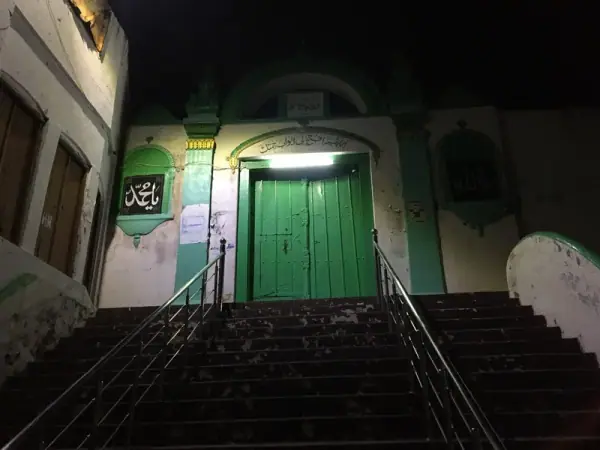
Shahi Jama Masjid, Sambhal (1526 Mughal-era mosque)
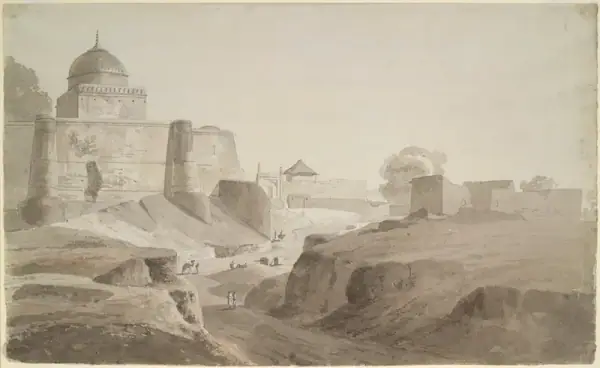
Wash drawing of Sambhal Jama Masjid by Thomas & William Daniell (1789)
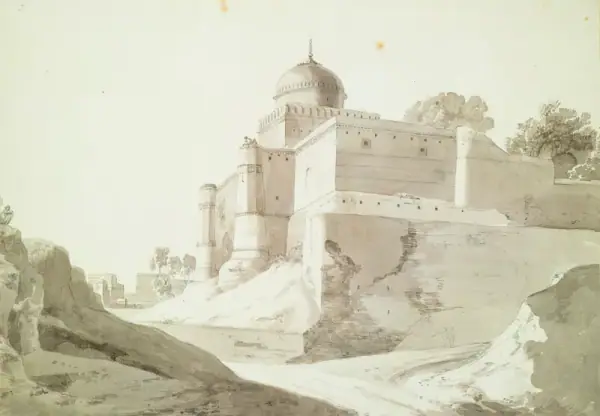
Perspective view of the mosque at Sambhal (RIBA architectural drawing)
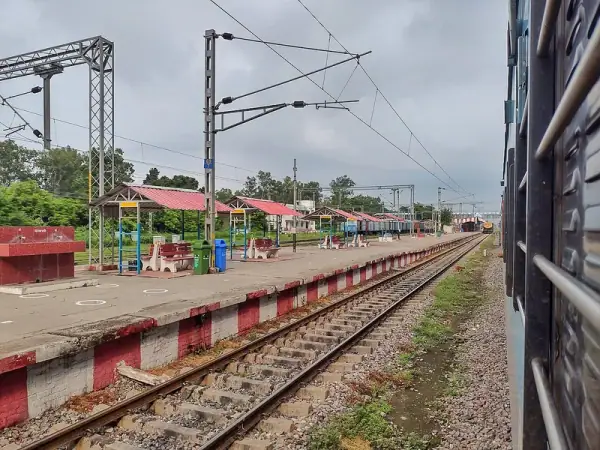
Chandausi Junction Railway Station
Why a pod hotel works in Sambhal
Sambhal district has virtually no branded, hygienic short-stay accommodation despite four distinct demand streams: Kalki Dham pilgrims (growing rapidly with temple construction), horn-and-bone craft trade visitors, Chandausi Junction rail transit passengers, and medical attendants at two teaching hospitals. The few existing lodges are unbranded, poorly maintained and offer no hourly-rest option — leaving a wide-open gap for affordable, climate-controlled sleeping pods.
People travel to and through Sambhal for the ancient Kalki Dham pilgrimage (believed birthplace of Lord Kalki), to trade in South Asia's largest menthol market, to source GI-tagged horn-and-bone handicrafts for global export, for medical care at Shri Siddhi Vinayak Medical College (650 beds), and to transit via Chandausi Junction onward to Moradabad, Bareilly, Aligarh or Delhi. The newly inaugurated Ganga Expressway (594 km, passing through Sambhal) and the upcoming Bareilly-Mathura NH are multiplying through-traffic. Most visitors — craft buyers, pilgrims, patient attendants, rail passengers — need clean, affordable rest for a few hours to one night, exactly the sleeping-pod sweet spot.
Best ways to use pods here
- Pilgrim overflow accommodation near Kalki Dham Temple and Kalki Vishnu Mandir during festivals, weekends and the construction-phase darshan surge
- Transit rest pods at or near Chandausi Junction for passengers on the Aligarh-Bareilly and Lucknow-Moradabad rail corridors (~48 trains/day)
- Patient-attendant stays near Shri Siddhi Vinayak Medical College & Hospital (650-bed) and Hakim Rais Unani Medical College (200-bed)
- Trade-visitor short stays for domestic and international buyers visiting Sambhal's GI-tagged horn-and-bone handicraft workshops and menthol oil market
- Highway rest stop on the Ganga Expressway / NH-509 corridor for long-haul drivers and road travellers between Delhi, Aligarh, Moradabad and Bareilly
Where the demand sits in Sambhal
Transit & travel
- •Chandausi Junction (3-platform railway junction since 1872, ~48 trains/day on Aligarh-Bareilly and Lucknow-Moradabad lines)
- •Sambhal Railway Station (on Chandausi loop line)
- •NH-509 (Aligarh-Moradabad highway passing through Sambhal district)
- •Ganga Expressway (594 km, inaugurated April 2026, passes through Sambhal district)
- •Moradabad Junction (~45 km, major North Indian rail hub)
- •Delhi-NCR (~160 km via NH, ~3 hours by road)
Healthcare demand
- •Shri Siddhi Vinayak Medical College & Hospital (650-bed, NMC-approved MBBS college)
- •Hakim Rais Unani Medical College & Hospital (200-bed, est. 1984, 20-acre campus)
- •District Hospital Sambhal
- •District Women's Hospital
- •Eye Hospital Sambhal
Education & coaching
- •Shri Siddhi Vinayak Medical College (MBBS students from across UP)
- •Mahatma Gandhi Memorial Post Graduate College, Sambhal
- •Government Degree College, Sambhal
- •N.K.B.M.G Post Graduate College, Chandausi
- •Zonal Railway Training Institute (ZRTI), Chandausi (ISO 9001-certified, trains Northern Railway staff)
Industry & trade
- •Horn-and-bone handicraft cluster, Sarai Tarin (GI-tagged, thousands of artisan workshops, exports to 80+ countries)
- •South Asia's largest menthol oil market (exports to Western Europe and China)
- •DSM Sugar / Dhampur Bio Organics Ltd, Asmoli (sugar mill + 5 MW cogeneration plant)
- •Moradabad brass-ware cluster (~45 km, 30,000-40,000 units, 40% of India's handicraft exports)
Tourism & pilgrimage
- •Shri Kalki Dham Temple (PM Modi laid foundation stone Feb 2024, 108-ft shikhara, 5-acre complex under construction)
- •Pracheen Shri Kalki Vishnu Mandir (ancient temple, one of India's oldest Kalki shrines)
- •Shahi Jama Masjid (1526, oldest surviving Mughal-era mosque, built by Babur's general Mir Hindu Beg)
- •Amarpati Kheda / Dadhichi Ashram (ASI-protected archaeological site with 21 samadhis)
- •Jim Corbett National Park (~110 km via Moradabad, premier tiger reserve)
Profit & ROI projection for Sambhal
A starter model based on a minimum 50 pods at 70% occupancy and an indicative ₹700/pod/night. Costs use the same itemised basis as our full ROI calculator — pods, add-ons, 18% GST, transport, fit-out and full monthly running cost.
Important: this is only an ASSUMPTION-based projection — not an accurate quote or a guarantee.
The real cost, occupancy, pricing and profit will change with your exact location, property rent, season, competition and how you run the business. Treat these figures as a planning estimate only. For real numbers, use the full calculator or get a custom quote from BIDUA.
Total investment
₹75.7 lakh
50 pods + add-ons + GST + fit-out
Monthly revenue
₹7.3 lakh
35 of 50 pods filled/night
Monthly net profit
₹3.2 lakh
44% margin after all costs
Payback
~23 mo
51% annual ROI
Break-even occupancy ≈ 30% — you only need this much filled to cover all costs; everything above is profit.
| 50 pods (BIDUA mix) | ₹40,30,000 |
| Add-ons (mattress, bedding, panels, safe lock, table) | ₹16,25,200 |
| GST @ 18% (pods + add-ons) | ₹10,17,936 |
| Transport (warehouse → site) | ₹4,00,000 |
| Fit-out, AC, reception, branding + rent deposit | ₹5,00,000 |
| Total investment | ₹75,73,136 |
| Revenue (50 × 70% × ₹700 × 30) | ₹7,35,000 |
| Fixed costs (rent, staff, power, housekeeping…) | – ₹2,42,000 |
| Variable (OTA + marketing + gateway, 23%) | – ₹1,69,050 |
| Net profit / month | ₹3,23,950 |
| Net profit / year | ₹38,87,400 |
These are indicative assumptions for a Tier 3 western UP town, not a guarantee. Actual revenue depends on location, season, pilgrim-traffic growth and operational execution. The shared ROI model adds capex, full opex, GST and transport automatically. Figures are indicative estimates, not guarantees.
Sambhal pod-hotel business plan & study
A step-by-step plan to launch a capsule / sleeping-pod hotel in Sambhal — from picking the right location to licences, setup, pricing and reaching profitable occupancy.
Demand drivers
21+
transit, hospital, student & tourism footfall points
Space needed (50 pods)
2250–2750 sq ft
single rented floor + reception & washrooms
Break-even occupancy
30%
fill above this and you are in profit
Indicative payback
~23 months
on ₹75.7 lakh all-in setup
1. Pick the right location
Target a floor near Shri Siddhi Vinayak Medical College & Hospital (650-bed, NMC-approved MBBS college) or Sambhal Railway Station (on Chandausi loop line). Best opening use-case: Pilgrim overflow accommodation near Kalki Dham Temple and Kalki Vishnu Mandir during festivals, weekends and the construction-phase darshan surge.
2. Plan investment & funding
Budget about ₹75.7 lakh all-in for 50 pods (pods + add-ons + 18% GST + transport + fit-out & deposit). Many operators fund this with a mix of own capital + a small business/MSME loan against projected cash flow.
3. Licences & compliance
Arrange a municipal trade licence, GST registration, fire safety NOC, police/guest verification (where required), and basic building & sanitation approvals before launch.
4. Build & launch
BIDUA shares a free 3D layout, then delivers and helps install the pods. Civil, electrical, AC and reception fit-out typically takes ~30–45 days, so you can open quickly on a leased floor.
5. Pricing & operations
Start at ~₹700/pod/night, and add hourly slots near hospitals for day-rest demand. Run lean with a small reception + housekeeping team; keep pods clean, private and secure to earn repeat stays.
6. Marketing & occupancy
List on OTAs (MakeMyTrip, Booking.com, OYO, Goibibo) + Google Business Profile, and tie up with nearby hospitals, coaching institutes and tour operators to push occupancy past the 30% break-even quickly.
Key risks & how to manage them
Low occupancy in early months. Open with OTA listings + hospital/coaching tie-ups; use hourly pricing to fill day-time.
High rent eating margins. Choose a slightly off-main but accessible floor near Chandausi Junction (3-platform railway junction since 1872, ~48 trains/day on Aligarh-Bareilly and Lucknow-Moradabad lines); rent is the biggest lever.
Seasonality / exam & festival peaks. Flex pricing up in peak weeks; offer weekly/monthly pod rentals to students for a stable base.
Cleanliness & safety complaints. Invest in housekeeping, safe locks and CCTV — reputation drives repeat and OTA ratings.
Recommended pod setup for Sambhal
Start with a 50-pod Standard (Galaxy or Cosmos series) installation in 3,000-4,000 sq ft near Chandausi Junction or the Kalki Dham pilgrimage corridor. Mix single-bed horizontal pods (80%) for solo pilgrims, transit passengers and attendants with a few double-bed pods (20%) for couples and families. Offer both nightly and hourly booking to capture the rail-transit and trade-visitor micro-stay segment.

GALAXY Series - Horizontal Single
Standard ABS shell with metal frame featuring TV slot, security sliding door, and ergonomic non-slip ladder. Perfect for hotels, airports, and commercial applications.
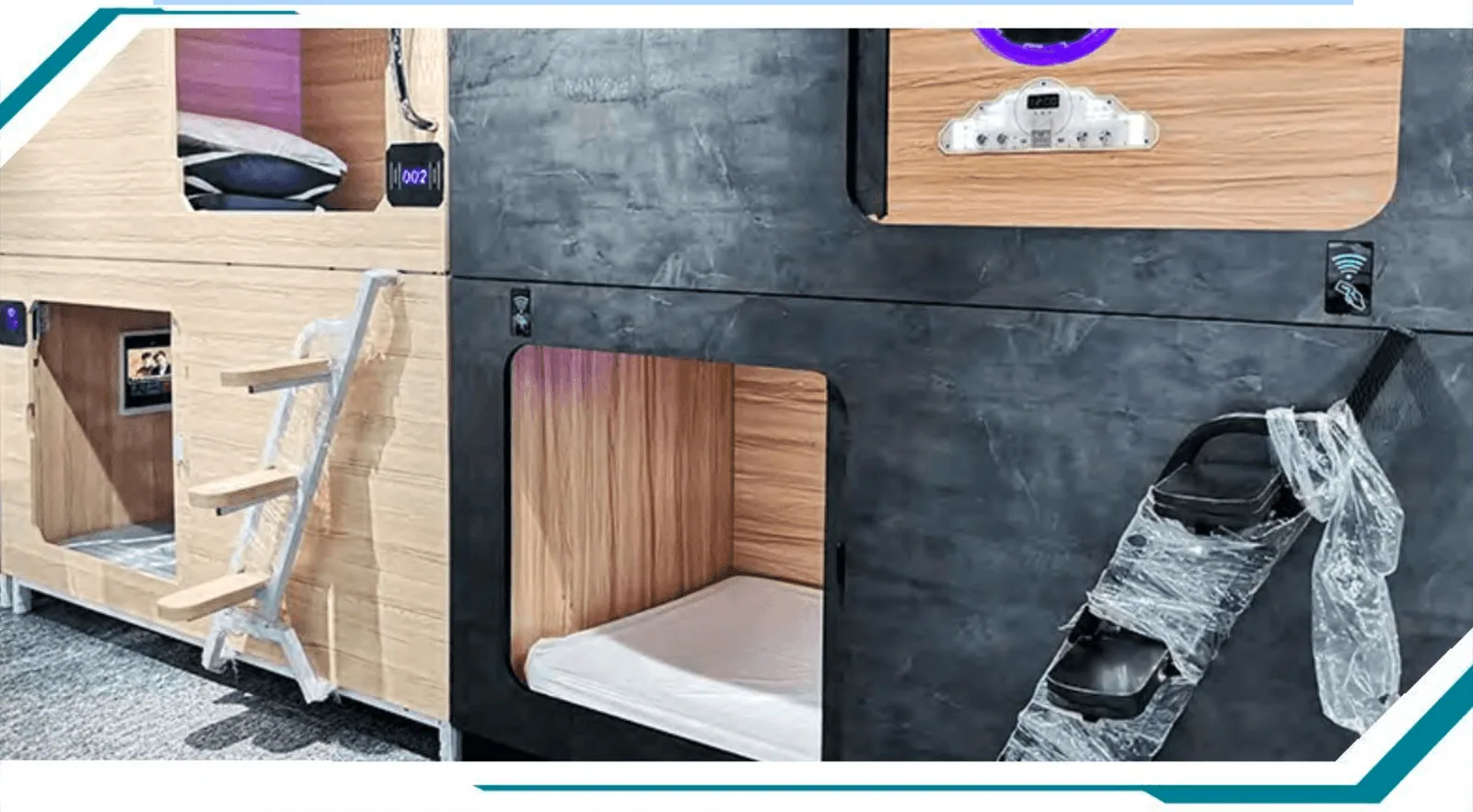
Wooden Series - Horizontal Single
Premium eco multi-layer board construction with metal frame, offering natural wood-grain aesthetics while maintaining all essential capsule bed features.
Market deep-dive
The Sambhal pod-hotel opportunity
Sambhal is no ordinary small town — it is a place woven into Hindu eschatology itself, revered across centuries as the prophesied birthplace of Lord Kalki, the tenth avatar of Vishnu. The ancient Pracheen Shri Kalki Vishnu Mandir has drawn devotees for generations, and now the massive new Kalki Dham Temple — whose foundation stone was laid by Prime Minister Modi in February 2024, with a planned 108-foot shikhara rising over a five-acre complex — is set to transform Sambhal into a nationally significant pilgrimage node. For a sleeping-pod operator, this emerging pilgrim economy means surging demand for affordable, hygienic overnight stays, especially during festival peaks and weekend darshan rushes that Sambhal's scant existing lodging cannot absorb.
Beyond faith, Sambhal is a craft powerhouse with genuine global reach. The district's GI-tagged horn-and-bone handicraft industry, concentrated in the Sarai Tarin quarter, turns slaughterhouse waste into exquisite bone-inlay furniture, flatware, jewellery and home decor exported to buyers in New York, Dubai and across Europe. Alongside this, Sambhal operates South Asia's largest menthol oil market, supplying Western European and Chinese processors. These two export clusters bring a steady stream of domestic and international trade visitors who need short-stay rest — exactly the gap a capsule hotel fills between arrival, factory visit and departure. A pod unit near the main bazaar or Chandausi rail corridor would capture this niche that no existing hotel consciously serves.
Chandausi Junction, the district's primary rail node opened in 1872, sits at the crossroads of the Aligarh-Bareilly line and the Lucknow-Moradabad route, handling around 48 trains daily and connecting Sambhal to Delhi, Lucknow, Bareilly and Mumbai-bound corridors. The April 2026 inauguration of the 594-km Ganga Expressway — which passes directly through Sambhal district — has dramatically amplified road connectivity, slashing travel times to Meerut, Prayagraj and points between. Add to this the proximity of Moradabad, India's Brass City and a major handicraft export hub just 45 kilometres away, and Jim Corbett National Park roughly 110 kilometres to the north, and Sambhal becomes a natural rest-stop node on multiple high-traffic corridors where affordable sleeping pods make commercial sense.
On the institutional side, the 650-bed Shri Siddhi Vinayak Medical College and the 200-bed Hakim Rais Unani Medical College pull patients and attendants from across western UP — a demographic that desperately needs clean, low-cost overnight shelter but finds few decent options today. The Zonal Railway Training Institute at Chandausi brings rotating batches of railway staff for weeks-long courses. Meanwhile, degree colleges and coaching centres generate seasonal student-accommodation pressure. For a BIDUA Pods franchisee, a 50-pod installation near either Chandausi Junction or the Kalki Dham pilgrimage zone can realistically target 70 percent occupancy by serving this layered demand stack — pilgrims, craft buyers, medical attendants, rail passengers and trainees — at a nightly rate of around Rs 700 that undercuts every hotel in town while delivering a superior, climate-controlled rest experience.
Sambhal pod hotel — FAQs
Why does Sambhal need a sleeping pod hotel when it already has budget lodges?+
Sambhal's existing budget lodges are few and often below modern hygiene standards. A capsule hotel near Chandausi Junction or the Kalki Dham pilgrimage zone offers air-conditioned, sanitised privacy pods at rates lower than traditional hotels — ideal for the craft buyers, rail passengers and patient attendants who dominate short-stay demand here.
Where is the best location for a Japanese-style pod hotel in Sambhal district?+
Three locations stand out: (1) near Chandausi Junction railway station, which handles ~48 daily trains and thousands of transit passengers; (2) within 1 km of Shri Kalki Dham / Kalki Vishnu Mandir in Sambhal town, serving pilgrims; (3) on the NH-509 (Aligarh-Moradabad highway) corridor to capture Ganga Expressway-linked road travellers.
What is the expected nightly rate for a nap pod or capsule hotel in Sambhal?+
Sambhal is a Tier 3 market, so pod rates typically range from Rs 600 to Rs 900 per night — significantly cheaper than a standard hotel room yet offering superior privacy, climate control and hygiene. Hourly rest packages for transit passengers and attendants can start even lower.
How many pods should a first pod hotel in Sambhal install?+
A 50-pod setup across roughly 3,000-4,000 sq ft is the recommended starting configuration. This keeps capital outlay manageable while covering the key segments: railway transit rest, pilgrim overflow during Kalki Dham festivals, medical-attendant stays near the 650-bed Siddhi Vinayak hospital, and visiting craft buyers.
Will the new Kalki Dham Temple increase demand for budget or hourly hotels in Sambhal?+
Absolutely. The Kalki Dham Temple — with PM Modi laying its foundation in February 2024 and a 108-ft shikhara planned on a 5-acre site — is positioning Sambhal as a major Hindu pilgrimage destination. As construction progresses and darshan traffic grows, demand for clean, affordable sleeping pods will rise sharply, especially during festivals and weekends.
Is a Chinese-style pod hotel concept viable in a small town like Sambhal?+
Yes. Sambhal may be a small town, but its unique combination of a GI-tagged export-craft cluster attracting international buyers, South Asia's largest menthol market drawing commodity traders, a 650-bed medical college pulling patients from surrounding districts, and emerging pilgrimage traffic to Kalki Dham creates diverse, year-round short-stay demand that pod hotels serve better and more affordably than traditional lodging.
Start your Sambhal pod hotel with BIDUA
Sign up to design your space in 3D, build a presentation, and get a quotation + ROI from one dashboard — or talk to our team for a custom Sambhal plan.