Tier 2 pilgrim market · Hindu · Uttarakhand
Haridwar’s Premier Sleeping Pods for Pilgrims
Haridwar, revered as the gateway to the Ganga, is a premier Hindu pilgrimage site where the deity Ganga is worshipped, ranking among the most sacred river‑front shrines in India.

Annual pilgrim footfall
Haridwar attracts roughly 20‑25 lakh pilgrims each year, with daily footfall soaring to 30‑50 k during Kumbh Mela and the Ganga Aarti evenings.
Peak seasons
Winter (Nov‑Feb), Monsoon (July‑Sept), Kumbh Mela (every 12 years)
Deity & tradition
Ganga — Hindu. Pilgrims range from budget seekers to affluent devotees, yet dharamshalas overflow on peak days and affordable clean rooms are scarce.
Why Haridwar matters
Haridwar, revered as the gateway to the Ganga, is a premier Hindu pilgrimage site where the deity Ganga is worshipped, ranking among the most sacred river‑front shrines in India.
History & heritage
The city traces its origins to ancient Vedic legends and Mahabharata references, later flourishing under Mauryan and Kushan rule; its iconic Har ki Pauri was built by King Vikramaditya in the 1st century BC and the area witnessed visits by Adi Shankaracharya and Guru Nanak, embedding layers of religious and cultural heritage.
Why a pod hotel works at Haridwar
During peak festivals dharamshalas fill beyond capacity, hotels charge premium rates, and many pilgrims resort to sleeping on railway platforms or under open ghats, creating a clear demand for safe, affordable, and hygienic lodging.
Most visitors arrive by train to Haridwar Railway Station or by road from Delhi (≈210 km); the nearest airport is Dehradun (≈55 km), and the city forms a hub in the North‑India yatra circuit linking Rishikesh, Kedarnath and Varanasi.
Best ways to use pods here
- Budget capsule stay for Kumbh Mela overflow crowds seeking nightly rest
- Family pod rooms for groups visiting Maya Devi and Chandi Devi together
- Single‑pod quick‑check‑in for early‑morning Ganga Aarti participants
- Premium pod suites for senior pilgrims requiring medical‑grade amenities
- Transit‑pod lounges for travelers awaiting trains after long road journeys
Where the pilgrim demand sits
Transit & arrival
- •Haridwar Railway Station – 2 km from main ghats
- •Jolly Grant Airport, Dehradun – 55 km
- •NH 7 Highway – passes through Haridwar town
On the yatra route
- •Har ki Pauri Darshan Centre
- •Maya Devi Temple Registration Desk
- •Chandi Devi Base Camp (via Rajaji Gate)
Nearby shrines & circuit
- •Maya Devi Temple – 11th‑century shrine of Sati’s heart
- •Chandi Devi Temple – hilltop shrine accessed by rope‑car
- •Sureshvari Devi Mandir – nestled in Rajaji National Park
Major festivals & melas
- •Kumbh Mela – massive congregation for Ganga dip
- •Ganga Aarti – nightly ritual at Har ki Pauri
- •Maha Shivratri – special worship at Chandi Devi Temple
Profit & ROI projection at Haridwar
A starter model based on a minimum 50 pods at 70% occupancy and an indicative ₹1,000/pod/night. Costs use the same itemised basis as our full ROI calculator — pods, add-ons, 18% GST, transport, fit-out and full monthly running cost.
Important: this is only an ASSUMPTION-based projection — not an accurate quote or a guarantee.
Real cost, occupancy, pricing and profit change with your exact location, property rent, yatra season, festival peaks and competition. Treat these as a planning estimate only. For real numbers, use the full calculator or get a custom quote from BIDUA.
Total investment
₹84.7 lakh
50 pods + add-ons + GST + fit-out
Monthly revenue
₹10.5 lakh
35 of 50 pods filled/night
Monthly net profit
₹4.7 lakh
45% margin after all costs
Payback
~18 mo
67% annual ROI
Break-even occupancy ≈ 29% — you only need this much filled to cover all costs; everything above is profit. Festival & yatra peaks routinely push pilgrim-town occupancy far higher.
| 50 pods (BIDUA mix) | ₹40,30,000 |
| Add-ons (mattress, bedding, panels, safe lock, table) | ₹16,25,200 |
| GST @ 18% (pods + add-ons) | ₹10,17,936 |
| Transport (warehouse → site) | ₹4,00,000 |
| Fit-out, AC, reception, branding + rent deposit | ₹14,00,000 |
| Total investment | ₹84,73,136 |
| Revenue (50 × 70% × ₹1,000 × 30) | ₹10,50,000 |
| Fixed costs (rent, staff, power, housekeeping…) | – ₹3,37,000 |
| Variable (OTA + marketing + gateway, 23%) | – ₹2,41,500 |
| Net profit / month | ₹4,71,500 |
| Net profit / year | ₹56,58,000 |
Indicative ROI inputs based on tier benchmarks; not a guarantee — adjust to your specific lease and ADR. Figures are indicative estimates, not guarantees.
Also planning standalone rooms?
Consider prefab Capsule Houses for outdoor accommodation in Haridwar
Sleeping pods maximise indoor bed capacity. Capsule houses solve a different need: detached, self-contained guest rooms for resorts, scenic plots and destination stays.
Haridwar pilgrim pod-hotel business plan & study
A step-by-step plan to launch a capsule / sleeping-pod hotel for pilgrims at Haridwar — from picking a spot near the shrine to licences, setup, pricing and reaching profitable occupancy through yatra and festival peaks.
Demand drivers
12+
transit, yatra-route, circuit & festival footfall points
Space needed (50 pods)
2250–2750 sq ft
single rented floor + reception & washrooms
Break-even occupancy
29%
fill above this and you are in profit
Indicative payback
~18 months
on ₹84.7 lakh all-in setup
1. Pick the right location
Target a floor close to Har ki Pauri Darshan Centre or Haridwar Railway Station – 2 km from main ghats, within walking or short-shuttle distance of the shrine. Best opening use-case: Budget capsule stay for Kumbh Mela overflow crowds seeking nightly rest.
2. Plan investment & funding
Budget about ₹84.7 lakh all-in for 50 pods (pods + add-ons + 18% GST + transport + fit-out & deposit). Many operators fund this with own capital plus a small business/MSME loan against projected yatra-season cash flow.
3. Licences & compliance
Arrange a municipal trade licence, GST registration, fire safety NOC, police/guest verification, and any temple-town/local authority approvals before launch.
4. Build & launch
BIDUA shares a free 3D layout, then delivers and helps install the pods. Civil, electrical, AC and reception fit-out typically takes ~30–45 days, so you can open before the next big festival.
5. Pricing & operations
Start at ~₹1,000/pod/night, flex up sharply during Winter (Nov‑Feb), and add hourly slots for darshan-queue rest. Keep pods clean, private and secure to win repeat pilgrim stays.
6. Marketing & occupancy
List on OTAs (MakeMyTrip, Booking.com, Goibibo) + Google Business Profile, and tie up with tour operators, yatra package agents and local pandas/priests to push occupancy past the 29% break-even.
Recommended pod setup for Haridwar
60 horizontal single pods + 20 vertical single pods + 10 family pods on a single floor of ~4,500 sq ft
GALAXY Series - Horizontal Single
Standard ABS shell with metal frame featuring TV slot, security sliding door, and ergonomic non-slip ladder. Perfect for hotels, airports, and commercial applications.

SPACE Series - Horizontal Single
Standard SPACE series with mirror panel, sliding door, TV slot, and intelligent LED controls. Perfect for hotels and commercial applications.
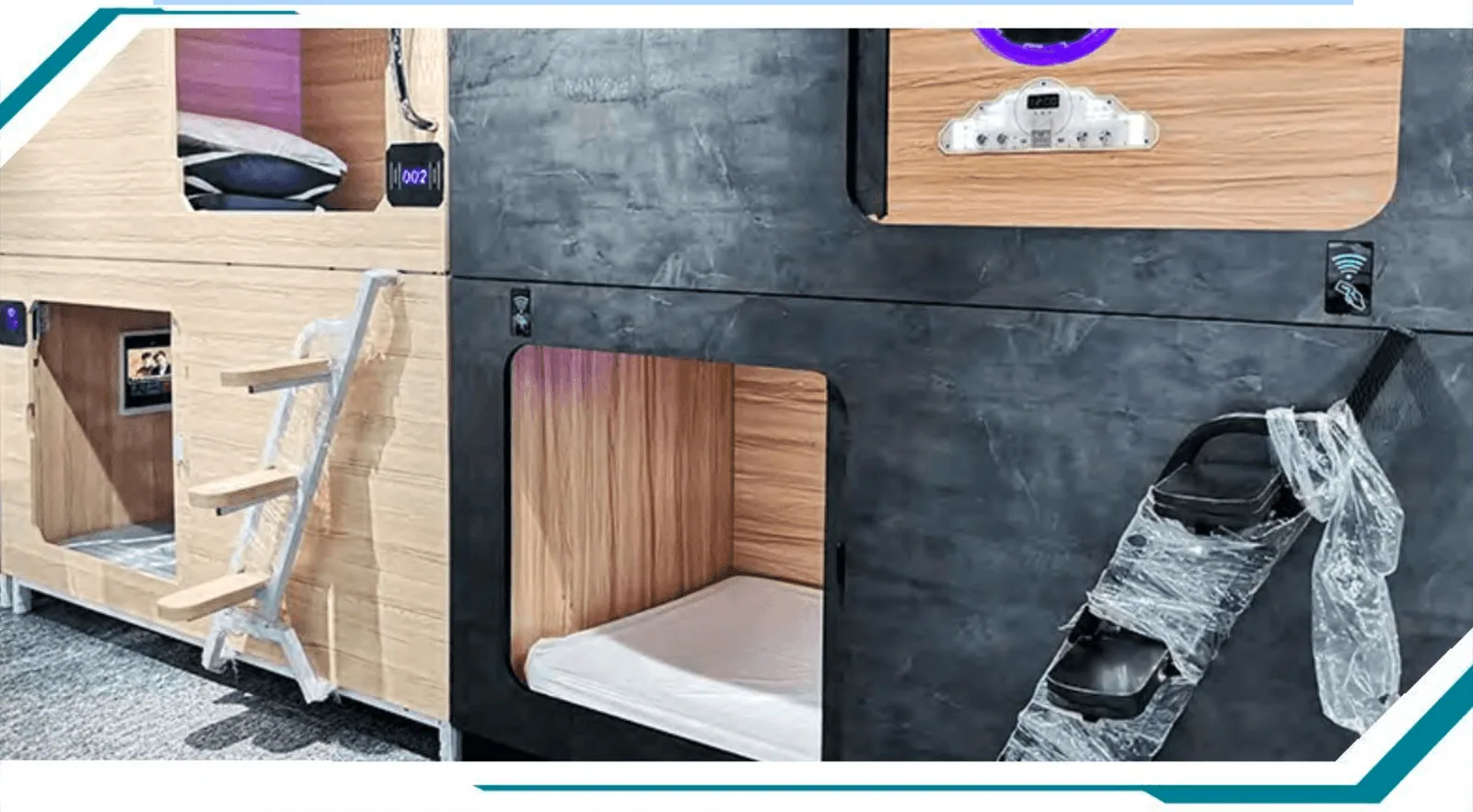
Wooden Series - Horizontal Single
Premium eco multi-layer board construction with metal frame, offering natural wood-grain aesthetics while maintaining all essential capsule bed features.
Pilgrim-market deep-dive
The Haridwar pilgrim pod-hotel opportunity
Haridwar, known as the ‘Gateway to the Ganga’, stands as a cornerstone of Hindu pilgrimage where the sacred river Ganga is venerated alongside ancient temples such as Maya Devi and Chandi Devi, drawing devotees from across the subcontinent to its historic ghats and spiritual sites.
The city witnesses a relentless influx of pilgrims, especially during Kumbh Mela, Ganga Aarti evenings and festivals like Maha Shivratri, with footfall swelling to tens of thousands per day, creating a dynamic rhythm of worship, prayer and cultural exchange.
On the ground, accommodation is strained: dharamshalas overflow, hotels become prohibitively expensive, and many pilgrims resort to sleeping on railway platforms or under open ghats, leading to discomfort, safety concerns and a loss of spiritual focus.
Sleeping pods and capsule hotels present a perfect solution – modular, affordable, and hygienic – allowing operators to meet the surge demand, provide dignified rest, and generate sustainable revenue while preserving the sanctity of Haridwar’s pilgrimage experience.
Haridwar pod hotel — FAQs
What is a sleeping pod and why is it suitable for Haridwar pilgrims?+
A sleeping pod is a compact, climate‑controlled capsule that offers privacy, hygiene and quick turnover – ideal for the high‑volume, short‑stay crowd that floods Haridwar during festivals.
Can I book a capsule hotel near Har ki Pauri?+
Yes, pods can be positioned within a 500‑meter radius of Har ki Pauri, allowing pilgrims to walk to the ghat for Aarti while enjoying secure lodging.
Are capsules safe for families with children?+
Family pods provide two adjoining capsules with a shared entrance and child‑proof fittings, making them perfect for small families visiting the Maya Devi Temple together.
How do capsules handle peak Kumbh Mela crowds?+
Modular pod units can be rapidly expanded; a 200‑pod configuration can accommodate an extra 10,000 nightly stays during the Kumbh Mela surge.
Do capsule hotels offer vegetarian meals?+
On‑site kitchens can serve simple sattvic meals and tea, aligning with the dietary preferences of most Hindu pilgrims.
Is Wi‑Fi available for pilgrims in a capsule hotel?+
High‑speed Wi‑Fi is provided in common lounges, enabling pilgrims to stay connected with family and access digital darshan services.
Start your Haridwar pilgrim pod hotel with BIDUA
Sign up to design your space in 3D, build a presentation, and get a quotation + ROI from one dashboard — or talk to our team for a custom Haridwar plan.