Tier 3 pod-hotel market · Uttar Pradesh
Pod Hotel in Chitrakoot — Smart Sleeping Pods for India's Ramayana Pilgrimage Capital
Low resident population is offset by massive seasonal pilgrim influx (Amavasya, Ram Navami, Deepavali), two university campuses drawing students from across India, and growing wildlife tourism at Ranipur Tiger Reserve — all generating short-stay accommodation demand that far exceeds permanent resident numbers.
Population & catchment
Chitrakoot district has a population of approximately 9.9 lakh (991,730 per the 2011 Census; estimated ~11-12 lakh by 2026), making it the second-least-populated district in Uttar Pradesh after Mahoba.
Urban pull
Only about 9.7% of the population is urban (~96,352), with the vast majority rural. The district HQ town of Chitrakoot (Karwi) has ~66,000 residents, but floating pilgrim and student populations add significant transient demand.
Economic base
Chitrakoot's economy is predominantly agrarian, with over half the population engaged in rain-fed cultivation of wheat, rice, and pulses. The district supplements farm income with a significant minor-minerals sector — granite quarrying at Shankargarh and Bargarh, silica sand extraction at Mau feeding glass manufacturing, and ochre mining. Pilgrimage tourism anchored by Kamadgiri and Ram Ghat is the town's largest service-sector employer, supporting a hospitality ecosystem of dharamshalas, eateries, boat operators, and religious-goods vendors, while two state universities generate a steady education-services economy.
Around Chitrakoot
Key landmarks and footfall hubs that drive short-stay demand in Chitrakoot.
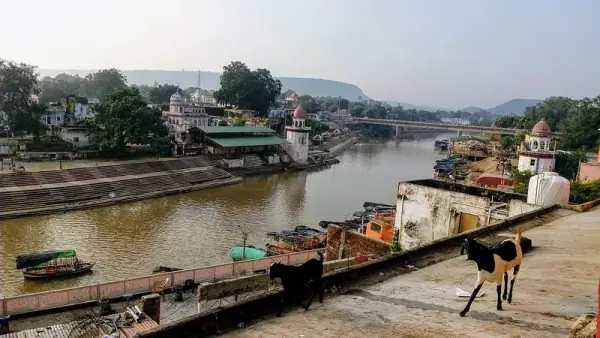
Ram Ghat on the Mandakini River, Chitrakoot
Why a pod hotel works in Chitrakoot
Chitrakoot has zero branded budget hotels, zero capsule or pod hotels, and no standardised micro-hospitality anywhere in the Bundelkhand region. The town's accommodation is split between unregulated dharamshalas (basic, overcrowded during Amavasya surges) and a handful of overpriced private guest houses. Millions of pilgrims, two university campuses' worth of students, patient attendants, and a growing wildlife-tourism segment have no modern, hygienic, bookable short-stay option — a textbook pod-hotel gap.
Chitrakoot is one of Hinduism's most venerated pilgrimage centres — where Lord Rama spent 11 of his 14 years of exile on the banks of the Mandakini river. Millions of devotees visit annually for Kamadgiri Parikrama, Ram Ghat evening aarti, and Gupt Godavari caves. Beyond pilgrimage, Chitrakoot draws students to two state universities, patient attendants to District Hospital and Sadguru Seva Sangh, wildlife enthusiasts to Ranipur Tiger Reserve (India's 53rd, designated 2022), and transit travellers through Manikpur Junction on the Prayagraj-Jabalpur mainline. The 296 km Bundelkhand Expressway now terminates at Bharatkoop near NH-35, connecting Chitrakoot to Agra-Lucknow-Delhi in under 7 hours. Most visitors — pilgrims during Amavasya surges, university students, patient families, wildlife tourists — need clean, affordable short-stay rest that the town's ageing dharamshalas and sparse guest houses cannot reliably provide.
Best ways to use pods here
- Kamadgiri-Ram Ghat pilgrim rest hub — serving devotees arriving by overnight train for parikrama, aarti, and darshan who need 4-12 hours of clean rest
- University student and visitor accommodation — exam-period and admission-season surge housing for MGCGV and JRDU students, parents, and faculty
- Railway transit rest pods — short-stay facility near Manikpur Junction or Karwi station for passengers on 30+ daily trains on the Prayagraj-Jabalpur and Jhansi lines
- Hospital patient-attendant stay — affordable overnight pods for families accompanying patients at District Hospital and Sadguru Seva Sangh Hospital
- Ranipur Tiger Reserve eco-tourism base — clean budget pods for wildlife tourists, birders, and jeep-safari visitors exploring India's newest tiger reserve
Where the demand sits in Chitrakoot
Transit & travel
- •Chitrakootdham Karwi railway station (Delhi, Mumbai, Kolkata, Varanasi connections on NCR mainline)
- •Manikpur Junction (4 platforms; Prayagraj-Jabalpur & Jhansi-Manikpur lines; 30+ daily trains including Bundelkhand Express)
- •Bundelkhand Expressway terminus at Bharatkoop/NH-35 (296 km access-controlled link to Agra-Lucknow Expressway and Delhi)
- •NH-35 (Jhansi-Prayagraj) and NH-731A running through the district
- •Chitrakoot Airport (regional airstrip)
- •Prayagraj Airport 106 km away (flights to Delhi, Mumbai, Bengaluru, Kolkata)
Healthcare demand
- •District Hospital Chitrakoot (Shonepur Road — multi-specialty with surgical wing, gynaecology, orthopaedics, paediatrics)
- •Sadguru Seva Sangh Hospital (charitable, serves rural Bundelkhand catchment)
- •Jankikund Netra Chikitsalaya (eye care hospital)
- •Arogya Dham Ayurvedic and yoga wellness centre (5 km from Ram Ghat)
- •Community Health Centres at Manikpur and Mau blocks
Education & coaching
- •Jagadguru Rambhadracharya Divyanga University (India's first university for disabled persons, est. 2001; 26 courses across 8 faculties; NAAC accredited)
- •Mahatma Gandhi Chitrakoot Gramodaya Vishwavidyalaya (MGCGV — rural state university, est. 1991; NAAC Grade A; 16 departments, 50+ UG/PG programmes)
- •Sanskrit College, Taronha (traditional Vedic and Sanskrit studies)
- •Seth Radha Krishna Poddar Inter College and affiliated degree colleges
Industry & trade
- •Granite and silica sand mining belt (Shankargarh, Bargarh, Mau tehsil — feeds glass manufacturing and construction)
- •Ochre and minor mineral extraction operations across the district
- •Tussar and Eri silk development centres (state-backed scheme across 12 UP districts including Chitrakoot)
- •Agro-processing units (wheat, rice, pulses — rain-fed agriculture base)
- •Stone-crushing and construction-material enterprises
Tourism & pilgrimage
- •Kamadgiri Mountain — holiest site; 5 km parikrama route with dozens of shrines including Kamtanath Temple
- •Ram Ghat on Mandakini River — daily Mandakini Aarti, laser Ramayana show, boat rides; where Tulsidas received divine vision and composed Ramcharitmanas
- •Hanuman Dhara — hilltop Hanuman temple with perpetual spring, 355 steps or aerial ropeway, panoramic Vindhya views
- •Gupt Godavari — twin limestone caves with knee-deep water and stone thrones attributed to Rama and Lakshman
- •Sati Anusuya Ashram — forest retreat near Jhuri River source with Dattatreya mythology
- •Sphatik Shila — crystal rock on Mandakini banks with Sita's legendary footprints
- •Bharat Milap Mandir — marks the emotional reunion of the four brothers during exile
- •Janki Kund — Sita's bathing ghat on the Mandakini with adjacent temple complex
- •Bharat Koop — sacred well 20 km west, said to contain waters from all pilgrimages
- •Ranipur Tiger Reserve (230 sq km; tigers, leopards, sloth bears; jeep safari and birding; India's 53rd tiger reserve since 2022)
- •Ganesh Bagh — 19th-century Peshwa-era temple called 'Mini Khajuraho' with intricate stone carvings
- •Rajapur — birthplace of Tulsidas (40 km); houses handwritten Ramcharitmanas manuscript
- •Shabri Waterfall (Tulsi Falls) — 47 km monsoon cascade associated with Shabari mythology
- •Madfa Fort — Chandela-period hilltop fort (30 km) with Hathi Darwaza and medieval temple ruins
- •Somnath Temple (12 km east) — late 14th-century Shiva temple with ~2,000 animal and celestial sculptures
Profit & ROI projection for Chitrakoot
A starter model based on a minimum 50 pods at 70% occupancy and an indicative ₹700/pod/night. Costs use the same itemised basis as our full ROI calculator — pods, add-ons, 18% GST, transport, fit-out and full monthly running cost.
Important: this is only an ASSUMPTION-based projection — not an accurate quote or a guarantee.
The real cost, occupancy, pricing and profit will change with your exact location, property rent, season, competition and how you run the business. Treat these figures as a planning estimate only. For real numbers, use the full calculator or get a custom quote from BIDUA.
Total investment
₹74.7 lakh
50 pods + add-ons + GST + fit-out
Monthly revenue
₹7.3 lakh
35 of 50 pods filled/night
Monthly net profit
₹3.4 lakh
46% margin after all costs
Payback
~22 mo
55% annual ROI
Break-even occupancy ≈ 28% — you only need this much filled to cover all costs; everything above is profit.
| 50 pods (BIDUA mix) | ₹40,30,000 |
| Add-ons (mattress, bedding, panels, safe lock, table) | ₹16,25,200 |
| GST @ 18% (pods + add-ons) | ₹10,17,936 |
| Transport (warehouse → site) | ₹4,00,000 |
| Fit-out, AC, reception, branding + rent deposit | ₹4,00,000 |
| Total investment | ₹74,73,136 |
| Revenue (50 × 70% × ₹700 × 30) | ₹7,35,000 |
| Fixed costs (rent, staff, power, housekeeping…) | – ₹2,25,000 |
| Variable (OTA + marketing + gateway, 23%) | – ₹1,69,050 |
| Net profit / month | ₹3,40,950 |
| Net profit / year | ₹40,91,400 |
Indicative assumptions for a Tier 3 pilgrimage town in Bundelkhand — actual rates will vary by exact location, season (Amavasya surges vs lean periods), and property terms. Not a guarantee of returns. Figures are indicative estimates, not guarantees.
Chitrakoot pod-hotel business plan & study
A step-by-step plan to launch a capsule / sleeping-pod hotel in Chitrakoot — from picking the right location to licences, setup, pricing and reaching profitable occupancy.
Demand drivers
30+
transit, hospital, student & tourism footfall points
Space needed (50 pods)
2250–2750 sq ft
single rented floor + reception & washrooms
Break-even occupancy
28%
fill above this and you are in profit
Indicative payback
~22 months
on ₹74.7 lakh all-in setup
1. Pick the right location
Target a floor near District Hospital Chitrakoot (Shonepur Road — multi-specialty with surgical wing, gynaecology, orthopaedics, paediatrics) or Manikpur Junction (4 platforms; Prayagraj-Jabalpur & Jhansi-Manikpur lines; 30+ daily trains including Bundelkhand Express). Best opening use-case: Kamadgiri-Ram Ghat pilgrim rest hub — serving devotees arriving by overnight train for parikrama, aarti, and darshan who need 4-12 hours of clean rest.
2. Plan investment & funding
Budget about ₹74.7 lakh all-in for 50 pods (pods + add-ons + 18% GST + transport + fit-out & deposit). Many operators fund this with a mix of own capital + a small business/MSME loan against projected cash flow.
3. Licences & compliance
Arrange a municipal trade licence, GST registration, fire safety NOC, police/guest verification (where required), and basic building & sanitation approvals before launch.
4. Build & launch
BIDUA shares a free 3D layout, then delivers and helps install the pods. Civil, electrical, AC and reception fit-out typically takes ~30–45 days, so you can open quickly on a leased floor.
5. Pricing & operations
Start at ~₹700/pod/night, and add hourly slots near hospitals for day-rest demand. Run lean with a small reception + housekeeping team; keep pods clean, private and secure to earn repeat stays.
6. Marketing & occupancy
List on OTAs (MakeMyTrip, Booking.com, OYO, Goibibo) + Google Business Profile, and tie up with nearby hospitals, coaching institutes and tour operators to push occupancy past the 28% break-even quickly.
Key risks & how to manage them
Low occupancy in early months. Open with OTA listings + hospital/coaching tie-ups; use hourly pricing to fill day-time.
High rent eating margins. Choose a slightly off-main but accessible floor near Chitrakootdham Karwi railway station (Delhi, Mumbai, Kolkata, Varanasi connections on NCR mainline); rent is the biggest lever.
Seasonality / exam & festival peaks. Flex pricing up in peak weeks; offer weekly/monthly pod rentals to students for a stable base.
Cleanliness & safety complaints. Invest in housekeeping, safe locks and CCTV — reputation drives repeat and OTA ratings.
Recommended pod setup for Chitrakoot
50 pods in a mix of single-berth horizontal capsules (70%) for solo pilgrims and transit travellers, plus double-width family pods (30%) for pilgrim families and university visitors. Climate control is essential for Bundelkhand's extreme summers (45°C+). Recommended Grade: Galaxy or Cosmos series with luggage lockers and mobile-charging points. Digital booking integration critical for university and wildlife-tourism segments.

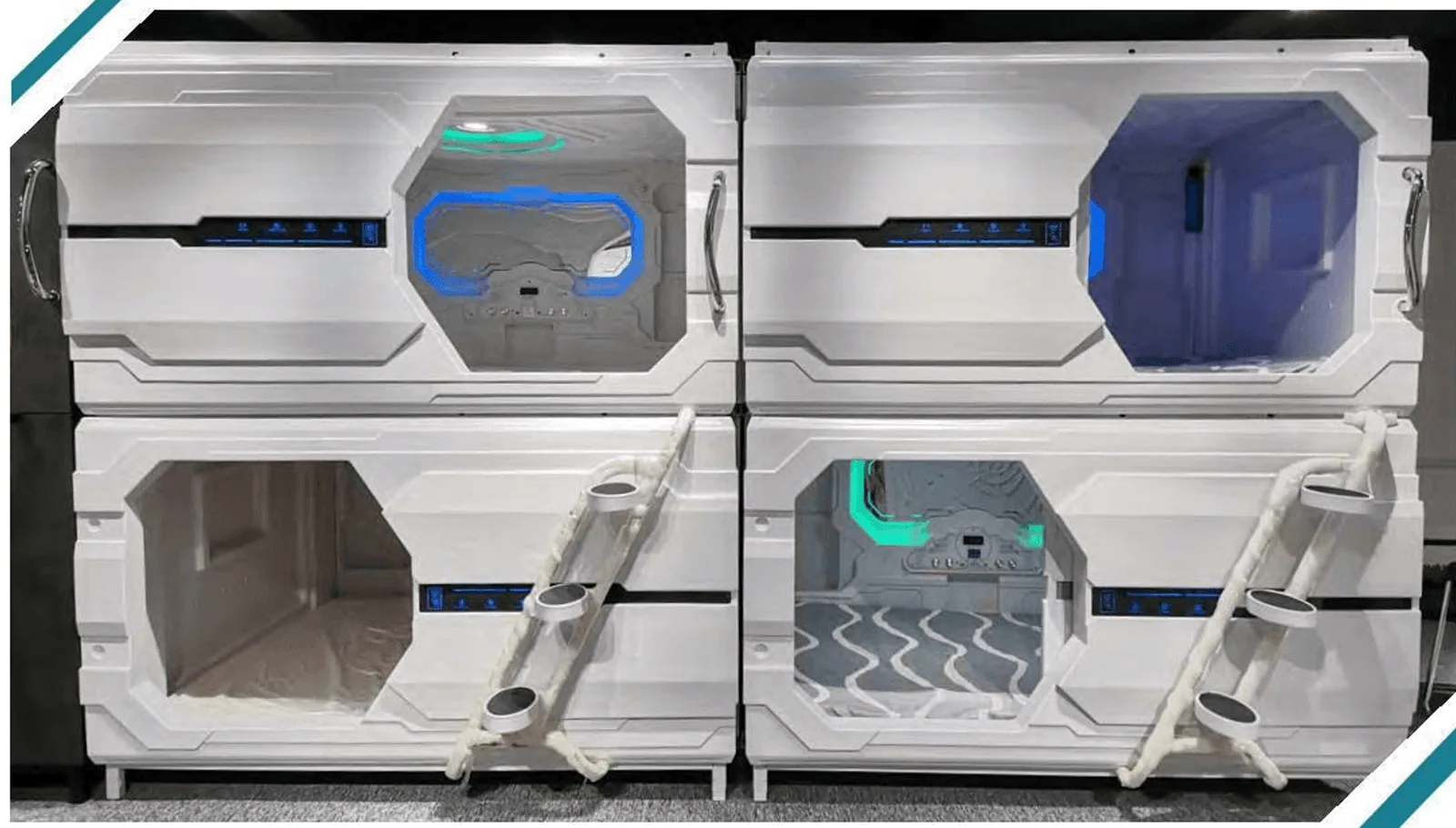
GALAXY Series - Horizontal Single
Standard ABS shell with metal frame featuring TV slot, security sliding door, and ergonomic non-slip ladder. Perfect for hotels, airports, and commercial applications.
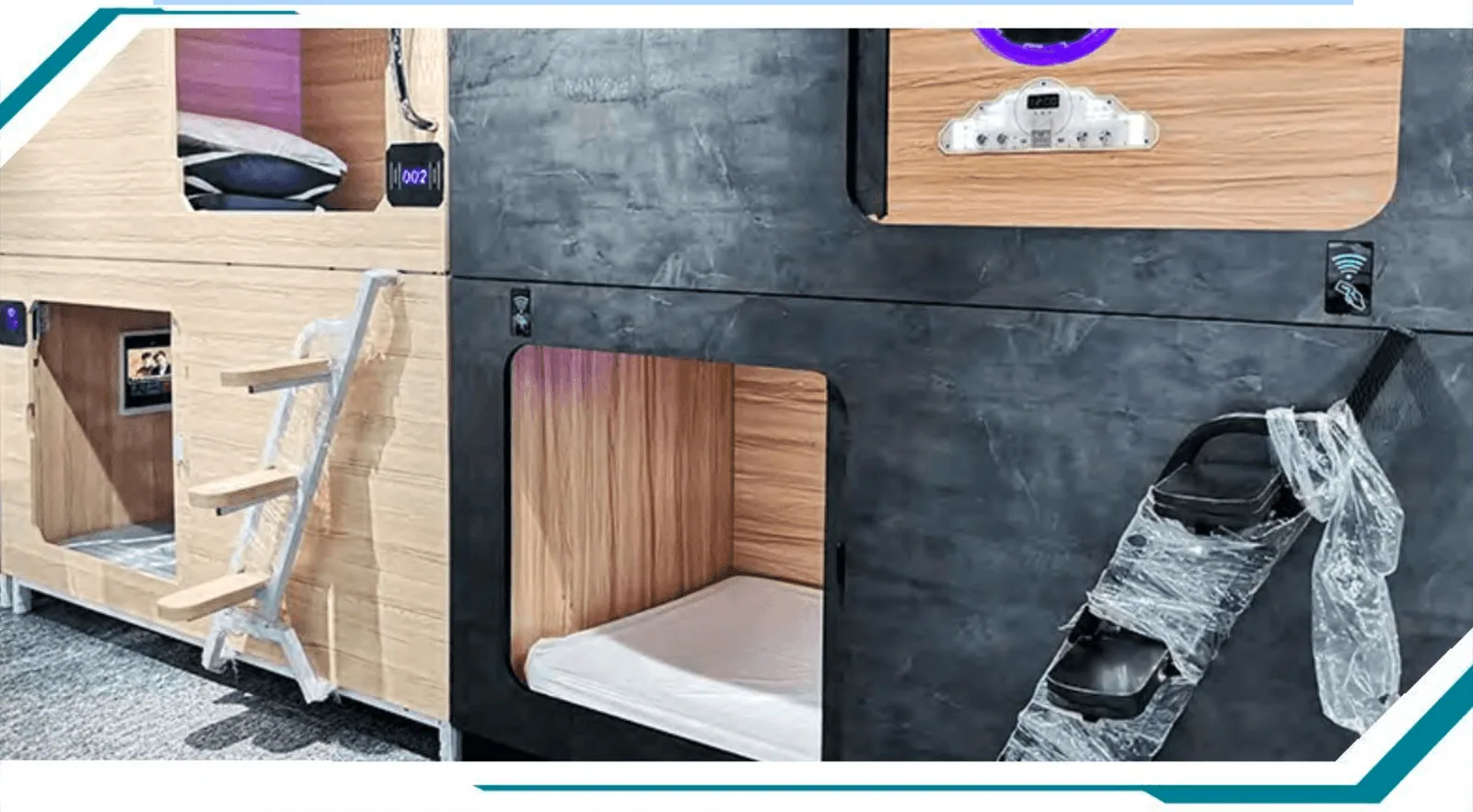
Wooden Series - Horizontal Single
Premium eco multi-layer board construction with metal frame, offering natural wood-grain aesthetics while maintaining all essential capsule bed features.
Market deep-dive
The Chitrakoot pod-hotel opportunity
Chitrakoot is not merely a dot on the map of Bundelkhand — it is the living landscape of the Ramayana itself. Hindu tradition holds that Lord Rama, Sita, and Lakshman spent eleven of their fourteen years of exile on the forested banks of the Mandakini river here, composing the spiritual geography that draws millions of devotees each year. The five-kilometre Kamadgiri Parikrama — a barefoot circumambulation of the sacred hill lined with dozens of shrines including the ancient Kamtanath Temple — is performed by a continuous stream of pilgrims on every Amavasya, swelling to lakhs during Ram Navami and Deepavali. Ram Ghat hosts a nightly Mandakini Aarti and laser Ramayana show that rivals Varanasi's spectacle. For a sleeping-pod operator, this unbroken pilgrim current is the demand engine: devotees arrive by overnight trains at Manikpur Junction or Karwi station, need a few hours of clean rest before darshan, and find the town's dharamshalas overcrowded and under-maintained.
Beyond devotional tourism, Chitrakoot is an unlikely academic hub. Mahatma Gandhi Chitrakoot Gramodaya Vishwavidyalaya — India's first rural state university, founded in 1991 by social reformer Nanaji Deshmukh and now NAAC Grade-A accredited — runs sixteen departments and over fifty programmes from its campus on the Madhya Pradesh side. On the Uttar Pradesh bank sits the Jagadguru Rambhadracharya Divyanga University, established in 2001 as the world's first university exclusively for persons with disabilities, offering twenty-six courses across eight faculties. Together these institutions pull thousands of students, faculty, and visiting parents from across India, generating steady accommodation demand that peaks during admission season, examinations, and convocation. A pod hotel near the university belt could serve this educated, digitally-savvy demographic with app-bookable, privacy-assured capsules at rates well below the town's limited guest houses.
Chitrakoot's economic identity runs deeper than temples and universities. The district sits atop a mineral belt: high-grade silica sandstone at Shankargarh and Bargarh feeds glass-manufacturing supply chains, granite quarries dot the Karwi and Mau tehsils, and ochre extraction supports local pigment trade. The state-backed Tussar and Eri silk development programme designates Chitrakoot among twelve UP districts for sericulture expansion. In 2022, the Ranipur Wildlife Sanctuary — home to leopards, sloth bears, and visiting tigers from Panna Tiger Reserve — was upgraded to India's fifty-third tiger reserve, unlocking central eco-tourism funding and jeep-safari infrastructure that is now drawing a new category of nature travellers. Meanwhile, the Bundelkhand Expressway's 296-kilometre terminus at Bharatkoop on NH-35 has collapsed travel time to Agra, Lucknow, and Delhi, transforming Chitrakoot from a remote backwater into a weekend-drive destination from the national capital region.
The pod-hotel opportunity in Chitrakoot is structurally compelling precisely because supply is so thin. The town has no branded budget chain, no Oyo-class standardized property, and no capsule-hotel concept anywhere in the Bundelkhand region. Yet demand is layered and year-round: pilgrims for Kamadgiri and Ram Ghat, students at two universities, patient attendants at District Hospital and Sadguru Seva Sangh, railway transit passengers at Manikpur Junction, and a rising tide of wildlife tourists bound for Ranipur Tiger Reserve. A fifty-pod BIDUA installation near Ram Ghat or Karwi station — climate-controlled, digitally bookable, hygienically maintained — would be the first modern micro-hospitality asset in the entire district, capturing demand currently leaking to overcrowded dharamshalas or the four-hour drive to Prayagraj hotels. With monthly rents as low as fifteen to twenty thousand rupees for commercial space in Karwi, the unit economics of Tier-3 pod hospitality become exceptionally attractive.
Chitrakoot pod hotel — FAQs
Why does Chitrakoot need a sleeping pod hotel when it already has dharamshalas?+
Chitrakoot's dharamshalas serve a basic dormitory function but lack privacy, climate control, hygiene standards, and digital booking. Pilgrims arriving for Kamadgiri Parikrama on Amavasya nights, university students during exams, patient attendants at District Hospital, and wildlife tourists visiting Ranipur Tiger Reserve all need clean, affordable, bookable short-stay rest — exactly what a capsule hotel provides at a fraction of traditional hotel rates.
Where is the best location for a Japanese-style pod hotel in Chitrakoot?+
Three zones offer strong footfall: (1) Near Ram Ghat and Kamadgiri Parikrama gate, where the densest pilgrim traffic concentrates; (2) Near Chitrakootdham Karwi railway station, serving transit passengers on the Delhi-Mumbai-Kolkata mainline; (3) Near the university belt (MGCGV/JRDU campuses), capturing student and visitor demand year-round.
What is the nightly rate for a nap pod or capsule hotel stay in Chitrakoot?+
As a Tier 3 pilgrimage town, Chitrakoot pod hotels can realistically price at Rs 600-800 per pod per night — significantly cheaper than the few private guest houses (Rs 1,200-2,500) while offering far better privacy, cleanliness, and amenities than Rs 100-300 dharamshalas. Hourly rest options for transit passengers can start even lower.
How many tourists and pilgrims visit Chitrakoot Dham annually?+
Chitrakoot receives several million pilgrim visits per year, with massive surges on every Amavasya (new moon), Somvati Amavasya, Ram Navami, Mahashivratri, and Deepavali. The 5 km Kamadgiri Parikrama route sees continuous foot traffic, and the newly designated Ranipur Tiger Reserve (2022) is adding a growing eco-tourism segment. This pilgrim and tourist volume far exceeds the town's existing accommodation capacity.
Is a budget hourly hotel or Chinese pod hotel concept viable in a small religious town like Chitrakoot?+
Absolutely. Chitrakoot's demand pattern is ideal for pods: pilgrims often arrive by overnight train at Manikpur Junction or Karwi station and need only 4-8 hours of rest before darshan. University students need short-stay rooms during exams. Patient attendants at Sadguru Seva Sangh Hospital need affordable overnight stays. The hourly/nightly pod model matches these use-cases perfectly, unlike conventional hotels that require full-night bookings.
What makes Chitrakoot different from other pod hotel locations in Uttar Pradesh?+
Chitrakoot combines three rare demand drivers: (1) It is among Hinduism's most sacred sites — where Lord Rama spent 11 years of exile, attracting year-round devotional tourism rivalling Ayodhya and Varanasi in religious significance; (2) Two state universities (including India's first disability-focused university) bring student and academic traffic; (3) The newly designated Ranipur Tiger Reserve adds wildlife tourism. The 296 km Bundelkhand Expressway now connects this once-remote district to Delhi, multiplying access.
Start your Chitrakoot pod hotel with BIDUA
Sign up to design your space in 3D, build a presentation, and get a quotation + ROI from one dashboard — or talk to our team for a custom Chitrakoot plan.