Tier 3 pod-hotel market · Uttar Pradesh
Sleeping Pods & Capsule Hotel in Kaushambi — Ancient Heritage, Modern Comfort
High SC population (34.7%) and 63.7% literacy — classified among India's 250 most backward districts under the BRGF, signalling significant unmet infrastructure demand including affordable accommodation.
Population & catchment
~1.6 million (Census 2011: 15,99,596; est. ~1.9 million in 2026 at ~1.5% annual growth)
Urban pull
Only 7.8% urban (Census 2011) — overwhelmingly rural, with Manjhanpur, Bharwari, and Sirathu as the main towns
Economic base
Kaushambi's economy is overwhelmingly agrarian — over half the workforce farms wheat, rice, pulses (arhar, urad, chana), guava, mango, and banana. The district holds Uttar Pradesh's ODOP (One District One Product) designation for banana processing, with food-processing units producing banana chips, beauty products, and packaged goods. It is also the true origin belt of the globally recognised 'Allahabad Safeda' guava and the local Surkha Mango variety, though industrial diversification remains limited.
Around Kaushambi
Key landmarks and footfall hubs that drive short-stay demand in Kaushambi.
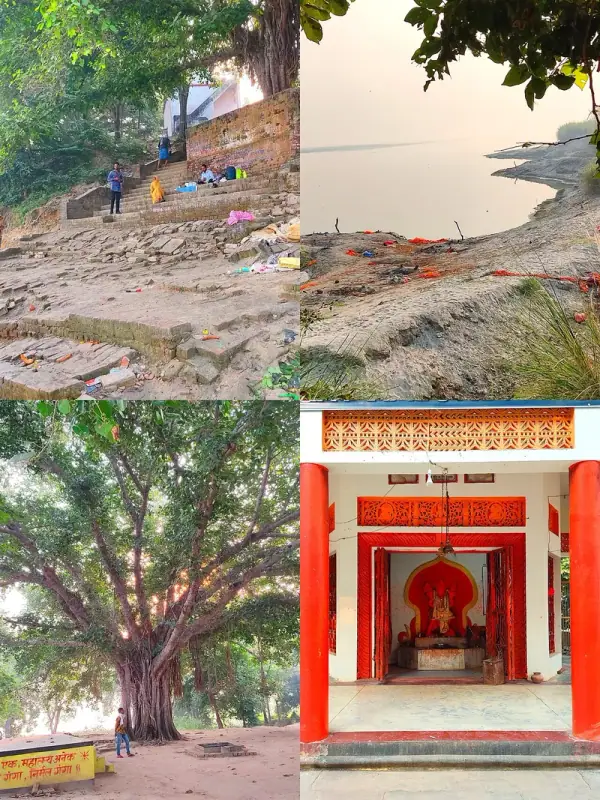
Sandeepan Ghat on the Yamuna, Kaushambi
Why a pod hotel works in Kaushambi
Kaushambi records over 13 lakh domestic tourists annually yet has zero branded hotels, zero capsule or pod hotels, and only basic dharamshalas and unregistered lodges. The 2024-opened ASMC hospital, two major railway junctions with 400+ daily trains, proximity to Prayagraj's Kumbh corridor, and triple-faith pilgrimage sites (Buddhist Kosambi, Hindu Shakti Peeth at Kara, Jain Prabhosa) create massive unmet demand for clean, affordable, short-stay accommodation.
Kaushambi sits on the Howrah-Delhi main line and NH-2 (Grand Trunk Road), channelling pilgrims bound for the Triveni Sangam at Prayagraj (55 km), Buddhist circuit visitors to the 2,600-year-old Kosambi ruins, and Shakti Peeth devotees heading to Sheetla Mata Temple at Kara. The 2025 Maha Kumbh Mela drew over 660 million visitors to Prayagraj, with Kaushambi Road serving as a key access corridor, underscoring the district's role as a transit and overflow zone for one of the world's largest religious gatherings.
Best ways to use pods here
- Railway-station pod lounge at Sirathu or Bharwari for transit passengers on 400+ daily Howrah-Delhi trains
- Hospital-adjacent pod stay near ASMC Kadipur-Manjhanpur for patient attendants and visiting families
- Pilgrim pod hotel at Kara (Sheetla Mata Shakti Peeth) for Navratri and year-round devotee overflow
- Buddhist-circuit tourist pod stay at Kosambi archaeological site for domestic and international visitors
- Exam-season student accommodation hub near Manjhanpur's coaching-centre cluster and polytechnic
Where the demand sits in Kaushambi
Transit & travel
- •Sirathu Railway Station — 216 daily trains on the Prayagraj-Kanpur main line
- •Bharwari Railway Junction — 210 daily trains; Mahabodhi Express (Gaya-Delhi) and Chauri Chaura Express (Varanasi-Kaushambi) halt here
- •NH-2 (Grand Trunk Road) passes through Bharwari connecting Delhi-Kolkata corridor
- •Prayagraj Airport (Bamrauli) — 55 km, flights to Delhi, Mumbai, Bengaluru, Kolkata
- •Manjhanpur Roadways Bus Depot — state bus links to Prayagraj, Kanpur, Lucknow, Banda
Healthcare demand
- •Autonomous State Medical College & Hospital, Kadipur-Manjhanpur — 100 MBBS seats, 300-bed district hospital (est. 2024)
- •Community Health Centre, Manjhanpur
- •Community Health Centre, Sarai Akil
- •108 Critical Care Ambulance Service and 102 Mother-Child Transport across the district
Education & coaching
- •Autonomous State Medical College, Kaushambi (ASMC) — affiliated to Atal Bihari Vajpayee Medical University
- •Mahatma Jyotiba Phule Government Polytechnic, Kaushambi
- •Maharishi College of Education, Bharwari (BA, B.Sc)
- •286+ colleges district-wide including degree colleges and ITIs
- •Dozens of competitive-exam coaching centres in Manjhanpur and Bharwari preparing students for UPSC, SSC, state police exams
Industry & trade
- •Banana-based food processing cluster — ODOP (One District One Product) designation for banana chips and processed foods
- •Allahabad Safeda Guava orchards — Kaushambi is the actual origin belt of the famous Allahabad guava variety
- •Surkha Mango cultivation and mango pulp processing units
- •Agro-livestock enterprises — dairy, poultry, and cattle-feed processing
- •Brick kilns and small-scale construction-material manufacturing along the Yamuna floodplain
Tourism & pilgrimage
- •Kosambi Archaeological Site — ruins of the 2,600-year-old Vatsa Mahajanapada capital, ASI-protected, with fortification walls spanning 6.5 km
- •Ghositarama Monastery ruins — 6th-century BCE Buddhist monastery where Buddha spent his 9th rainy season retreat
- •Ashoka Pillar at Kosambi — 3rd-century BCE Pali-inscribed pillar erected by Emperor Ashoka
- •Sheetla Mata Temple (Kada Dham), Kara — one of 51 Shakti Peethas, built c. 1000 CE on the Ganga bank
- •Prabhasa Giri (Prabhosa) — Jain pilgrimage hill with cave inscriptions in 2nd-century Brahmi script and reconstructed Jain temple (1824 CE)
- •Saint Malookdas Ashram & Samadhi, Kara — memorial of the 17th-century Nirguna saint-poet
- •Triveni Sangam, Prayagraj — 55 km, the holiest Hindu confluence; Maha Kumbh Mela venue
- •Sandeepan Ghat on the Yamuna — bathing ghat linked to sage Sandeepan's legend
Profit & ROI projection for Kaushambi
A starter model based on a minimum 50 pods at 70% occupancy and an indicative ₹750/pod/night. Costs use the same itemised basis as our full ROI calculator — pods, add-ons, 18% GST, transport, fit-out and full monthly running cost.
Important: this is only an ASSUMPTION-based projection — not an accurate quote or a guarantee.
The real cost, occupancy, pricing and profit will change with your exact location, property rent, season, competition and how you run the business. Treat these figures as a planning estimate only. For real numbers, use the full calculator or get a custom quote from BIDUA.
Total investment
₹74.7 lakh
50 pods + add-ons + GST + fit-out
Monthly revenue
₹7.9 lakh
35 of 50 pods filled/night
Monthly net profit
₹3.7 lakh
48% margin after all costs
Payback
~20 mo
60% annual ROI
Break-even occupancy ≈ 27% — you only need this much filled to cover all costs; everything above is profit.
| 50 pods (BIDUA mix) | ₹40,30,000 |
| Add-ons (mattress, bedding, panels, safe lock, table) | ₹16,25,200 |
| GST @ 18% (pods + add-ons) | ₹10,17,936 |
| Transport (warehouse → site) | ₹4,00,000 |
| Fit-out, AC, reception, branding + rent deposit | ₹4,00,000 |
| Total investment | ₹74,73,136 |
| Revenue (50 × 70% × ₹750 × 30) | ₹7,87,500 |
| Fixed costs (rent, staff, power, housekeeping…) | – ₹2,32,000 |
| Variable (OTA + marketing + gateway, 23%) | – ₹1,81,125 |
| Net profit / month | ₹3,74,375 |
| Net profit / year | ₹44,92,500 |
These figures are indicative assumptions for a Tier 3 district (low rents, modest ADR) and do not constitute a financial guarantee. Actual returns depend on location, season, and execution. Figures are indicative estimates, not guarantees.
Kaushambi pod-hotel business plan & study
A step-by-step plan to launch a capsule / sleeping-pod hotel in Kaushambi — from picking the right location to licences, setup, pricing and reaching profitable occupancy.
Demand drivers
22+
transit, hospital, student & tourism footfall points
Space needed (50 pods)
2250–2750 sq ft
single rented floor + reception & washrooms
Break-even occupancy
27%
fill above this and you are in profit
Indicative payback
~20 months
on ₹74.7 lakh all-in setup
1. Pick the right location
Target a floor near Autonomous State Medical College & Hospital, Kadipur-Manjhanpur — 100 MBBS seats, 300-bed district hospital (est. 2024) or Bharwari Railway Junction — 210 daily trains; Mahabodhi Express (Gaya-Delhi) and Chauri Chaura Express (Varanasi-Kaushambi) halt here. Best opening use-case: Railway-station pod lounge at Sirathu or Bharwari for transit passengers on 400+ daily Howrah-Delhi trains.
2. Plan investment & funding
Budget about ₹74.7 lakh all-in for 50 pods (pods + add-ons + 18% GST + transport + fit-out & deposit). Many operators fund this with a mix of own capital + a small business/MSME loan against projected cash flow.
3. Licences & compliance
Arrange a municipal trade licence, GST registration, fire safety NOC, police/guest verification (where required), and basic building & sanitation approvals before launch.
4. Build & launch
BIDUA shares a free 3D layout, then delivers and helps install the pods. Civil, electrical, AC and reception fit-out typically takes ~30–45 days, so you can open quickly on a leased floor.
5. Pricing & operations
Start at ~₹750/pod/night, and add hourly slots near hospitals for day-rest demand. Run lean with a small reception + housekeeping team; keep pods clean, private and secure to earn repeat stays.
6. Marketing & occupancy
List on OTAs (MakeMyTrip, Booking.com, OYO, Goibibo) + Google Business Profile, and tie up with nearby hospitals, coaching institutes and tour operators to push occupancy past the 27% break-even quickly.
Key risks & how to manage them
Low occupancy in early months. Open with OTA listings + hospital/coaching tie-ups; use hourly pricing to fill day-time.
High rent eating margins. Choose a slightly off-main but accessible floor near Sirathu Railway Station — 216 daily trains on the Prayagraj-Kanpur main line; rent is the biggest lever.
Seasonality / exam & festival peaks. Flex pricing up in peak weeks; offer weekly/monthly pod rentals to students for a stable base.
Cleanliness & safety complaints. Invest in housekeeping, safe locks and CCTV — reputation drives repeat and OTA ratings.
Recommended pod setup for Kaushambi
50-pod mixed configuration: 30 standard single pods for pilgrims and transit passengers, 10 double/couple pods for families visiting the hospital or touring heritage sites, and 10 premium pods with workstation for Buddhist-circuit international tourists and exam-prep students — all climate-controlled with digital check-in, lockers, and 24/7 security.

GALAXY Series - Horizontal Single
Standard ABS shell with metal frame featuring TV slot, security sliding door, and ergonomic non-slip ladder. Perfect for hotels, airports, and commercial applications.
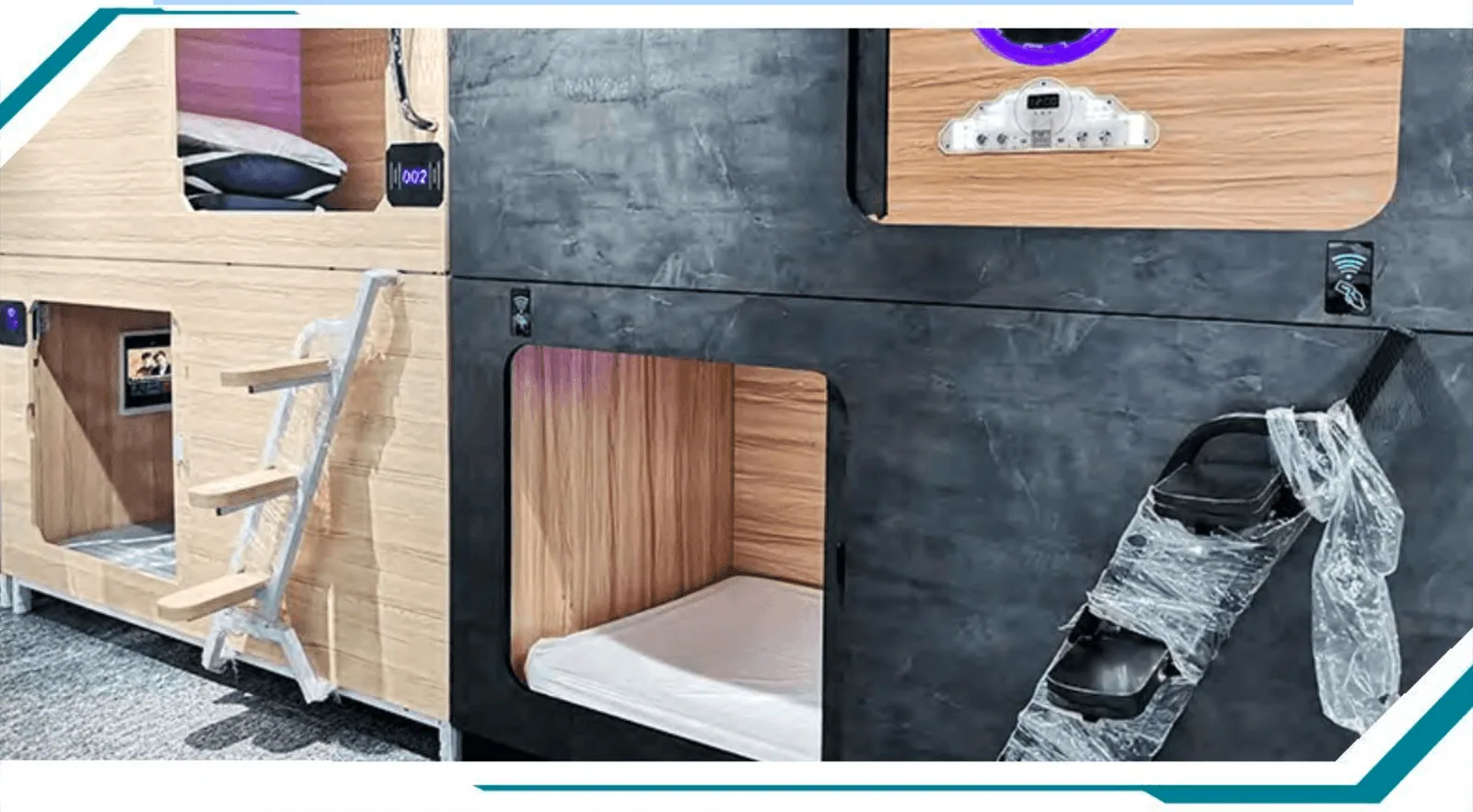
Wooden Series - Horizontal Single
Premium eco multi-layer board construction with metal frame, offering natural wood-grain aesthetics while maintaining all essential capsule bed features.
Market deep-dive
The Kaushambi pod-hotel opportunity
Kaushambi is not merely another dot on the map of rural Uttar Pradesh — it is one of the oldest continuously referenced settlements in Indian civilisation. The ancient city of Kosambi served as the capital of the Vatsa Mahajanapada, one of sixteen great kingdoms of the Buddha's era, and its fortified walls once stretched over six and a half kilometres along the Yamuna. Gautama Buddha himself spent his ninth rainy-season retreat at the Ghositarama Monastery here, and Emperor Ashoka later erected a Pali-inscribed pillar affirming the city's administrative importance. Today the ASI-protected ruins, over three thousand recovered sculptures, and a six-phase palace excavation draw Buddhist-circuit travellers from Japan, Sri Lanka, Thailand, and beyond — yet the district has virtually zero branded accommodation to host them.
The spiritual geography of Kaushambi extends well beyond Buddhism. At Kara, on the Ganga's bank, stands the Sheetla Mata Temple — one of Hinduism's 51 Shakti Peethas, believed to be the spot where Sati's bangle fell. Built around 1000 CE and drawing lakhs of devotees during Chaitra Navratri, it anchors a temple complex that includes the Kaleshwar Mahadev shrine, Chhetrapal Bhairav Temple, and the samadhi of the 17th-century Nirguna saint Malookdas. Nearby, Prabhasa Giri rises as a Jain pilgrimage hill with cave inscriptions in second-century Brahmi script and a reconstructed Svetambara temple dating to 1824. This triple-faith confluence — Buddhist, Hindu Shakta, and Jain — generates year-round footfall that modern sleeping pods can serve far more efficiently than scattered dharamshalas.
Sitting just 55 kilometres from Prayagraj's Triveni Sangam, Kaushambi functions as a natural transit corridor and overflow zone for one of the world's most visited pilgrimage hubs. The 2025 Maha Kumbh Mela drew over 660 million visitors, and Kaushambi Road was a primary access route; every bed within a hundred-kilometre radius was overwhelmed. The district's own railway stations — Sirathu with 216 daily trains and Bharwari with 210 — sit on the Howrah-Delhi main line, while NH-2 slices through Bharwari connecting the Delhi-Kolkata road corridor. The new Autonomous State Medical College and 300-bed hospital at Kadipur-Manjhanpur adds a steady stream of patient attendants needing affordable overnight stays. These converging flows make a compelling case for modular pod installations at railway stations, hospital peripheries, and pilgrimage nodes.
Economically, Kaushambi is agrarian but not stagnant. It holds Uttar Pradesh's official ODOP designation for banana processing, and its orchards produce the original 'Allahabad Safeda' guava — the cultivar that made the brand famous. The district's 286-plus colleges, government polytechnic, and flourishing coaching-centre ecosystem in Manjhanpur and Bharwari create seasonal surges in student accommodation demand during exam periods. With 13.28 lakh domestic tourists recorded in 2021 alone and infrastructure investment accelerating under BRGF, a 50-pod BIDUA installation here would face minimal competition and could realistically target Rs 750 per night — serving pilgrims, patients' families, exam candidates, and railway travellers with a clean, climate-controlled, tech-enabled capsule experience that simply does not exist in the district today.
Kaushambi pod hotel — FAQs
Why does Kaushambi need sleeping pods or a capsule hotel?+
Kaushambi has almost no branded accommodation despite hosting over 13 lakh domestic tourists annually (2021 data) visiting Sheetla Mata Shakti Peeth at Kara, the 2,600-year-old Kosambi Buddhist ruins, and Prabhosa Jain pilgrimage hill. Pilgrims, patient attendants at the new ASMC hospital, railway travellers at Sirathu and Bharwari, and exam-season students all need affordable, clean, short-stay beds that sleeping pods deliver at a fraction of traditional hotel costs.
Where would a Japanese-style pod hotel be installed in Kaushambi district?+
The highest-impact locations are near Sirathu or Bharwari railway stations (210-216 daily trains each), beside the ASMC district hospital at Kadipur-Manjhanpur for patient attendants, or at Kara Shakti Peeth for pilgrim overflow — especially during Navratri and Chaitra fairs when footfall surges dramatically.
What is the nightly rate for a nap pod or budget pod hotel in Kaushambi?+
As a Tier 3 district, realistic nightly rates for a pod hotel in Kaushambi range between Rs 600 and Rs 900 per pod. BIDUA Pods' indicative model uses Rs 750 per night at 70% occupancy, which undercuts the few available dharamshalas and lodges on both price and hygiene.
How does Kaushambi's proximity to Prayagraj and the Kumbh Mela create pod demand?+
Prayagraj is just 55 km away, and during the 2025 Maha Kumbh Mela, over 660 million visitors overwhelmed every bed in the region. Kaushambi Road was a primary access corridor, and the district served as an overflow zone. A permanent pod hotel installation captures this spillover demand during every Ardh Kumbh, Magh Mela, and year-round Sangam pilgrimage traffic.
Can a Chinese-style capsule hotel work in a backward rural district like Kaushambi?+
Yes — backward classification actually highlights the gap. Kaushambi receives BRGF development funds and has a new government medical college, growing railway traffic, and 13+ lakh annual tourists, yet zero branded hourly or capsule hotels exist. Pods fill this void with low capex, modular installation, and a clean, tech-enabled experience that appeals to young travellers and digital-savvy pilgrims alike.
What is the Buddhist significance of Kaushambi for international tourists?+
Ancient Kosambi was the capital of the Vatsa Mahajanapada where Gautama Buddha spent his 9th rainy-season retreat, delivered sermons at Ghositarama Monastery, and where the legendary first sandalwood Buddha image was carved for King Udayana. The ASI-protected ruins, Ashoka's Pali-inscribed pillar, and over 3,000 recovered stone sculptures make it a key stop on India's Buddhist circuit alongside Sarnath and Kushinagar — creating demand for clean, affordable pod stays from both domestic and international Buddhist pilgrims.
Start your Kaushambi pod hotel with BIDUA
Sign up to design your space in 3D, build a presentation, and get a quotation + ROI from one dashboard — or talk to our team for a custom Kaushambi plan.