Tier 1 pod-hotel market · Uttar Pradesh
Pod Hotel in Lucknow — Capsule Stays for India's Nawabi Capital and IT Powerhouse
As the capital of India's most populous state (24 crore people), Lucknow absorbs massive daily in-migration from all 75 UP districts plus Bihar, MP, and Uttarakhand for government work, medical referrals, education, and IT-sector employment — generating constant short-stay demand that far exceeds the resident population alone.
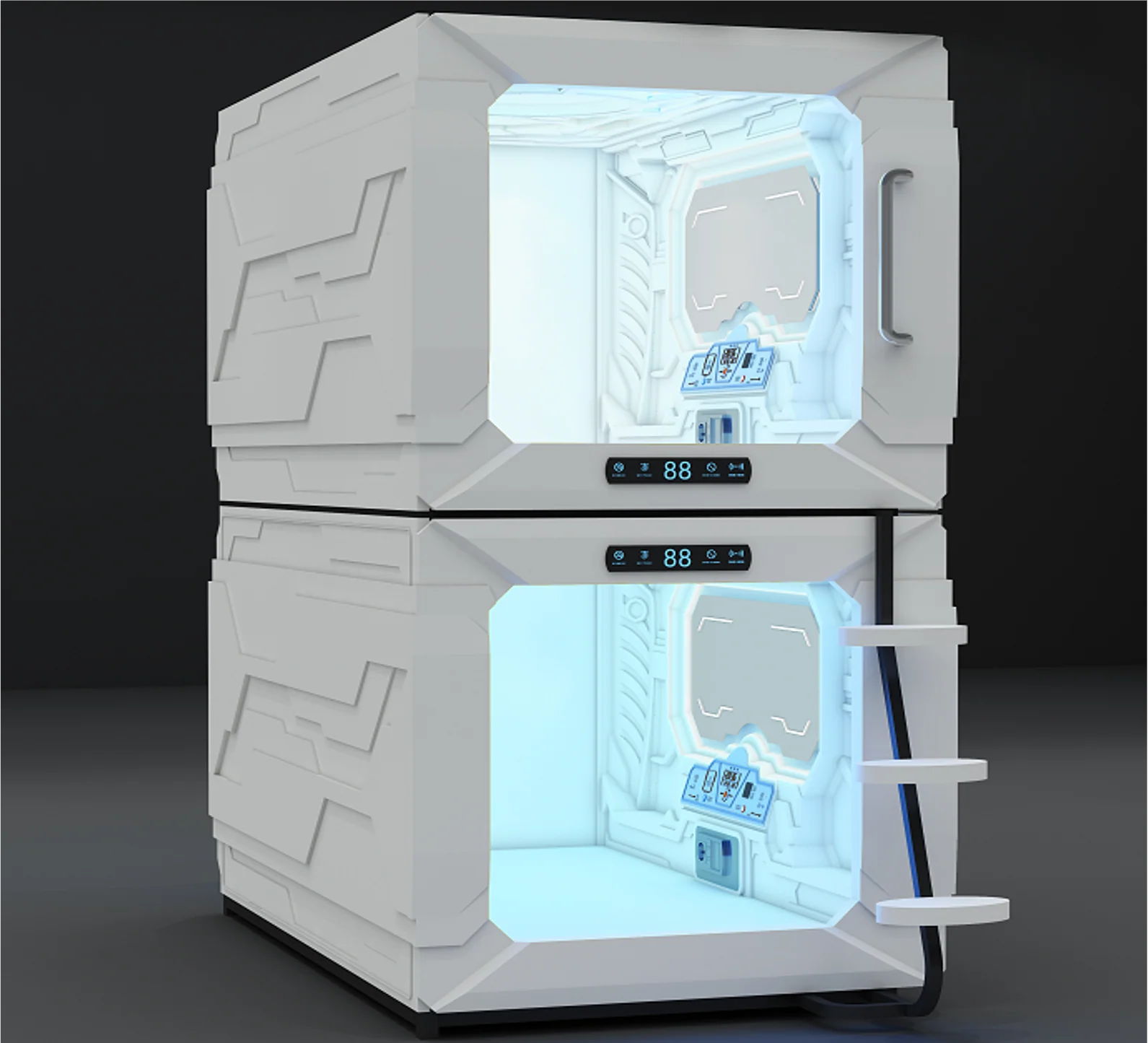
Population & catchment
Lucknow district: ~45.9 lakh (2011 Census: 4,589,838); estimated ~55-57 lakh by 2026. The metro area alone exceeds 42 lakh, making it the 11th most populous city in India.
Urban pull
Over 66% urban (30.4 lakh urban vs 15.5 lakh rural in 2011). Lucknow city proper has expanded from 402 sq km to 631 sq km with absorption of 88 peripheral villages, accelerating urbanisation.
Economic base
Lucknow is the administrative, cultural, and economic capital of Uttar Pradesh, driving a diversified economy anchored by state-government services, a booming IT/ITES sector (800+ tech firms, HCL's 10,000-employee campus), defence manufacturing (HAL, DRDO corridor), automotive production (Tata Motors), world-class medical institutions, and the centuries-old Chikankari embroidery export industry. The city's GDP is approximately $16 billion with ambitious plans to become India's first AI City and largest IT hub outside Bengaluru.
Around Lucknow
Key landmarks and footfall hubs that drive short-stay demand in Lucknow.

Bara Imambara, Lucknow — world's largest unsupported arched hall, built 1786 by Nawab Asaf-ud-Daula

Rumi Darwaza — the iconic Turkish Gate of Lucknow, built 1784

The British Residency, Lucknow — site of the 1857 Siege, ASI-protected monument
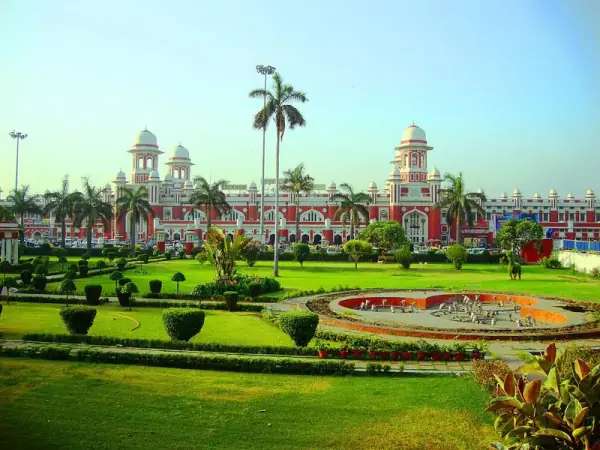
Charbagh Railway Station, Lucknow — architectural landmark and Northern Railway divisional HQ

Ambedkar Memorial Park, Gomti Nagar — 107-acre sandstone memorial complex
Why a pod hotel works in Lucknow
Despite being the capital of India's most populous state with 42+ lakh metro residents and millions of annual visitors, Lucknow has no capsule-hotel or pod-hotel option. The city's enormous floating population — patient attendants camping at KGMU and SGPGI, government workers on 1-2 day trips from 75 districts, IT professionals in transit, coaching students, and heritage tourists — currently chooses between expensive 3-star hotels (Rs 2,500+/night) or unbranded lodges with poor hygiene. A BIDUA Pods installation fills this gap with clean, tech-enabled, affordable short-stay accommodation precisely where demand concentrates: near railway stations, hospital campuses, IT corridors, and the old-city tourism belt.
Lucknow draws millions annually from across Uttar Pradesh and neighbouring states for state-government work, super-specialty medical referrals at KGMU and SGPGI, competitive-exam coaching, IT-sector business travel, and heritage tourism centred on the Nawabi monuments. As the state capital and largest city of India's most populous state, it functions as the gravitational centre for administrative, medical, educational, and commercial activity across the entire Awadh region. Most visitors need clean, affordable rest for a few hours between appointments or an overnight stay — the exact pod use-case.
Best ways to use pods here
- Hospital-adjacent pods near KGMU & SGPGI for patient attendants and outstation medical visitors (6,000+ daily OPD footfall combined, families sleeping in corridors)
- Railway-station pods at Charbagh and Lucknow Junction for transit passengers on overnight trains and layovers (14+ platforms, major junction for Delhi-Varanasi-Kolkata routes)
- IT-corridor pods along Shaheed Path and Gomti Nagar for business travellers, contract workers, and visiting consultants at HCL, TCS, and the expanding GCC cluster
- Old-city heritage-tourism pods near Bara Imambara and Hazratganj for domestic tourists exploring Nawabi monuments and Awadhi cuisine trails (UNESCO City of Gastronomy)
- Airport-adjacent pods at CCS International Airport for early-morning/late-night flyers and airline crew rest (11th busiest airport in India with growing international traffic)
Where the demand sits in Lucknow
Transit & travel
- •Lucknow Charbagh Railway Station (Northern Railway divisional HQ, 14+ platforms, connects Delhi-Kolkata-Mumbai trunk routes)
- •Lucknow Junction (North Eastern Railway hub)
- •Chaudhary Charan Singh International Airport (11th busiest in India, ranked 2nd-best small airport globally)
- •Lucknow Metro (north-south and east-west corridors, Munshipulia to CCS Airport)
- •Alambagh & Kaiserbagh ISBT inter-state bus terminals
- •NH-27, NH-28, NH-30 intersection at Hazratganj; Agra-Lucknow Expressway, Purvanchal Expressway, Lucknow-Kanpur Expressway
- •Lucknow Outer Ring Road (104 km, 8-lane)
Healthcare demand
- •KGMU — King George's Medical University (4,200+ beds, 8,000 daily OPD footfall, top referral centre for all UP)
- •SGPGIMS — Sanjay Gandhi Postgraduate Institute (1,600+ beds, tertiary referral for UP + 5 neighbouring states + Nepal)
- •RMLIMS — Dr Ram Manohar Lohia Institute of Medical Sciences (super-specialty transplant & critical care)
- •Medanta Hospital Lucknow (corporate super-specialty, cardiac & transplant)
- •Balrampur Hospital, Era's Lucknow Medical College, Sahara Hospital
Education & coaching
- •IIM Lucknow (200-acre campus, NIRF #5 management, 1,000+ students)
- •University of Lucknow (est. 1867, major state university)
- •AKTU — Abdul Kalam Technical University (largest technical university in UP)
- •IIIT Lucknow, BBAU (Babasaheb Bhimrao Ambedkar University)
- •Coaching hubs at Hazratganj, Aliganj, and Gomti Nagar for UPSC/SSC/Banking/NEET/JEE
Industry & trade
- •HCL IT City, Chak Gajaria (100-acre integrated campus, 10,000+ professionals)
- •TCS Awadh Park, Gomti Nagar (2,500+ employees, govt PSU IT projects)
- •Tata Motors Lucknow plant (640 vehicles/day capacity, light commercial vehicles)
- •HAL — Hindustan Aeronautics Limited, Amausi (aerospace manufacturing & MRO)
- •Amausi-Shaheed Path IT Corridor (Deloitte, Genpact, Wipro, Infosys, IBM expanding)
- •UP Defence Industrial Corridor — DRDO Amausi Campus node
Tourism & pilgrimage
- •Bara Imambara & Bhool Bhulaiya (1786, world's largest unsupported arched hall)
- •Chhota Imambara (ornate Hussainabad Imambara, 1838)
- •Rumi Darwaza (iconic Turkish Gate, 1784, Lucknow's signature landmark)
- •British Residency (1857 Siege of Lucknow, ASI-protected national monument)
- •Ambedkar Memorial Park (107-acre sandstone memorial complex, Gomti Nagar)
- •Hazratganj (heritage shopping promenade, Nawabi-era market district)
- •Lucknow Zoo (est. 1921, Bengal tigers, white tigers, Asian fauna)
- •UP State Museum (Mathura sculptures dating to 3rd century AD)
Profit & ROI projection for Lucknow
A starter model based on a minimum 50 pods at 70% occupancy and an indicative ₹1,400/pod/night. Costs use the same itemised basis as our full ROI calculator — pods, add-ons, 18% GST, transport, fit-out and full monthly running cost.
Important: this is only an ASSUMPTION-based projection — not an accurate quote or a guarantee.
The real cost, occupancy, pricing and profit will change with your exact location, property rent, season, competition and how you run the business. Treat these figures as a planning estimate only. For real numbers, use the full calculator or get a custom quote from BIDUA.
Total investment
₹98.7 lakh
50 pods + add-ons + GST + fit-out
Monthly revenue
₹14.7 lakh
35 of 50 pods filled/night
Monthly net profit
₹7.1 lakh
49% margin after all costs
Payback
~14 mo
87% annual ROI
Break-even occupancy ≈ 26% — you only need this much filled to cover all costs; everything above is profit.
| 50 pods (BIDUA mix) | ₹40,30,000 |
| Add-ons (mattress, bedding, panels, safe lock, table) | ₹16,25,200 |
| GST @ 18% (pods + add-ons) | ₹10,17,936 |
| Transport (warehouse → site) | ₹4,00,000 |
| Fit-out, AC, reception, branding + rent deposit | ₹28,00,000 |
| Total investment | ₹98,73,136 |
| Revenue (50 × 70% × ₹1,400 × 30) | ₹14,70,000 |
| Fixed costs (rent, staff, power, housekeeping…) | – ₹4,17,000 |
| Variable (OTA + marketing + gateway, 23%) | – ₹3,38,100 |
| Net profit / month | ₹7,14,900 |
| Net profit / year | ₹85,78,800 |
Tier 1 state-capital pricing. Nightly rate reflects Lucknow's positioning between top-tier metros and mid-size cities; actual ADR may vary by micro-location (airport/IT corridor commands premium, hospital-adjacent units may price lower for volume). These are indicative planning assumptions, not a guarantee of returns. Figures are indicative estimates, not guarantees.
Lucknow pod-hotel business plan & study
A step-by-step plan to launch a capsule / sleeping-pod hotel in Lucknow — from picking the right location to licences, setup, pricing and reaching profitable occupancy.
Demand drivers
25+
transit, hospital, student & tourism footfall points
Space needed (50 pods)
2250–2750 sq ft
single rented floor + reception & washrooms
Break-even occupancy
26%
fill above this and you are in profit
Indicative payback
~14 months
on ₹98.7 lakh all-in setup
1. Pick the right location
Target a floor near KGMU — King George's Medical University (4,200+ beds, 8,000 daily OPD footfall, top referral centre for all UP) or Lucknow Junction (North Eastern Railway hub). Best opening use-case: Hospital-adjacent pods near KGMU & SGPGI for patient attendants and outstation medical visitors (6,000+ daily OPD footfall combined, families sleeping in corridors).
2. Plan investment & funding
Budget about ₹98.7 lakh all-in for 50 pods (pods + add-ons + 18% GST + transport + fit-out & deposit). Many operators fund this with a mix of own capital + a small business/MSME loan against projected cash flow.
3. Licences & compliance
Arrange a municipal trade licence, GST registration, fire safety NOC, police/guest verification (where required), and basic building & sanitation approvals before launch.
4. Build & launch
BIDUA shares a free 3D layout, then delivers and helps install the pods. Civil, electrical, AC and reception fit-out typically takes ~30–45 days, so you can open quickly on a leased floor.
5. Pricing & operations
Start at ~₹1,400/pod/night, and add hourly slots near hospitals for day-rest demand. Run lean with a small reception + housekeeping team; keep pods clean, private and secure to earn repeat stays.
6. Marketing & occupancy
List on OTAs (MakeMyTrip, Booking.com, OYO, Goibibo) + Google Business Profile, and tie up with nearby hospitals, coaching institutes and tour operators to push occupancy past the 26% break-even quickly.
Key risks & how to manage them
Low occupancy in early months. Open with OTA listings + hospital/coaching tie-ups; use hourly pricing to fill day-time.
High rent eating margins. Choose a slightly off-main but accessible floor near Lucknow Charbagh Railway Station (Northern Railway divisional HQ, 14+ platforms, connects Delhi-Kolkata-Mumbai trunk routes); rent is the biggest lever.
Seasonality / exam & festival peaks. Flex pricing up in peak weeks; offer weekly/monthly pod rentals to students for a stable base.
Cleanliness & safety complaints. Invest in housekeeping, safe locks and CCTV — reputation drives repeat and OTA ratings.
Recommended pod setup for Lucknow
50-pod mixed deployment: Premium Cosmos-series pods near IT corridor and airport (business-traveller segment), Galaxy-series pods near hospitals and railway stations (value segment). Include 8-10 female-only pods given high female patient-attendant and student populations. Add hourly nap-pod billing for transit passengers. Wi-Fi, USB charging, and locker storage standard across all installations.
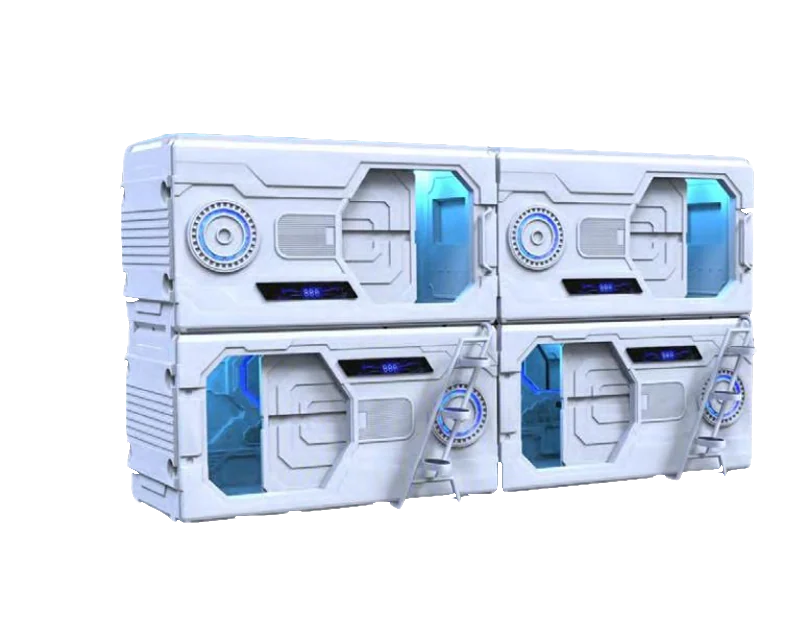
GALAXY Series - Horizontal Single
Standard ABS shell with metal frame featuring TV slot, security sliding door, and ergonomic non-slip ladder. Perfect for hotels, airports, and commercial applications.
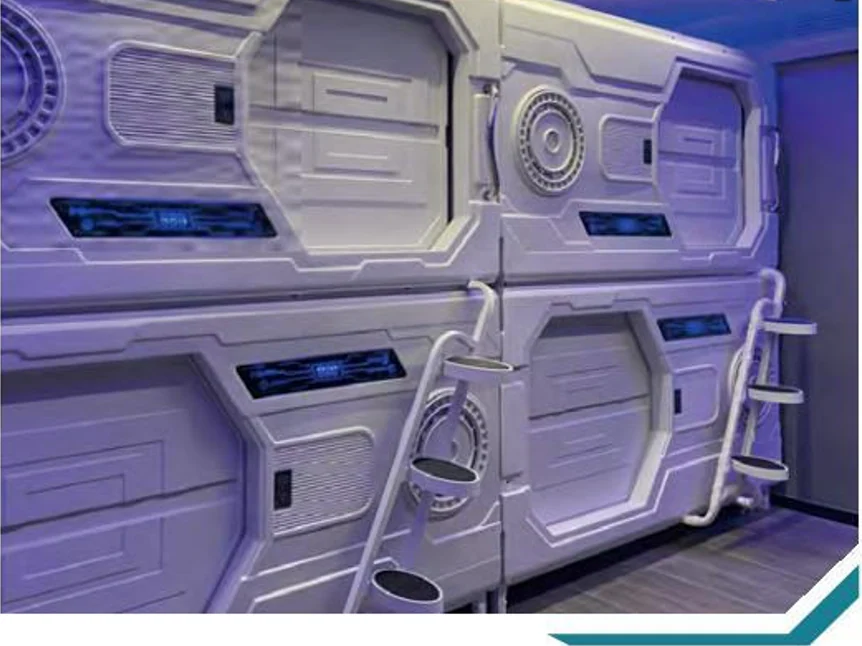
GALAXY Series - Horizontal Double
Spacious double variant with all premium GALAXY features, designed for couples or guests requiring extra space in commercial facilities.
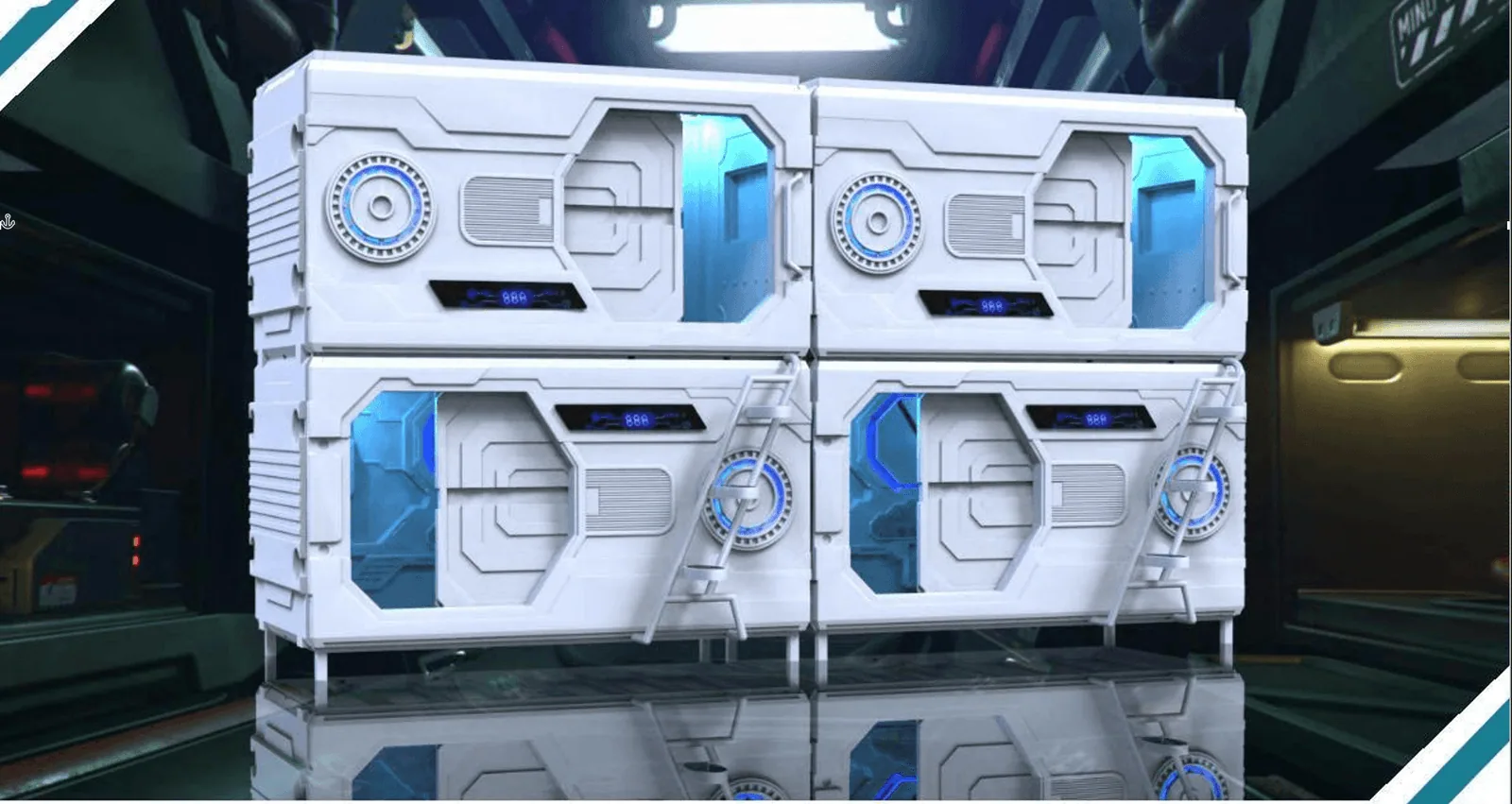
SPACE Series - Horizontal Single
Standard SPACE series with mirror panel, sliding door, TV slot, and intelligent LED controls. Perfect for hotels and commercial applications.
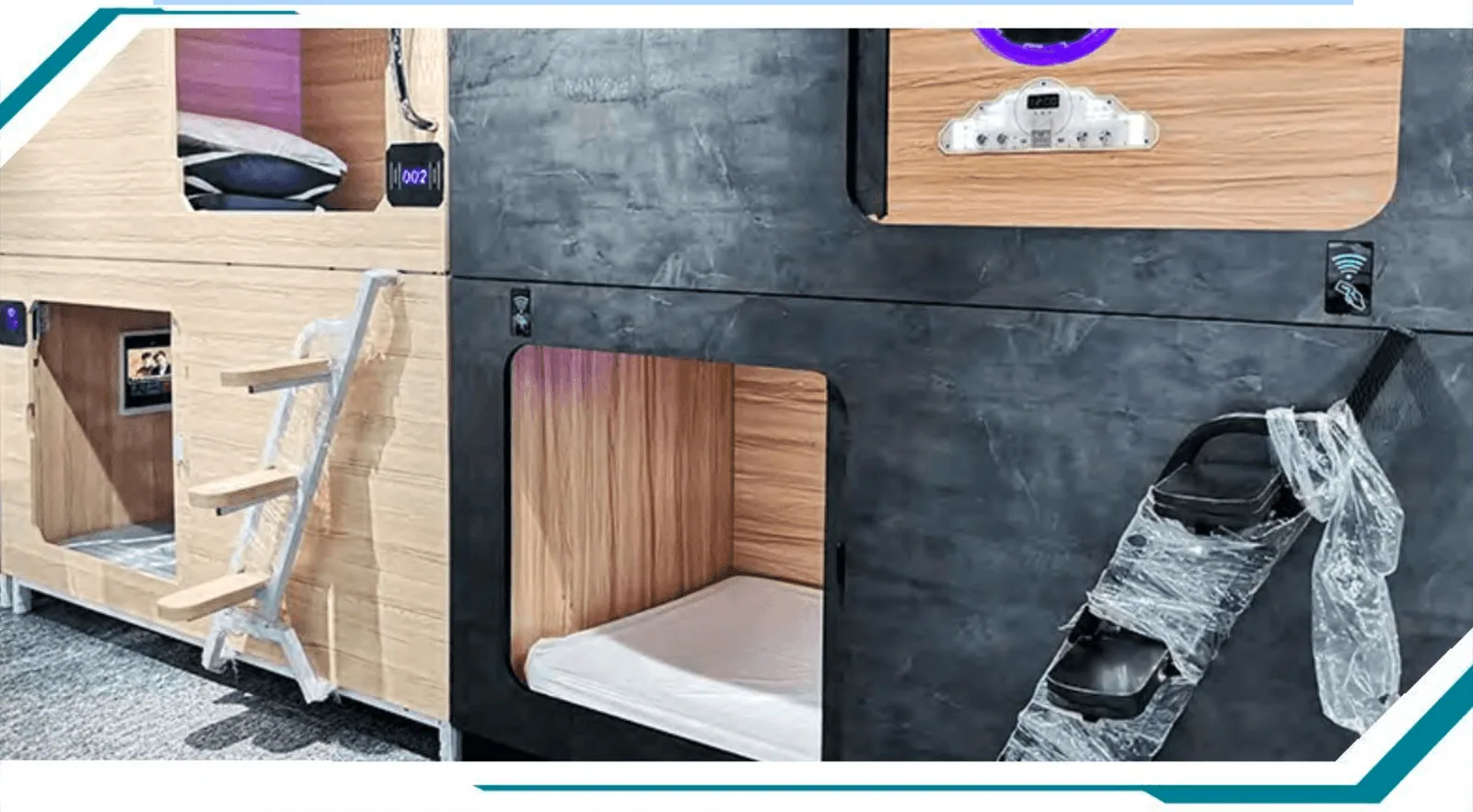
Wooden Series - Horizontal Single
Premium eco multi-layer board construction with metal frame, offering natural wood-grain aesthetics while maintaining all essential capsule bed features.
Market deep-dive
The Lucknow pod-hotel opportunity
Lucknow is not merely the capital of Uttar Pradesh — it is the gravitational centre of governance, healthcare, education, and commerce for a state of 240 million people. Founded as the seat of the Nawabs of Awadh in 1775 when Asaf-ud-Daula shifted his court from Faizabad, the city wears its Nawabi heritage in every archway of the Bara Imambara, every stitch of Chikankari embroidery, and every plate of Tunday Kababi. Today, it is simultaneously a heritage city designated by UNESCO as a City of Gastronomy and a fast-evolving technology hub where HCL's 10,000-strong IT City and TCS's Awadh Park campus operate alongside defence manufacturing at HAL Amausi. This duality of old-world culture and new-economy ambition creates a traveller profile unlike any other Indian city — and a pod-hotel opportunity that is both broad and deep.
The medical-referral economy alone could sustain a pod network. KGMU's 4,200 beds and 8,000 daily outpatient visitors make it one of North India's busiest hospitals, while SGPGI serves as the tertiary referral centre for all of UP plus Bihar, Madhya Pradesh, Uttarakhand, and even Nepal. Families travel from Gorakhpur, Bahraich, Varanasi, and Allahabad — often arriving by overnight train at Charbagh and heading straight to hospital corridors where they sleep on floors for days. A pod installation within walking distance of these medical campuses offers what no budget lodge can: hourly billing, air-conditioned privacy, secure lockers for belongings, and USB charging — at one-third the price of the nearest hotel. The sheer volume of medical visitors, estimated at over 10,000 daily across Lucknow's major hospitals, represents a demand floor that exists regardless of season or economic cycle.
Lucknow's transit infrastructure amplifies pod demand from every direction. Charbagh station, a Northern Railway divisional headquarters with 14 platforms, handles trunk routes connecting Delhi, Kolkata, Mumbai, and Varanasi. The Lucknow Metro now links Munshipulia to the international airport. Six expressways — including the Agra-Lucknow, Purvanchal, and Lucknow-Kanpur corridors — funnel highway traffic through the city. CCS International Airport, ranked the world's second-best small airport, is the busiest in Uttar Pradesh with growing international connectivity. Each of these nodes generates a population that needs a few hours of rest but not a full hotel stay: the overnight train passenger with a morning appointment, the IT consultant flying in for a day-long client meeting, the government official summoned to the Secretariat from a remote district. Pod hotels positioned at these transit chokepoints convert wasted waiting time into revenue.
The investment case for BIDUA Pods in Lucknow rests on a structural gap: India's fourth-largest state capital, with 42 lakh metro residents and millions of annual visitors, has zero capsule-hotel or pod-hotel options. The competitive set is either overpriced branded hotels in Gomti Nagar and Hazratganj at Rs 2,500 and above per night, or unbranded lodges near Charbagh with questionable hygiene standards. Between these extremes lies a vast, underserved market of budget-conscious professionals, medical visitors, students, and domestic tourists who want cleanliness, privacy, and technology at an honest price. With the IT corridor projected to add 20,000 jobs by 2027, the UP Defence Industrial Corridor attracting MSME investment, and Lucknow's coaching and competitive-exam industry drawing lakhs of students annually, the demand trajectory is decisively upward. A 50-pod flagship in Lucknow is not a speculative bet — it is an overdue market correction.
Lucknow pod hotel — FAQs
What is a sleeping pod hotel and is one available in Lucknow?+
A sleeping pod hotel (also called a capsule hotel or Japanese pod hotel) offers compact, private, tech-enabled sleep cabins at a fraction of traditional hotel rates. Lucknow currently has no capsule hotel despite being the capital of India's most populous state. BIDUA Pods is bringing this concept to Lucknow with climate-controlled, soundproofed pods near key demand zones like Charbagh station, KGMU, and the IT corridor.
Where in Lucknow would a pod hotel see the highest demand?+
The strongest demand clusters are: (1) near KGMU and SGPGI hospitals, where thousands of patient attendants need affordable overnight rest daily; (2) around Charbagh and Lucknow Junction railway stations, with massive transit passenger volumes; (3) along the Shaheed Path IT corridor where HCL, TCS, and Deloitte employees and visiting consultants need short stays; and (4) the Hazratganj-Bara Imambara heritage tourism belt.
How do nap pods near Lucknow's hospitals help patient families?+
KGMU alone sees 8,000 daily OPD visitors and SGPGI serves as the tertiary referral centre for all of UP and five neighbouring states. Patient attendants, often from rural districts, currently sleep in hospital corridors or on footpaths. Pod hotels within walking distance offer a clean, private, lockable cabin with AC and charging — available by the hour or overnight — at rates far below any hotel, giving families dignity and rest during stressful medical visits.
Can a Chinese-style capsule hotel work near Lucknow's IT parks?+
Absolutely. Lucknow's IT ecosystem now employs over 15,000 professionals at HCL IT City, TCS Awadh Park, Deloitte, Genpact, and Wipro — with the Amausi-Shaheed Path corridor projected to add 20,000 more IT jobs by 2027. Business travellers, vendor consultants, and employees on project rotations from other cities need clean, no-frills overnight accommodation without 3-star hotel prices. A pod hotel along this corridor captures exactly this demand, especially with hourly billing for daytime nap pods between meetings.
What ROI can a pod hotel franchise expect in Lucknow?+
With 50 pods at 70% average occupancy and a nightly rate of approximately Rs 1,400 in Lucknow's Tier 1 market, the revenue model is compelling. Monthly rent for a suitable 3,000-4,000 sq ft commercial floor runs around Rs 2,00,000-2,25,000. Lucknow's year-round demand drivers — government workers, medical visitors, IT professionals, students, and tourists — provide stable occupancy without seasonal dips. Exact returns depend on location, operating costs, and management; the BIDUA ROI calculator provides detailed scenario modelling.
Is there demand for budget hourly hotels or nap pods near Lucknow airport and railway stations?+
Chaudhary Charan Singh International Airport is the 11th busiest in India and Lucknow Charbagh is a major railway junction connecting Delhi, Varanasi, Kolkata, and Mumbai routes. Early-morning departures, late-night arrivals, long layovers, and missed connections create constant demand for short-duration rest. A pod hotel with hourly nap-pod billing near these transit hubs — something Lucknow currently lacks entirely — would serve airline crew, business travellers, and budget-conscious families who only need 3-6 hours of rest.
Start your Lucknow pod hotel with BIDUA
Sign up to design your space in 3D, build a presentation, and get a quotation + ROI from one dashboard — or talk to our team for a custom Lucknow plan.