Tier 1 pod-hotel market · Uttar Pradesh
Sleeping Pods & Capsule Hotel in Agra — India's Heritage Tourism Capital
India's single most-visited monument (Taj Mahal) plus a massive leather-footwear manufacturing base create a rare twin demand: leisure tourists needing affordable overnight stays AND industrial/trade workers needing short-rest accommodation year-round.

Population & catchment
Agra district: ~44.2 lakh (2011 Census 4,418,797); metro area estimated at ~25-27 lakh (2026). One of India's 25 most populous cities and Uttar Pradesh's fourth-largest urban centre.
Urban pull
About 46% urban (2011); Agra city alone houses ~16 lakh residents with heavy daily inflows of tourists (6.9 million annual Taj visitors), patient attendants, leather trade workers, and pilgrims transiting to the Mathura-Vrindavan Braj circuit.
Economic base
Agra's economy rests on three pillars: tourism (anchored by three UNESCO World Heritage Sites drawing nearly 7 million visitors annually), leather and footwear manufacturing (producing 65% of India's total shoe output, with over 3 lakh pairs daily from the Hing Ki Mandi cluster alone and annual exports exceeding Rs 5,000 crore), and traditional handicrafts including Mughal-era pietra dura marble inlay (parchinkari), zari-zardozi embroidery, carpet weaving, and the iconic Agra petha confectionery industry worth Rs 500 crore annually.
Around Agra
Key landmarks and footfall hubs that drive short-stay demand in Agra.

Taj Mahal — UNESCO World Heritage Site

Agra Fort — UNESCO World Heritage Site
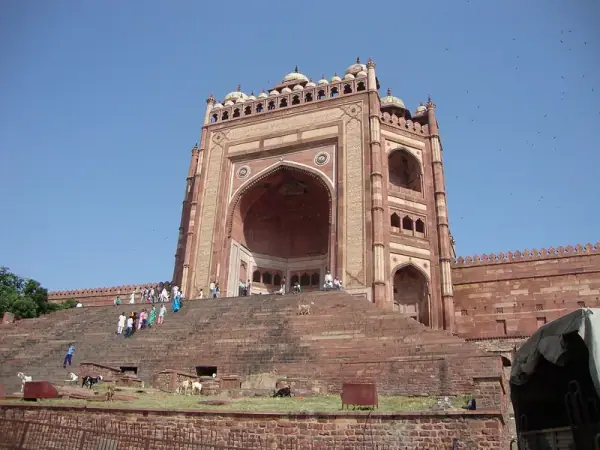
Buland Darwaza at Fatehpur Sikri — UNESCO World Heritage Site
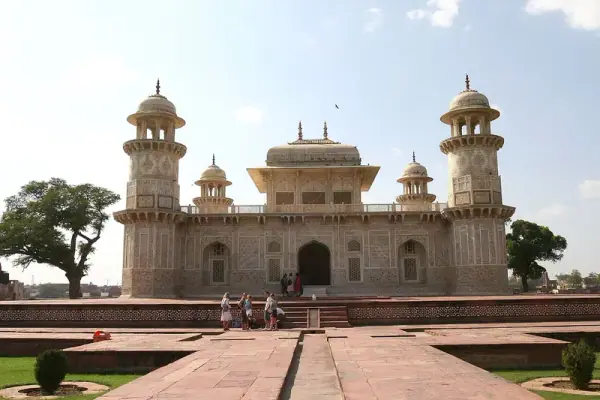
Tomb of Itimad-ud-Daulah (Baby Taj)

Mehtab Bagh — Moonlight Garden with Taj Mahal view
Why a pod hotel works in Agra
Despite being India's most-visited heritage city with nearly 7 million annual Taj visitors, Agra's budget accommodation is dominated by aging lodge-style hotels around Taj Ganj and Sadar Bazaar that offer poor hygiene at inflated tourist-season rates. There is virtually no modern capsule or pod-hotel format available — the segment between Rs 500 dharamshalas and Rs 2,000+ hotel rooms is an underserved gap. Simultaneously, the massive leather-trade workforce (lakhs of daily commuters and wholesale buyers) and SN Medical College's 4 lakh+ annual OPD patients with attendants create non-tourist demand that existing hotels ignore entirely.
Agra is India's single busiest heritage tourism destination — the Taj Mahal alone draws 6.9 million visitors per year. Beyond leisure tourists, the city is a major leather-trade hub pulling wholesale buyers from across India and the Middle East, a medical referral centre for western UP, and a gateway to the Mathura-Vrindavan Krishna pilgrimage circuit (58 km). Agra Cantt station handles 1.3 crore passengers annually on the Delhi-Chennai and Delhi-Mumbai mainlines, while the 165 km Yamuna Expressway connects Delhi in under 3 hours. Most visitors — budget tourists, trade buyers, patient attendants, exam-takers — need clean, affordable short-stay rest that traditional hotels either overprice or undersupply.
Best ways to use pods here
- Near Agra Cantt station — transit pods for 1.3 crore annual rail passengers, especially overnight train layovers and Yamuna Expressway road-trippers
- Taj Ganj / Eastern Gate zone — budget tourist pods for the 6.9 million annual Taj visitors seeking clean, affordable 1-night stays instead of overpriced lodges
- Near SN Medical College / Pushpanjali — rest pods for patient attendants and medical staff doing 12-hour shifts at the 1,200-bed tertiary hospital
- Hing Ki Mandi / Shahganj leather market zone — nap and rest pods for 5,000+ workshop owners, wholesale buyers, and migrant shoe workers
- Fatehpur Sikri / Sikandra corridor — day-rest pods for heritage circuit tourists covering multiple UNESCO sites across 40+ km
Where the demand sits in Agra
Transit & travel
- •Agra Cantt railway station (1.3 crore passengers/year; Delhi-Chennai & Delhi-Mumbai mainlines; 250+ daily trains)
- •Raja Ki Mandi & Idgah railway stations
- •Yamuna Expressway (165 km to Delhi/Noida in ~2.5 hrs)
- •Agra-Lucknow Expressway (302 km; 6-lane access-controlled)
- •NH-2 (Grand Trunk Road), NH-3, NH-11, NH-21 junction
- •Agra Airport (Kheria) with regional air connectivity
- •ISBT Agra — inter-state buses to Rajasthan, MP, Delhi
Healthcare demand
- •Sarojini Naidu Medical College & Hospital (1,200 beds, 100+ ICU, 4 lakh+ OPD patients/year)
- •Pushpanjali Hospital & Research Centre (350 beds, 5 lakh+ patients/year)
- •SN Medical College — tertiary referral hub for western UP districts
- •District Hospital Agra & government CHCs across 15 blocks
Education & coaching
- •Dr. Bhimrao Ambedkar University (DBRAU, est. 1927) — 200+ affiliated colleges across 7 districts
- •Dayalbagh Educational Institute (DEI)
- •SN Medical College (MBBS, PG medical)
- •IHM Agra (Institute of Hotel Management)
- •Coaching centres for competitive exams (UPSC, SSC, UP Board)
Industry & trade
- •Hing Ki Mandi footwear cluster (5,000+ shops, 3 lakh+ shoes/day)
- •Shahganj & Jeoni Mandi wholesale leather markets
- •Trans Yamuna Industrial Area
- •Artoni & Nunhai industrial zones (iron foundries, electrical goods, pipes)
- •Marble inlay (parchinkari) workshops — Mughal-era craft cluster
Tourism & pilgrimage
- •Taj Mahal — UNESCO World Heritage, India's #1 ticketed monument (6.9M visitors/year)
- •Agra Fort — UNESCO World Heritage, Mughal citadel with Diwan-i-Khas & Moti Masjid
- •Fatehpur Sikri — UNESCO World Heritage (36 km), Akbar's abandoned capital with Buland Darwaza
- •Itimad-ud-Daulah's Tomb ('Baby Taj') — white marble pietra dura masterpiece
- •Akbar's Tomb at Sikandra (13 km) & Mariam's Tomb
- •Mehtab Bagh — Moonlight Garden with iconic Taj sunset views
- •Bateshwar temple complex (70 km) — 100+ Shiva temples on Yamuna ghats
- •Mathura-Vrindavan Braj pilgrimage circuit (58 km) — Krishna Janmabhoomi, Banke Bihari, ISKCON
- •Sur Sarovar (Keetham Lake) Bird Sanctuary
Profit & ROI projection for Agra
A starter model based on a minimum 50 pods at 70% occupancy and an indicative ₹1,400/pod/night. Costs use the same itemised basis as our full ROI calculator — pods, add-ons, 18% GST, transport, fit-out and full monthly running cost.
Important: this is only an ASSUMPTION-based projection — not an accurate quote or a guarantee.
The real cost, occupancy, pricing and profit will change with your exact location, property rent, season, competition and how you run the business. Treat these figures as a planning estimate only. For real numbers, use the full calculator or get a custom quote from BIDUA.
Total investment
₹84.7 lakh
50 pods + add-ons + GST + fit-out
Monthly revenue
₹14.7 lakh
35 of 50 pods filled/night
Monthly net profit
₹7.5 lakh
51% margin after all costs
Payback
~11 mo
106% annual ROI
Break-even occupancy ≈ 24% — you only need this much filled to cover all costs; everything above is profit.
| 50 pods (BIDUA mix) | ₹40,30,000 |
| Add-ons (mattress, bedding, panels, safe lock, table) | ₹16,25,200 |
| GST @ 18% (pods + add-ons) | ₹10,17,936 |
| Transport (warehouse → site) | ₹4,00,000 |
| Fit-out, AC, reception, branding + rent deposit | ₹14,00,000 |
| Total investment | ₹84,73,136 |
| Revenue (50 × 70% × ₹1,400 × 30) | ₹14,70,000 |
| Fixed costs (rent, staff, power, housekeeping…) | – ₹3,82,000 |
| Variable (OTA + marketing + gateway, 23%) | – ₹3,38,100 |
| Net profit / month | ₹7,49,900 |
| Net profit / year | ₹89,98,800 |
Indicative projections for a Tier 1 heritage-tourism city with massive year-round footfall. Actual returns depend on location, season (peak Oct-Mar vs lean Apr-Jun), and operator execution. Not a guarantee of income. Figures are indicative estimates, not guarantees.
Agra pod-hotel business plan & study
A step-by-step plan to launch a capsule / sleeping-pod hotel in Agra — from picking the right location to licences, setup, pricing and reaching profitable occupancy.
Demand drivers
25+
transit, hospital, student & tourism footfall points
Space needed (50 pods)
2250–2750 sq ft
single rented floor + reception & washrooms
Break-even occupancy
24%
fill above this and you are in profit
Indicative payback
~11 months
on ₹84.7 lakh all-in setup
1. Pick the right location
Target a floor near Sarojini Naidu Medical College & Hospital (1,200 beds, 100+ ICU, 4 lakh+ OPD patients/year) or Raja Ki Mandi & Idgah railway stations. Best opening use-case: Near Agra Cantt station — transit pods for 1.3 crore annual rail passengers, especially overnight train layovers and Yamuna Expressway road-trippers.
2. Plan investment & funding
Budget about ₹84.7 lakh all-in for 50 pods (pods + add-ons + 18% GST + transport + fit-out & deposit). Many operators fund this with a mix of own capital + a small business/MSME loan against projected cash flow.
3. Licences & compliance
Arrange a municipal trade licence, GST registration, fire safety NOC, police/guest verification (where required), and basic building & sanitation approvals before launch.
4. Build & launch
BIDUA shares a free 3D layout, then delivers and helps install the pods. Civil, electrical, AC and reception fit-out typically takes ~30–45 days, so you can open quickly on a leased floor.
5. Pricing & operations
Start at ~₹1,400/pod/night, and add hourly slots near hospitals for day-rest demand. Run lean with a small reception + housekeeping team; keep pods clean, private and secure to earn repeat stays.
6. Marketing & occupancy
List on OTAs (MakeMyTrip, Booking.com, OYO, Goibibo) + Google Business Profile, and tie up with nearby hospitals, coaching institutes and tour operators to push occupancy past the 24% break-even quickly.
Key risks & how to manage them
Low occupancy in early months. Open with OTA listings + hospital/coaching tie-ups; use hourly pricing to fill day-time.
High rent eating margins. Choose a slightly off-main but accessible floor near Agra Cantt railway station (1.3 crore passengers/year; Delhi-Chennai & Delhi-Mumbai mainlines; 250+ daily trains); rent is the biggest lever.
Seasonality / exam & festival peaks. Flex pricing up in peak weeks; offer weekly/monthly pod rentals to students for a stable base.
Cleanliness & safety complaints. Invest in housekeeping, safe locks and CCTV — reputation drives repeat and OTA ratings.
Recommended pod setup for Agra
50-pod mixed deployment: 60% single horizontal pods (budget tourists & transit passengers), 25% double/couple pods (domestic tourists), 15% premium pods with luggage lockers. Install USB charging, AC, and multilingual pod-screen info (English, Hindi, Japanese for foreign tourist appeal). Cluster primary installations at Agra Cantt station zone and Taj East Gate to capture both transit and tourism demand simultaneously.
GALAXY Series - Horizontal Single
Standard ABS shell with metal frame featuring TV slot, security sliding door, and ergonomic non-slip ladder. Perfect for hotels, airports, and commercial applications.
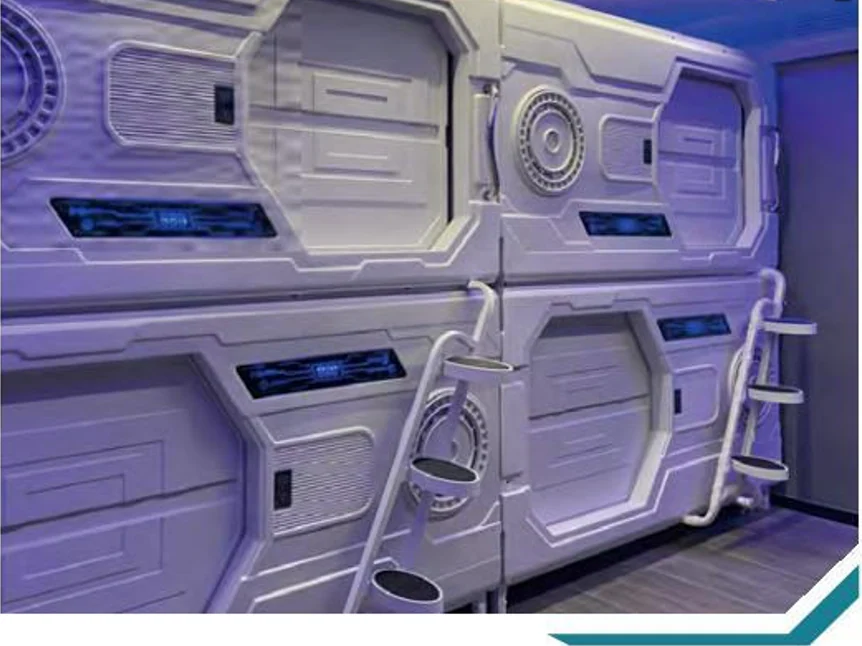
GALAXY Series - Horizontal Double
Spacious double variant with all premium GALAXY features, designed for couples or guests requiring extra space in commercial facilities.

SPACE Series - Horizontal Single
Standard SPACE series with mirror panel, sliding door, TV slot, and intelligent LED controls. Perfect for hotels and commercial applications.
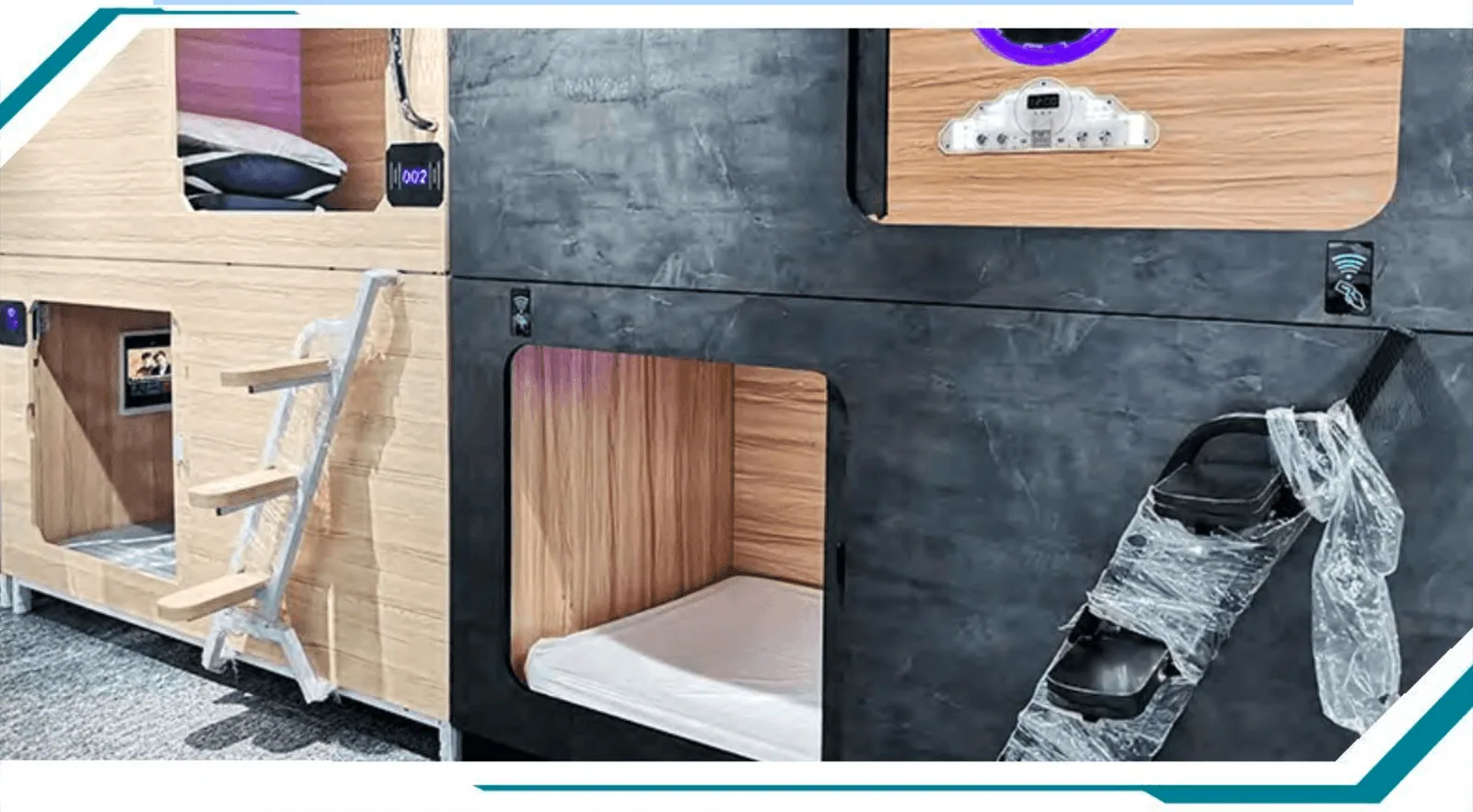
Wooden Series - Horizontal Single
Premium eco multi-layer board construction with metal frame, offering natural wood-grain aesthetics while maintaining all essential capsule bed features.
Market deep-dive
The Agra pod-hotel opportunity
Agra is not merely the city of the Taj Mahal — it is a living industrial powerhouse where Mughal heritage and modern manufacturing coexist in a way unique among Indian cities. The Hing Ki Mandi footwear cluster, born from the leather scraps of Afghan spice caravans in the pre-Independence era, today produces over three lakh pairs of shoes daily and accounts for sixty-five percent of India's total shoe output. Top global brands including Nike, Clarks, and Reebok have licensed manufacturing units here. This enormous blue-collar workforce — from migrant stitchers to wholesale buyers arriving from the Middle East — needs affordable, hygienic short-stay rest in a city where budget hotels are almost entirely tourist-oriented. Sleeping pods placed near Shahganj, Jeoni Mandi, or the Trans Yamuna Industrial Area would tap a demand pool that no hotel format currently serves.
Three UNESCO World Heritage Sites within a single district is a distinction shared by very few places on Earth. The Taj Mahal draws 6.9 million visitors annually — making it India's most-visited ticketed monument — while Agra Fort and Fatehpur Sikri (36 km southwest) add millions more to the city's tourism footprint. Yet Agra's accommodation landscape remains polarised: overpriced tourist-zone hotels in Taj Ganj and Fatehabad Road on one end, and cramped, poorly maintained lodges on the other. The modern capsule-hotel format fills precisely this missing middle. A pod installation near the Taj's Eastern Gate or Agra Cantt station could capture the seventy percent of domestic visitors who stay just one night, offering them clean, air-conditioned, tech-enabled rest at a fraction of hotel prices.
Agra's strategic position amplifies its pod-hotel potential far beyond its own boundaries. The 165-kilometre Yamuna Expressway connects it to Delhi-NCR in under three hours, while the 302-kilometre Agra-Lucknow Expressway links it to the state capital. Agra Cantt station — on both the Delhi-Chennai and Delhi-Mumbai mainlines — handles over 1.3 crore passengers annually across 250-plus daily trains. Just 58 kilometres north lies the Mathura-Vrindavan Braj pilgrimage circuit, drawing millions of Krishna devotees year-round, many of whom transit through Agra. The Bateshwar temple complex (70 km), with its hundred-plus Shiva temples along Yamuna ghats, adds another pilgrimage stream. Every one of these transit and pilgrimage flows passes through Agra, creating layover demand that pods are uniquely positioned to serve.
The institutional anchors cement Agra's year-round pod demand beyond seasonal tourism. Sarojini Naidu Medical College, a 1,200-bed tertiary hospital established in 1854, treats over four lakh OPD patients annually — their attendants, often from rural western UP, desperately need affordable overnight rest nearby. Dr. Bhimrao Ambedkar University (founded 1927 as Agra University) affiliates over 200 colleges across seven districts, channelling thousands of exam-takers into the city every session. The Dayalbagh Educational Institute adds another student population cluster. Meanwhile, Agra's pietra dura artisans — practitioners of the same marble-inlay craft that adorns the Taj — have been recognised under the ODOP (One District One Product) programme, sustaining a heritage-craft economy that draws international buyers, researchers, and cultural tourists throughout the year. Pods serve every one of these segments with a format that is modern, affordable, and scalable.
Agra pod hotel — FAQs
Why does Agra need sleeping pods or capsule hotels near the Taj Mahal?+
The Taj Mahal draws 6.9 million visitors annually, yet Agra's budget accommodation is dominated by aging Taj Ganj lodges with poor hygiene at inflated rates. Sleeping pods offer a clean, modern, affordable alternative — especially for the majority of domestic tourists who visit for just one night. Pods fill the gap between Rs 500 dharamshalas and Rs 2,000+ hotel rooms, a segment that barely exists in Agra today.
Where are the best locations to install a Japanese-style pod hotel in Agra?+
Five high-demand zones stand out: (1) Agra Cantt station area, which handles 1.3 crore passengers per year on the Delhi-Mumbai and Delhi-Chennai mainlines; (2) Taj Ganj / Eastern Gate for budget tourists; (3) Near SN Medical College for patient attendants at the 1,200-bed hospital; (4) Hing Ki Mandi leather market for trade workers and wholesale buyers; and (5) the Fatehpur Sikri corridor for heritage-circuit day visitors.
How much does a nap pod or hourly hotel room cost in Agra?+
BIDUA Pods targets a nightly rate of around Rs 1,400 for a fully air-conditioned, private sleeping pod with Wi-Fi and USB charging — significantly cheaper than Agra's tourist-zone hotels (Rs 2,000-5,000) while being far cleaner and more modern than budget lodges. Hourly rest options can bring the per-use cost even lower, making pods ideal for transit passengers and day-trippers.
Is there enough non-tourist demand for a capsule hotel in Agra?+
Absolutely. Beyond tourism, Agra is India's largest footwear manufacturing hub — Hing Ki Mandi alone has 5,000+ shops producing 3 lakh shoes daily, drawing wholesale buyers from across India and the Middle East. SN Medical College treats 4 lakh+ OPD patients annually whose attendants need affordable rest. DBRAU's 200+ affiliated colleges bring thousands of exam-takers every session. This non-tourist base provides year-round occupancy even during the lean summer months.
Can a Chinese or Japanese pod hotel concept work in a heritage city like Agra?+
Agra is actually an ideal market. The city already receives significant Japanese, Chinese, and East Asian tourist traffic familiar with the capsule hotel concept. The compact pod format also respects the Taj Trapezium Zone's strict environmental regulations — pods have a smaller carbon footprint than conventional hotels, aligning with ASI and pollution-control norms that restrict heavy construction near the Taj Mahal.
What is the expected ROI timeline for a pod hotel franchise near Agra Fort or the Yamuna Expressway?+
With 50 pods at 70% average occupancy and an ADR of Rs 1,400, a well-located Agra installation can generate strong monthly revenues. The Yamuna Expressway corridor and Agra Cantt station zone benefit from year-round transit traffic, smoothing the seasonal tourism cycle (peak October-March, lean April-June). Detailed projections including GST, opex, and fit-out costs are available through the BIDUA Pods ROI calculator on this page.
Start your Agra pod hotel with BIDUA
Sign up to design your space in 3D, build a presentation, and get a quotation + ROI from one dashboard — or talk to our team for a custom Agra plan.