Tier 1 pod-hotel market · Uttar Pradesh
Pod Hotel in Ghaziabad — Sleeping Pods for NCR's Busiest Transit & Industrial Gateway
3rd most populous district in Uttar Pradesh; highest population density in the state at ~3,970 per sq km; 85% literacy rate; rapid growth driven by NCR expansion and Delhi spillover migration
Population & catchment
~46.8 lakh (4.68 million) district population (2011 census: 46.8 lakh pre-bifurcation; post-Hapur split ~33.4 lakh, but city agglomeration estimated at ~35.8 lakh by 2026)
Urban pull
67.6% urban — one of India's most urbanised districts; Ghaziabad city alone ~24.8 lakh (2026 est.), dense NCR suburban sprawl
Economic base
Ghaziabad is Uttar Pradesh's second-largest industrial hub after Kanpur, anchored by a massive steel sector (500+ units, 25,000+ jobs), defence manufacturing at Ordnance Factory Muradnagar, and a diversified Sahibabad-Modinagar industrial belt hosting Dabur, BEL, Tata Steel BSL, and Shriram Pistons. The district's NCR location makes it a magnet for IT services, real estate development, and logistics, with per capita income reaching Rs 2.11 lakh (2023-24) — well above the UP state average.
Around Ghaziabad
Key landmarks and footfall hubs that drive short-stay demand in Ghaziabad.
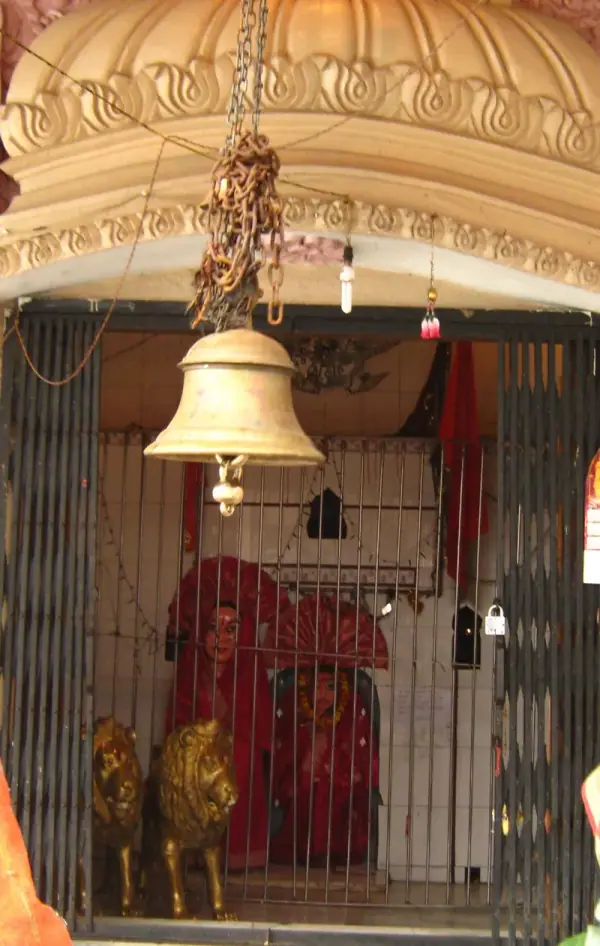
Mahamaya Mandir, Modinagar
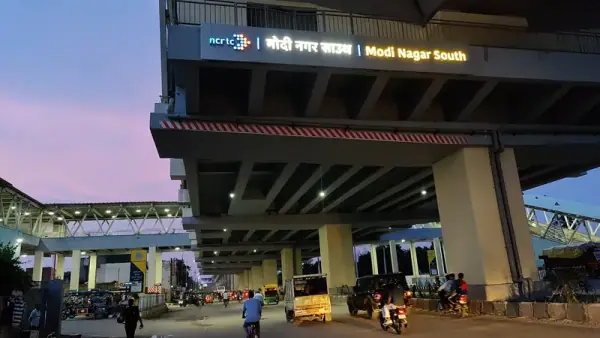
Modinagar South RRTS (Namo Bharat) Station
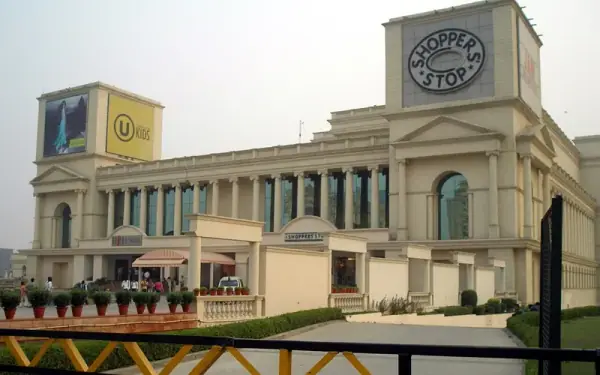
Shipra Mall, Ghaziabad
Why a pod hotel works in Ghaziabad
Despite being NCR's busiest eastern gateway with 50,000+ daily rail passengers, 12 Metro stations, 6 RRTS stations, and a commercial airport, Ghaziabad has zero branded capsule or pod-hotel properties. The gap between Delhi's premium hotel market and Ghaziabad's unbranded lodges leaves transit passengers, hospital attendants, factory visitors, and exam-season students with no clean, tech-enabled, hourly-bookable sleep option. A pod hotel here doesn't compete with Delhi's supply — it captures demand that Delhi's supply cannot reach.
Ghaziabad is the eastern gateway to Delhi-NCR, funnelling millions of daily commuters, business travellers, and transit passengers through its railway junction (50,000 daily footfall), 12 Delhi Metro stations across three lines, and the new Namo Bharat RRTS rapid rail. Hindon Airport adds domestic air traffic, while NH-9, NH-24, and NH-34 carry heavy road volumes between Delhi and all of eastern-northern UP. Corporate travellers visit Sahibabad-Modinagar industrial belt, medical tourists seek its super-specialty hospitals, and students pour in for coaching and college admissions across dozens of institutions.
Best ways to use pods here
- Railway station pod lounge — 50,000 daily passengers at Ghaziabad Junction need layover rest between Delhi-Howrah and Delhi-Saharanpur trains
- Hospital attendant pods — Yashoda (800+ beds) and Max Vaishali (387+ beds) generate nightly demand for 200+ affordable attendant sleep slots
- Industrial visitor pods — Sahibabad-Modinagar belt receives thousands of engineers, auditors, and sales reps weekly visiting BEL, Dabur, and 500+ steel units
- RRTS corridor pod station — Namo Bharat stations at Ghaziabad, Duhai, and Muradnagar create Japanese-style 'station-adjacent capsule hotel' demand
- Exam-season and student pods — IMT, engineering colleges, and IIT-JEE/NEET coaching centres bring seasonal waves of test-takers needing 1-2 night stays
Where the demand sits in Ghaziabad
Transit & travel
- •Ghaziabad Junction railway station — major junction on Delhi-Howrah and Delhi-Saharanpur lines, 50,000+ daily passengers, 37-acre complex
- •Delhi Metro Red Line (8 stations to Shaheed Sthal), Blue Line (Kaushambi, Vaishali), Pink Line (Shiv Vihar, Johri Enclave) — 12 metro stations in district
- •Namo Bharat RRTS — semi-high-speed rapid rail with stations at Sahibabad, Ghaziabad, Guldhar, Duhai, Muradnagar, and Modinagar South/North
- •Hindon Airport — second commercial airport in Delhi-NCR, inaugurated 2019, domestic flights to Pithoragarh and Hubli
- •NH-9 (Delhi-Lucknow), NH-24 (Delhi-Bareilly), NH-34 (Delhi-Meerut expressway corridor) — three national highways converge
Healthcare demand
- •Yashoda Hospital & Research Centre — 800+ bed multi-specialty, one of NCR's largest private hospitals
- •Max Super Speciality Hospital Vaishali — 387+ beds, 128 critical-care beds, 14 OTs, 390+ specialists
- •Manipal Hospital Ghaziabad — tertiary-care multi-specialty with nationally renowned orthopaedics department
- •Santosh Medical College & Hospital — teaching hospital with attached medical college
- •MMG District Hospital and Shanti Gopal Hospital — government and private maternity/general care
Education & coaching
- •Institute of Management Technology (IMT) Ghaziabad — top-ranked B-school, draws students nationally
- •Christ University Delhi-NCR Campus — growing multi-discipline university campus
- •IMS Engineering College, KIET Group of Institutions, Raj Kumar Goel Institute of Technology — major engineering colleges
- •Aakash Institute, Allen Career Institute, Resonance, Career Launcher — national coaching chains with Ghaziabad centres for IIT-JEE, NEET, UPSC
- •Inderprastha Dental College & Hospital, Santosh University — medical and dental education cluster
Industry & trade
- •Sahibabad Industrial Area — hosts Bharat Electronics Limited (BEL), Dabur India, Tata Steel BSL; thousands of manufacturing units
- •Ordnance Factory Muradnagar — WW2-era defence metallurgical unit producing alloy steel castings and ammunition hardware
- •Modinagar Industrial Complex — Modi Sugar Mills, International Tobacco Company, textile and chemical plants founded 1933
- •Meerut Road Industrial Area — Shriram Pistons & Rings, Danfoss India, heavy engineering and auto-component cluster
- •500+ steel units employing 25,000+ people — Ghaziabad known as 'Steel City of UP'; stainless steel wires, bars, ingots
Tourism & pilgrimage
- •Dudheshwar Nath Mahadev Mandir (Dasna) — ancient Shiva temple said to be 5,000 years old, major NCR pilgrimage
- •ISKCON Temple Ghaziabad — modern Hare Krishna temple, major draw during Janmashtami festival
- •Lakshmi Narayan Temple (Modi Mandir) Modinagar — 15.2-acre temple complex built 1963, shrines to Vishnu, Shiva, Hanuman
- •Mahamaya Mandir Modinagar — revered Devi temple drawing regional devotees
- •Swarna Jayanti Park Indirapuram and City Forest Park (Hindon riverbank) — major urban recreation and eco-tourism
Profit & ROI projection for Ghaziabad
A starter model based on a minimum 50 pods at 70% occupancy and an indicative ₹1,300/pod/night. Costs use the same itemised basis as our full ROI calculator — pods, add-ons, 18% GST, transport, fit-out and full monthly running cost.
Important: this is only an ASSUMPTION-based projection — not an accurate quote or a guarantee.
The real cost, occupancy, pricing and profit will change with your exact location, property rent, season, competition and how you run the business. Treat these figures as a planning estimate only. For real numbers, use the full calculator or get a custom quote from BIDUA.
Total investment
₹88.7 lakh
50 pods + add-ons + GST + fit-out
Monthly revenue
₹13.7 lakh
35 of 50 pods filled/night
Monthly net profit
₹6.7 lakh
49% margin after all costs
Payback
~13 mo
90% annual ROI
Break-even occupancy ≈ 25% — you only need this much filled to cover all costs; everything above is profit.
| 50 pods (BIDUA mix) | ₹40,30,000 |
| Add-ons (mattress, bedding, panels, safe lock, table) | ₹16,25,200 |
| GST @ 18% (pods + add-ons) | ₹10,17,936 |
| Transport (warehouse → site) | ₹4,00,000 |
| Fit-out, AC, reception, branding + rent deposit | ₹18,00,000 |
| Total investment | ₹88,73,136 |
| Revenue (50 × 70% × ₹1,300 × 30) | ₹13,65,000 |
| Fixed costs (rent, staff, power, housekeeping…) | – ₹3,82,000 |
| Variable (OTA + marketing + gateway, 23%) | – ₹3,13,950 |
| Net profit / month | ₹6,69,050 |
| Net profit / year | ₹80,28,600 |
Indicative projections for a 50-pod Ghaziabad unit at Tier 1 NCR rates. Actual revenue depends on location, seasonality, and operational execution — these figures are planning assumptions, not guarantees. Figures are indicative estimates, not guarantees.
Ghaziabad pod-hotel business plan & study
A step-by-step plan to launch a capsule / sleeping-pod hotel in Ghaziabad — from picking the right location to licences, setup, pricing and reaching profitable occupancy.
Demand drivers
20+
transit, hospital, student & tourism footfall points
Space needed (50 pods)
2250–2750 sq ft
single rented floor + reception & washrooms
Break-even occupancy
25%
fill above this and you are in profit
Indicative payback
~13 months
on ₹88.7 lakh all-in setup
1. Pick the right location
Target a floor near Yashoda Hospital & Research Centre — 800+ bed multi-specialty, one of NCR's largest private hospitals or Delhi Metro Red Line (8 stations to Shaheed Sthal), Blue Line (Kaushambi, Vaishali), Pink Line (Shiv Vihar, Johri Enclave) — 12 metro stations in district. Best opening use-case: Railway station pod lounge — 50,000 daily passengers at Ghaziabad Junction need layover rest between Delhi-Howrah and Delhi-Saharanpur trains.
2. Plan investment & funding
Budget about ₹88.7 lakh all-in for 50 pods (pods + add-ons + 18% GST + transport + fit-out & deposit). Many operators fund this with a mix of own capital + a small business/MSME loan against projected cash flow.
3. Licences & compliance
Arrange a municipal trade licence, GST registration, fire safety NOC, police/guest verification (where required), and basic building & sanitation approvals before launch.
4. Build & launch
BIDUA shares a free 3D layout, then delivers and helps install the pods. Civil, electrical, AC and reception fit-out typically takes ~30–45 days, so you can open quickly on a leased floor.
5. Pricing & operations
Start at ~₹1,300/pod/night, and add hourly slots near hospitals for day-rest demand. Run lean with a small reception + housekeeping team; keep pods clean, private and secure to earn repeat stays.
6. Marketing & occupancy
List on OTAs (MakeMyTrip, Booking.com, OYO, Goibibo) + Google Business Profile, and tie up with nearby hospitals, coaching institutes and tour operators to push occupancy past the 25% break-even quickly.
Key risks & how to manage them
Low occupancy in early months. Open with OTA listings + hospital/coaching tie-ups; use hourly pricing to fill day-time.
High rent eating margins. Choose a slightly off-main but accessible floor near Ghaziabad Junction railway station — major junction on Delhi-Howrah and Delhi-Saharanpur lines, 50,000+ daily passengers, 37-acre complex; rent is the biggest lever.
Seasonality / exam & festival peaks. Flex pricing up in peak weeks; offer weekly/monthly pod rentals to students for a stable base.
Cleanliness & safety complaints. Invest in housekeeping, safe locks and CCTV — reputation drives repeat and OTA ratings.
Recommended pod setup for Ghaziabad
50-pod mixed configuration: 60% single pods for solo transit/business travellers, 25% double-wide pods for hospital attendant pairs, 15% premium pods with workstation for corporate guests. Two locations recommended — one near Ghaziabad Junction/RRTS station for transit capture, one near Vaishali-Kaushambi hospital-metro corridor. Grade: Business-class fit-out to match NCR corporate expectations.
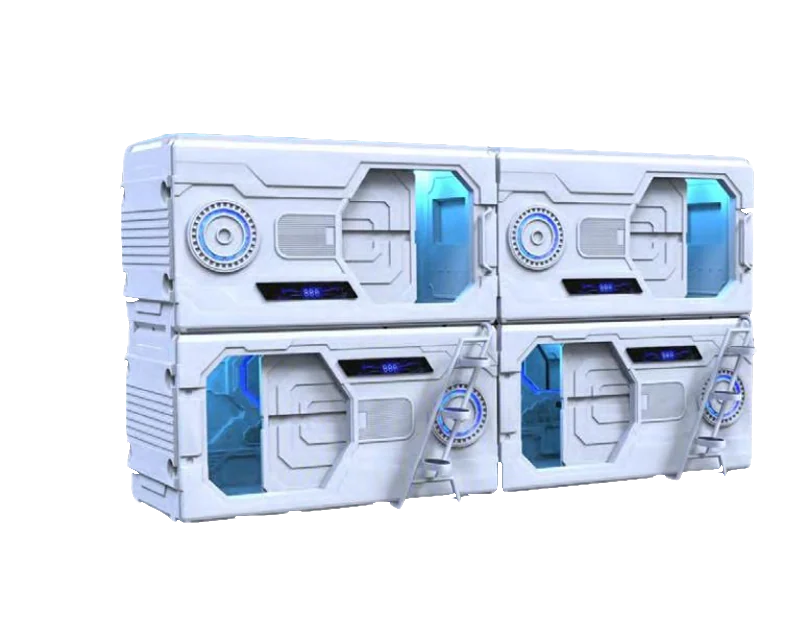
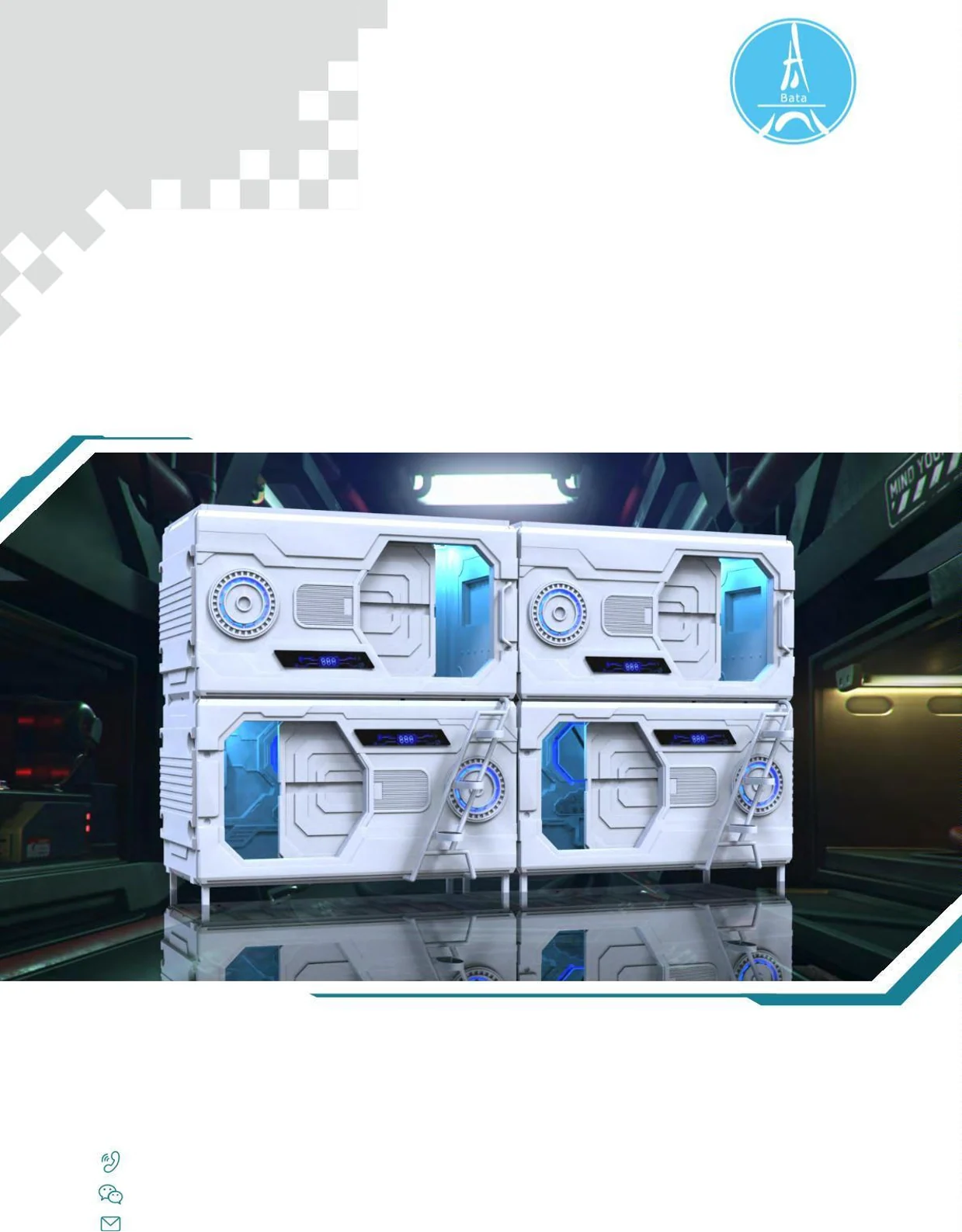
GALAXY Series - Horizontal Single
Standard ABS shell with metal frame featuring TV slot, security sliding door, and ergonomic non-slip ladder. Perfect for hotels, airports, and commercial applications.
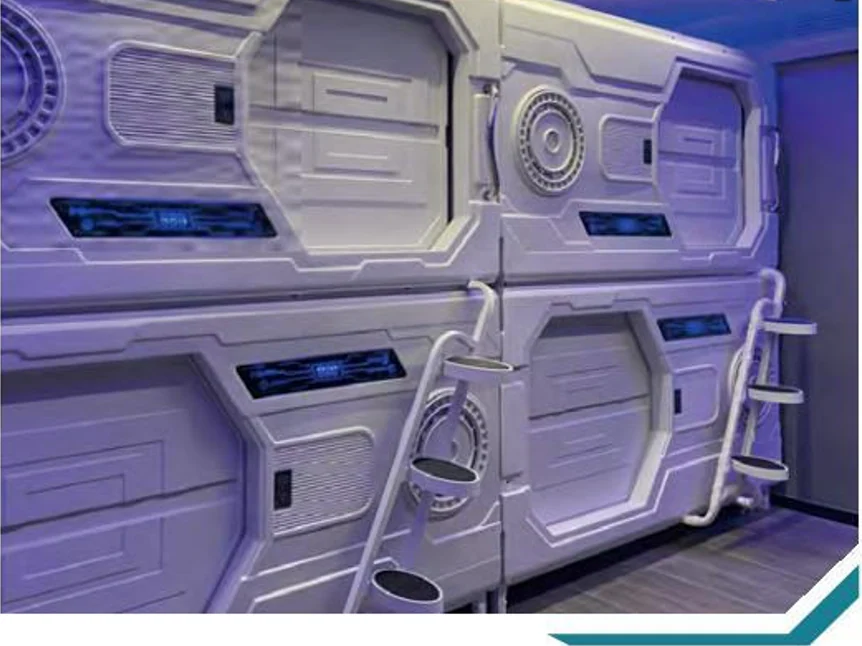
GALAXY Series - Horizontal Double
Spacious double variant with all premium GALAXY features, designed for couples or guests requiring extra space in commercial facilities.
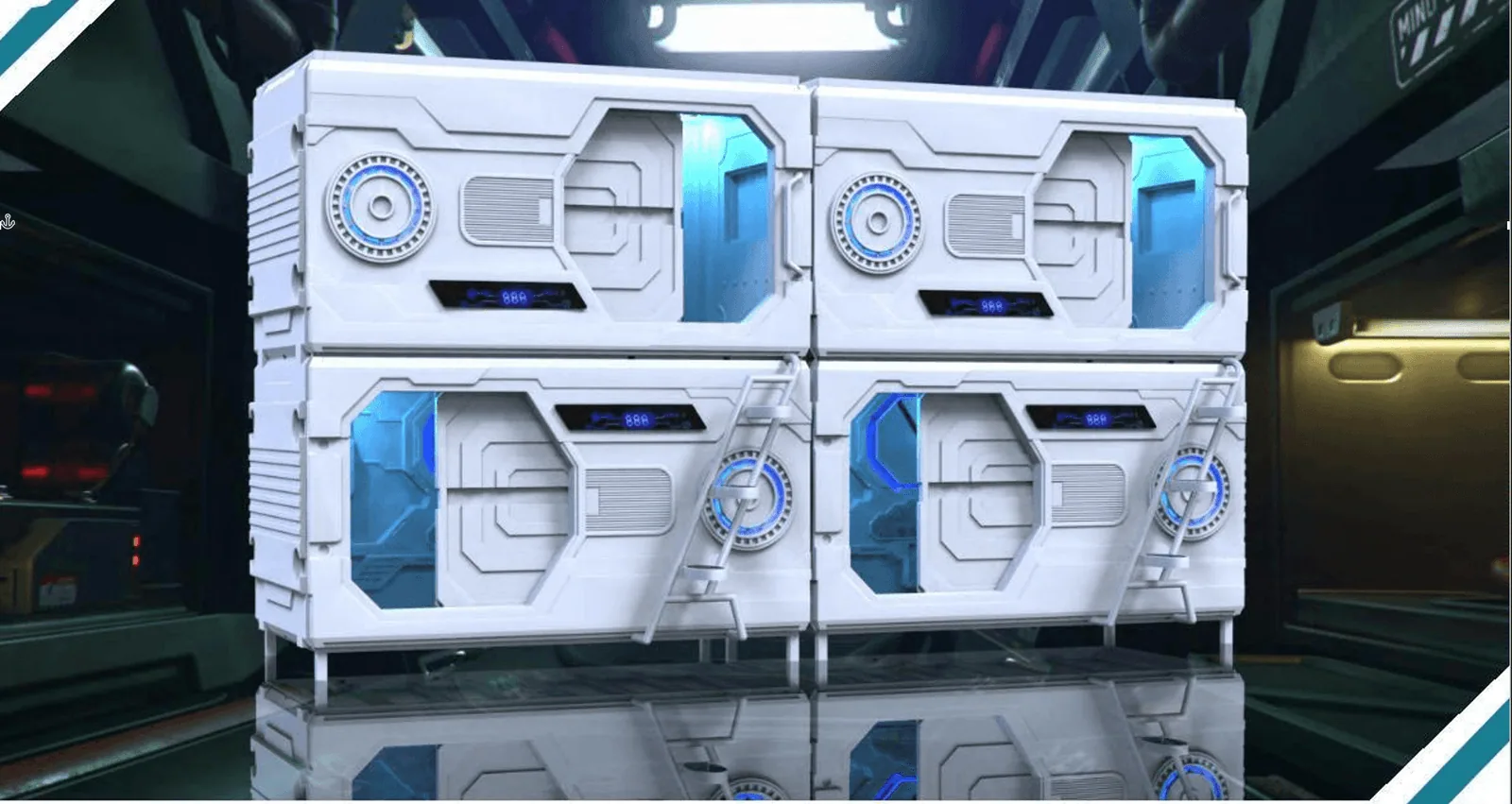
SPACE Series - Horizontal Single
Standard SPACE series with mirror panel, sliding door, TV slot, and intelligent LED controls. Perfect for hotels and commercial applications.
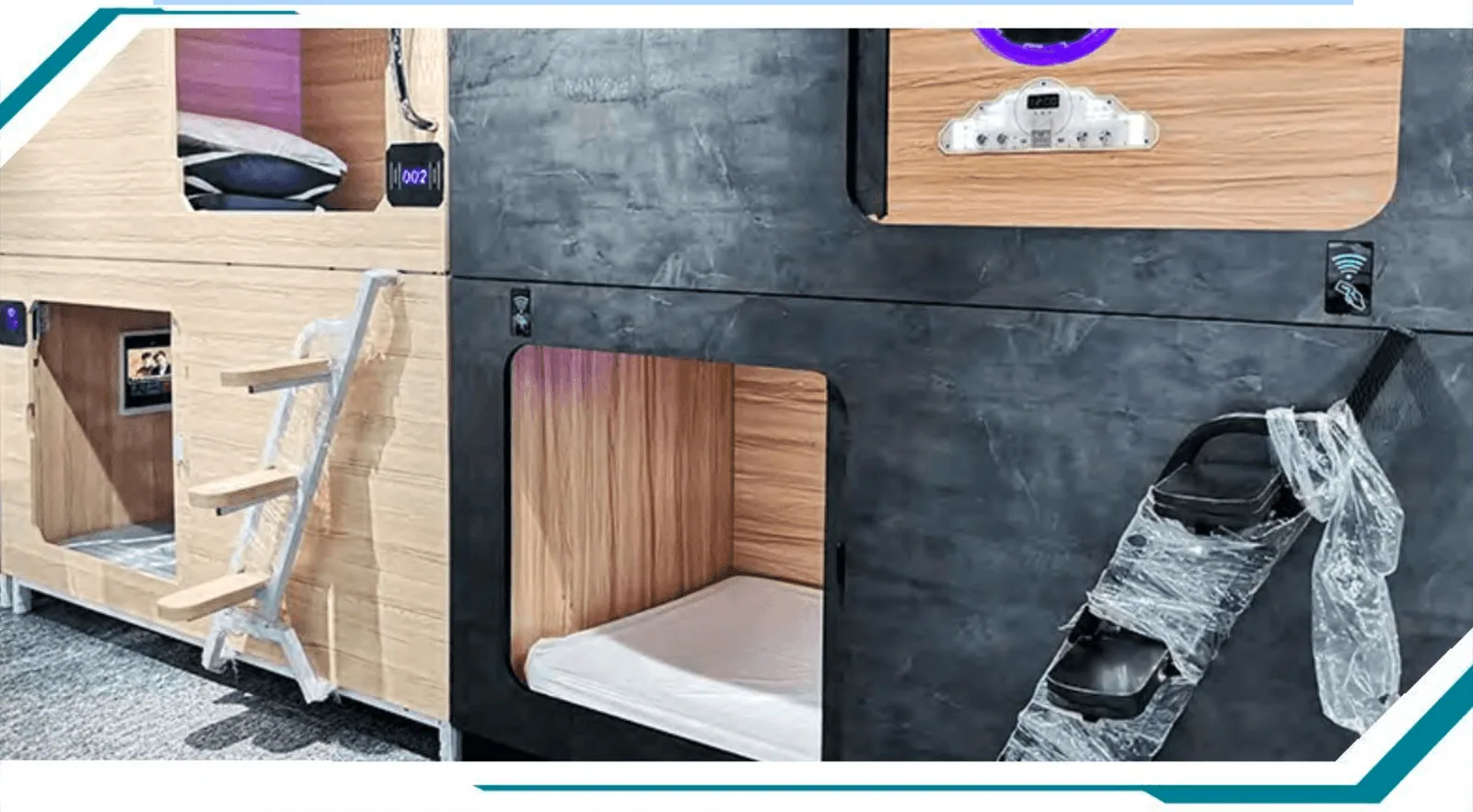
Wooden Series - Horizontal Single
Premium eco multi-layer board construction with metal frame, offering natural wood-grain aesthetics while maintaining all essential capsule bed features.
Market deep-dive
The Ghaziabad pod-hotel opportunity
Ghaziabad is not merely a suburb of Delhi — it is a powerhouse in its own right, the eastern gateway to India's National Capital Region and Uttar Pradesh's second-largest industrial hub. Founded in 1740 by Mughal wazir Ghazi-ud-Din II and originally named Ghaziuddinnagar, the city reinvented itself after Partition when entrepreneurs from Pakistani Punjab established factories that would grow into the Sahibabad-Modinagar industrial belt. Today, more than 500 steel manufacturing units earn it the title 'Steel City of UP,' while Ordnance Factory Muradnagar — a World War II-era defence plant — produces alloy castings for India's armed forces. Bharat Electronics, Dabur, Tata Steel BSL, and Shriram Pistons anchor a district that employs over 150,000 industrial workers, each a potential pod-hotel guest on every audit visit, training week, or shift rotation.
What truly sets Ghaziabad apart is its transit density. The city is one of the rare Indian districts served simultaneously by mainline rail, metro rail, and rapid rail. Ghaziabad Junction handles 50,000 passengers daily on the Delhi-Howrah and Delhi-Saharanpur trunk routes. Twelve Delhi Metro stations across the Red, Blue, and Pink lines stitch the district into Delhi's commuter fabric, while the Namo Bharat RRTS — an 82-km semi-high-speed corridor with six stations inside the district — has transformed it into a genuine regional transit hub since operations began in 2023. Add Hindon Airport, the NCR's second commercial airport inaugurated in 2019, and you have a district where 'last-mile sleep' demand mirrors the capsule-hotel ecosystems around Tokyo's Shinkansen stations or Hong Kong's cross-border terminals.
Beyond industry and transit, Ghaziabad anchors a formidable healthcare and education ecosystem that generates round-the-clock short-stay demand. Yashoda Hospital's 800-plus beds and Max Vaishali's 387-bed super-specialty campus mean hundreds of patient attendants need affordable overnight accommodation every single night — attendants who currently sleep on hospital floors or pay inflated rates at nearby lodges. On the education front, the Institute of Management Technology (IMT Ghaziabad) draws MBA aspirants from across India, while Aakash, Allen, and Resonance coaching centres serve thousands of IIT-JEE and NEET students year-round. Each entrance-exam season floods the city with young test-takers who need a clean, safe, affordable place to sleep for one or two nights — the exact use case for which pod hotels were invented.
Ghaziabad's own cultural and spiritual identity adds a tourism layer that most NCR satellites lack. The ancient Dudheshwar Nath Mahadev Mandir near Dasna — claimed to be 5,000 years old — draws Shiva devotees from across Delhi-NCR, while ISKCON Temple Ghaziabad sees massive footfall during Janmashtami. The 15-acre Lakshmi Narayan Temple complex (Modi Mandir) in Modinagar and the revered Mahamaya Mandir create a pilgrimage micro-circuit within the district. With Hastinapur Wildlife Sanctuary and the Ganga ghats of Garhmukteshwar just beyond the district boundary, Ghaziabad stands at the crossroads of devotion, industry, and transit — a combination that makes it arguably the single strongest pod-hotel market in all of Uttar Pradesh.
Ghaziabad pod hotel — FAQs
Why does Ghaziabad need sleeping pod hotels when Delhi is right next door?+
Ghaziabad's 50,000+ daily railway passengers, 12 Metro stations, and the new Namo Bharat RRTS generate massive in-district transit demand. Business travellers visiting Sahibabad-Modinagar industrial estates, hospital attendants at Yashoda and Max Vaishali, and students at IMT or coaching centres need affordable, hygienic overnight stays without crossing into Delhi. A capsule hotel near Ghaziabad Junction or the RRTS corridor fills a gap no budget hotel currently addresses — clean, private, hourly-bookable sleep pods at a fraction of Delhi hotel rates.
What is a sleeping pod or capsule hotel, and how does it work in Ghaziabad?+
A sleeping pod (also called a Japanese pod hotel or nap pod) is a compact, self-contained cabin with a comfortable bed, climate control, charging ports, and privacy screen. In Ghaziabad, pods are ideal for overnight rail passengers at the Junction, corporate visitors to Sahibabad's factories, or medical attendants at the city's super-specialty hospitals. Guests book by the hour or night via an app — no lengthy check-ins, no wasted lobby space. Think of it as a premium upgrade from a railway waiting room at budget hotel prices.
Where are the best locations for a pod hotel franchise in Ghaziabad?+
The top five spots are: (1) Near Ghaziabad Junction railway station — India's busiest junctions with 50,000 daily passengers; (2) Kaushambi-Vaishali Metro corridor — Blue Line terminus area with heavy commuter and corporate traffic; (3) Sahibabad Industrial Area — walkable from BEL, Dabur, and Tata Steel plants for visiting engineers and auditors; (4) Near Yashoda or Max Hospital — 800+ bed hospitals with constant attendant demand; (5) Modinagar along the RRTS line — industrial town with no branded short-stay accommodation.
How much does it cost to stay in a BIDUA pod hotel in Ghaziabad?+
Nightly rates in Ghaziabad are estimated around Rs 1,300 per pod — competitive with budget hotels but offering a far more modern, hygienic, and tech-enabled experience. Hourly nap-pod bookings during daytime are even more affordable, perfect for transit passengers with layovers at the Junction or travellers waiting for RRTS connections. Unlike traditional Chinese pod hotels or Japanese capsule hotels, BIDUA pods are designed for Indian preferences with full-length beds, individual climate control, and secure personal lockers.
Is there demand for budget hourly hotels near Ghaziabad's hospitals?+
Absolutely. Yashoda Hospital alone has 800+ beds, and Max Vaishali has 387+ beds with 128 ICU beds — meaning hundreds of patient attendants need affordable overnight stays daily. Most end up on hospital corridors or in overpriced nearby hotels. Pod hotels near these medical hubs offer a dignified, clean, and affordable alternative — guests can book a 6-hour or 12-hour slot, rest in a private pod with AC and charging, and be steps from the hospital entrance. This attendant-care model is one of the strongest pod demand drivers in Ghaziabad.
How does Ghaziabad's RRTS Namo Bharat rapid rail boost pod hotel demand?+
The Delhi-Ghaziabad-Meerut RRTS (Namo Bharat) is an 82-km semi-high-speed corridor with stations at Sahibabad, Ghaziabad, Guldhar, Duhai, Muradnagar, and Modinagar — all within the district. This transforms Ghaziabad into a regional transit hub where passengers may arrive late or need early-morning connections. Pod hotels near RRTS stations capture this 'last-mile sleep' demand the same way capsule hotels thrive near Tokyo's Shinkansen stations. Combined with Metro and railway connectivity, Ghaziabad is poised to become NCR's pod hotel capital.
Start your Ghaziabad pod hotel with BIDUA
Sign up to design your space in 3D, build a presentation, and get a quotation + ROI from one dashboard — or talk to our team for a custom Ghaziabad plan.