Tier 3 pod-hotel market · Uttar Pradesh
Pod Hotel in Bulandshahr — Sleeping Pods for India's Ceramics Capital, Ganga Pilgrimage Belt & NCR Industrial Corridor
One of western UP's most populous districts at 788/sq km density — large rural hinterland with rapid NCR-spillover urbanisation in Sikandrabad-Khurja belt; massive seasonal pilgrim influx at Garhmukteshwar and Anoopshahr Ganga ghats
Population & catchment
~3.5 million (2011 Census: 34,99,171; estimated ~40 lakh by 2026)
Urban pull
About 25% urban (8.67 lakh in 2011) across towns like Khurja, Sikandrabad, Bulandshahr, Anoopshahr, and Gulaothi; 75% rural across 1,300+ villages
Economic base
Bulandshahr's economy rests on three pillars: GI-tagged Khurja ceramics (500+ factories exporting $23M annually), strategic nuclear and vaccine manufacturing (Narora Atomic Power Station and BIBCOL), and intensive Doab agriculture producing wheat, sugarcane, and potatoes between the Ganga and Yamuna. The district is rapidly industrialising as the Eastern-Western Dedicated Freight Corridor junction at Khurja and the DNGIR investment region channel NCR overflow manufacturing and logistics into its southern tehsils.
Around Bulandshahr
Key landmarks and footfall hubs that drive short-stay demand in Bulandshahr.
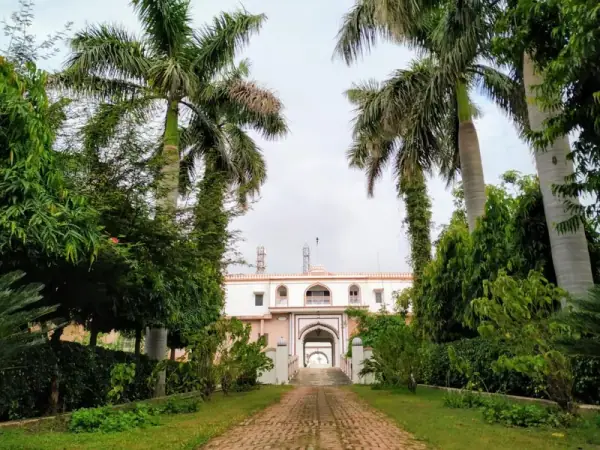
Kuchesar Mud Fort — 1734 Jat heritage fort, now Neemrana's Rao Raj Vilas
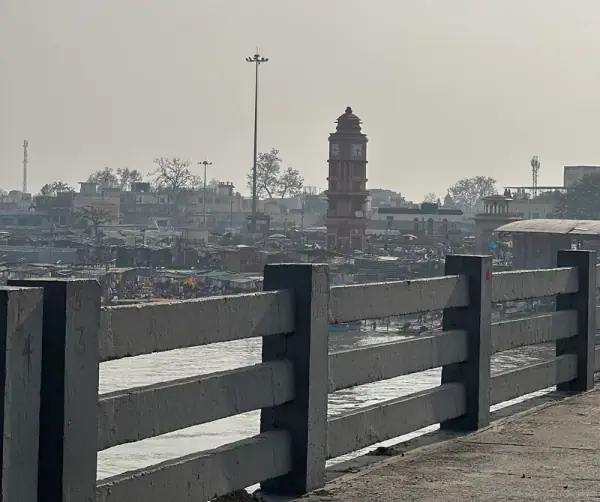
Clock Tower and Ghat at Garhmukteshwar — Ganga pilgrimage site
Why a pod hotel works in Bulandshahr
Despite 3.5 million residents, 40,000 ceramics workers, a nuclear power station workforce, a new 500-bed government medical college generating 1,363 daily OPD visits, and Ganga pilgrimage sites drawing over a million visitors annually at Garhmukteshwar alone, Bulandshahr district has zero branded budget accommodation below the heritage-hotel tier. The Kartik Purnima mela at Brijghat creates acute seasonal demand with no formal lodging, while the DFC logistics corridor is channelling thousands of transit workers through Khurja with nowhere affordable to sleep.
Bulandshahr sits just 68 km from New Delhi on NH-91 (Agra-Delhi corridor), placing it squarely in the National Capital Region. The district has 17 railway stations including Bulandshahr (BSC), Khurja Junction (on the Delhi-Kolkata main line), and Sikandrabad. NH-9 and the Grand Trunk Road traverse the district. The Eastern and Western Dedicated Freight Corridors intersect at Khurja, creating a massive logistics node. Jewar International Airport (Noida) under construction is roughly 50 km away, promising future air connectivity.
Best ways to use pods here
- Pilgrim overflow at Garhmukteshwar Kartik Mela and Anoopshahr Ganga ghats — over 1 million visitors need clean, affordable stay during peak season
- Hospital attendant and patient-family pods near Kalyan Singh Medical College — 1,363 daily OPD visitors and 95 daily admissions with no nearby budget stay
- Ceramics worker and buyer transit pods in Khurja — 40,000 factory workers plus wholesale buyers from across India need shift-rest and overnight options
- DFC logistics corridor crew rest at the Eastern-Western freight junction — truck drivers, engineers, and warehouse staff need hourly/nightly pods
- Student and exam-season accommodation near Jaypee University Anoopshahr and CHSGC — parents, entrance-exam candidates, and visiting faculty need budget rooms
Where the demand sits in Bulandshahr
Transit & travel
- •Bulandshahr Railway Station (BSC) on Northern Railway — daily trains to Delhi, Agra, Aligarh
- •Khurja Junction — major node on Delhi-Kolkata main line, DFC intersection point
- •Sikandrabad — on GT Road, 51 km from Delhi, near Greater Noida
- •NH-91 (Delhi-Agra) and NH-9 run through the district
- •Garhmukteshwar on Delhi-Moradabad line (NH-9), two railway stations
- •Upcoming Jewar International Airport ~50 km from Sikandrabad
Healthcare demand
- •Kalyan Singh Government Medical College (500-bed teaching hospital, inaugurated by PM Modi Jan 2025) — 1,363 daily OPD visits generate attendant/family pod demand
- •BBD District Hospital Bulandshahr — main government referral centre
- •Rajwanti Jyoti Multispeciality Hospital & Heart Institute — cardiac referrals from surrounding rural blocks
- •Mohan Hospital & Heart Centre — private cardiac care attracting patients from Aligarh-Hapur corridor
- •Narinder Hospital and Global Hospital — private multi-specialty facilities
Education & coaching
- •Jaypee University Anoopshahr — engineering, MBA, pharmacy programmes draw students from across UP
- •Kalyan Singh Government Medical College — MBBS intake creates year-round student and visitor traffic
- •Ch. Harchand Singh Group of Colleges (CHSGC) — NIRF-ranked, multiple professional programmes
- •NREC College Khurja — established degree college with large enrolment
- •Brahmanand Group of Institutions (BGI) — engineering and management campus
- •400+ colleges across the district serving 3.5 million population
Industry & trade
- •Khurja Ceramics Cluster — 500+ factories, 40,000 workers (GI-tagged Khurja Pottery), $23M exports
- •Narora Atomic Power Station — 440 MW PHWR nuclear plant (NPCIL), specialist workforce and visiting engineers
- •BIBCOL Chola — India's polio vaccine manufacturing facility (Indo-Russian collaboration)
- •Sikandrabad Industrial Zone — textiles, pharmaceuticals, paint, cement, steel, electronics manufacturing
- •Khurja Super Thermal Power Project (2x660 MW) by THDCIL — major construction and operations workforce
- •Dadri-Noida-Ghaziabad Investment Region (DNGIR) — 60 villages in Bulandshahr, 40% industrial zoning
Tourism & pilgrimage
- •Garhmukteshwar (Brijghat) — ancient Ganga pilgrimage site, Kartik Purnima mela draws 1 million+ visitors annually, Mukteshwar Mahadeva Temple
- •Anoopshahr (Choti Kashi) — Ganga ghats, Avantika Temple, year-round pilgrimage bathing and Kartik mela
- •Kuchesar Fort (Rao Raj Vilas, 1734) — Jat kingdom heritage hotel by Neemrana, Bollywood shoot location, 80 km from Delhi
- •Belon Temple (Sarva Mangala Devi) — major Navratri and Ram Navami pilgrimage
- •Ahar — Ganga-bank temples of Goddess Avantika and Lord Shiva, Shivratri pilgrimage
- •Karnavas — Mahabharata-era site linked to King Karna, Kalyani Devi temple
Profit & ROI projection for Bulandshahr
A starter model based on a minimum 50 pods at 70% occupancy and an indicative ₹799/pod/night. Costs use the same itemised basis as our full ROI calculator — pods, add-ons, 18% GST, transport, fit-out and full monthly running cost.
Important: this is only an ASSUMPTION-based projection — not an accurate quote or a guarantee.
The real cost, occupancy, pricing and profit will change with your exact location, property rent, season, competition and how you run the business. Treat these figures as a planning estimate only. For real numbers, use the full calculator or get a custom quote from BIDUA.
Total investment
₹74.7 lakh
50 pods + add-ons + GST + fit-out
Monthly revenue
₹8.4 lakh
35 of 50 pods filled/night
Monthly net profit
₹3.9 lakh
47% margin after all costs
Payback
~19 mo
63% annual ROI
Break-even occupancy ≈ 27% — you only need this much filled to cover all costs; everything above is profit.
| 50 pods (BIDUA mix) | ₹40,30,000 |
| Add-ons (mattress, bedding, panels, safe lock, table) | ₹16,25,200 |
| GST @ 18% (pods + add-ons) | ₹10,17,936 |
| Transport (warehouse → site) | ₹4,00,000 |
| Fit-out, AC, reception, branding + rent deposit | ₹4,00,000 |
| Total investment | ₹74,73,136 |
| Revenue (50 × 70% × ₹799 × 30) | ₹8,38,950 |
| Fixed costs (rent, staff, power, housekeeping…) | – ₹2,52,000 |
| Variable (OTA + marketing + gateway, 23%) | – ₹1,92,959 |
| Net profit / month | ₹3,93,992 |
| Net profit / year | ₹47,27,898 |
Tier 3 indicative projections — actual returns depend on location selection, seasonality (peak during Kartik Mela / exam seasons), and operating efficiency. These are planning assumptions, not a guarantee. Figures are indicative estimates, not guarantees.
Bulandshahr pod-hotel business plan & study
A step-by-step plan to launch a capsule / sleeping-pod hotel in Bulandshahr — from picking the right location to licences, setup, pricing and reaching profitable occupancy.
Demand drivers
23+
transit, hospital, student & tourism footfall points
Space needed (50 pods)
2250–2750 sq ft
single rented floor + reception & washrooms
Break-even occupancy
27%
fill above this and you are in profit
Indicative payback
~19 months
on ₹74.7 lakh all-in setup
1. Pick the right location
Target a floor near Kalyan Singh Government Medical College (500-bed teaching hospital, inaugurated by PM Modi Jan 2025) — 1,363 daily OPD visits generate attendant/family pod demand or Khurja Junction — major node on Delhi-Kolkata main line, DFC intersection point. Best opening use-case: Pilgrim overflow at Garhmukteshwar Kartik Mela and Anoopshahr Ganga ghats — over 1 million visitors need clean, affordable stay during peak season.
2. Plan investment & funding
Budget about ₹74.7 lakh all-in for 50 pods (pods + add-ons + 18% GST + transport + fit-out & deposit). Many operators fund this with a mix of own capital + a small business/MSME loan against projected cash flow.
3. Licences & compliance
Arrange a municipal trade licence, GST registration, fire safety NOC, police/guest verification (where required), and basic building & sanitation approvals before launch.
4. Build & launch
BIDUA shares a free 3D layout, then delivers and helps install the pods. Civil, electrical, AC and reception fit-out typically takes ~30–45 days, so you can open quickly on a leased floor.
5. Pricing & operations
Start at ~₹799/pod/night, and add hourly slots near hospitals for day-rest demand. Run lean with a small reception + housekeeping team; keep pods clean, private and secure to earn repeat stays.
6. Marketing & occupancy
List on OTAs (MakeMyTrip, Booking.com, OYO, Goibibo) + Google Business Profile, and tie up with nearby hospitals, coaching institutes and tour operators to push occupancy past the 27% break-even quickly.
Key risks & how to manage them
Low occupancy in early months. Open with OTA listings + hospital/coaching tie-ups; use hourly pricing to fill day-time.
High rent eating margins. Choose a slightly off-main but accessible floor near Bulandshahr Railway Station (BSC) on Northern Railway — daily trains to Delhi, Agra, Aligarh; rent is the biggest lever.
Seasonality / exam & festival peaks. Flex pricing up in peak weeks; offer weekly/monthly pod rentals to students for a stable base.
Cleanliness & safety complaints. Invest in housekeeping, safe locks and CCTV — reputation drives repeat and OTA ratings.
Recommended pod setup for Bulandshahr
50-pod flagship near Bulandshahr city centre (hospital-university corridor) with satellite 30-pod units planned for Khurja (ceramics-DFC zone) and Garhmukteshwar (pilgrimage-transit node) — phased rollout matching demand density

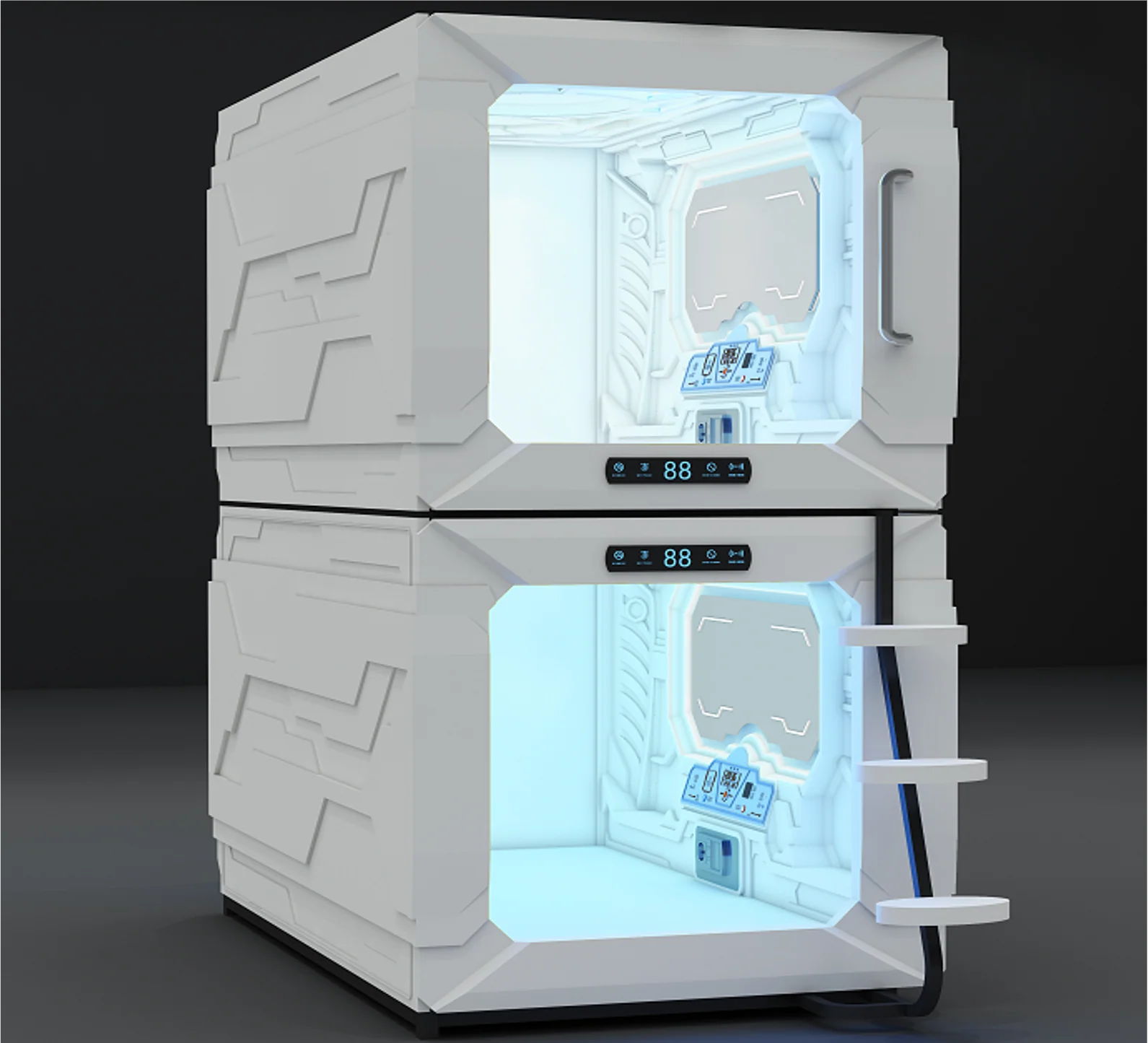
GALAXY Series - Horizontal Single
Standard ABS shell with metal frame featuring TV slot, security sliding door, and ergonomic non-slip ladder. Perfect for hotels, airports, and commercial applications.
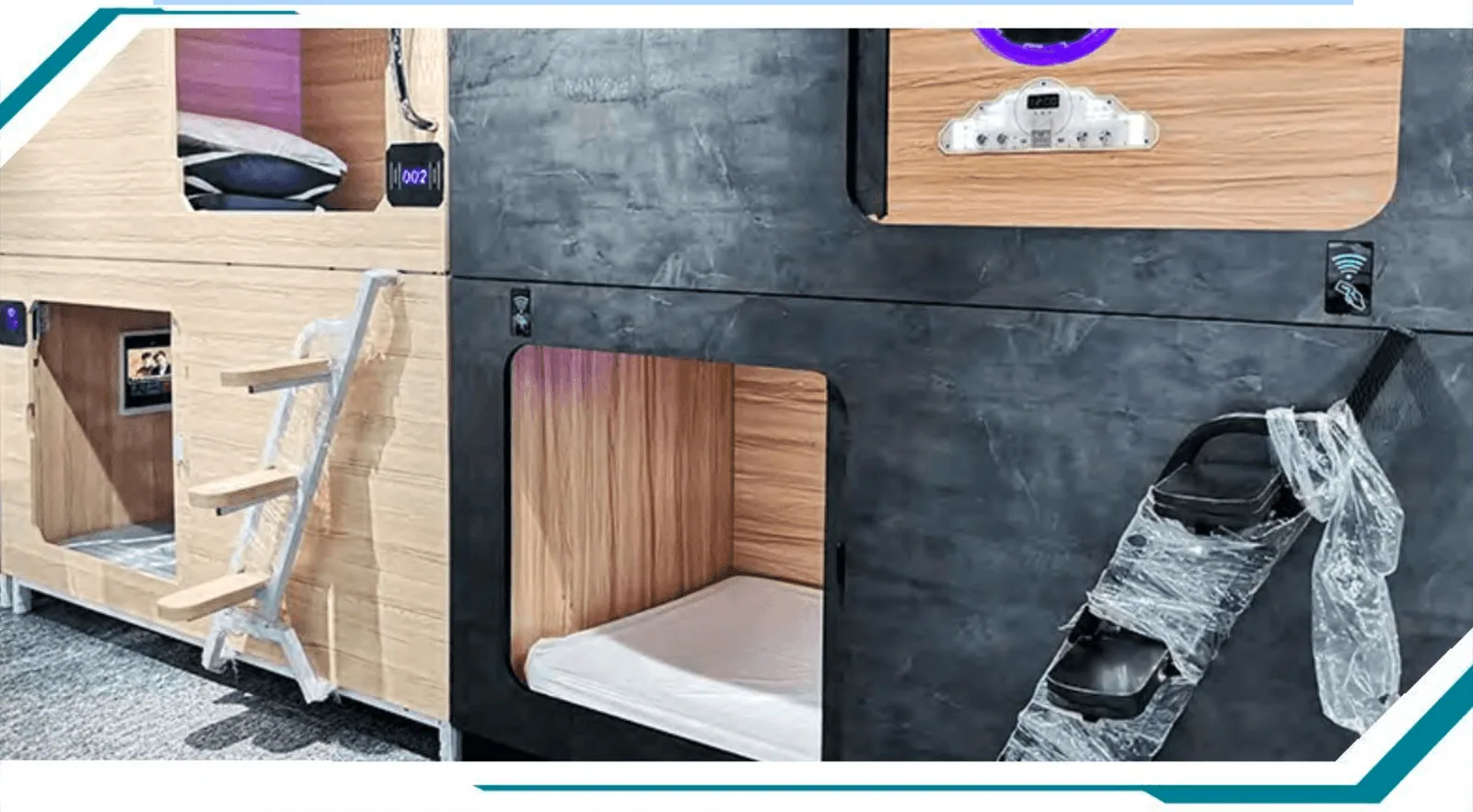
Wooden Series - Horizontal Single
Premium eco multi-layer board construction with metal frame, offering natural wood-grain aesthetics while maintaining all essential capsule bed features.
Market deep-dive
The Bulandshahr pod-hotel opportunity
Bulandshahr is not a place that announces itself — it earns attention through sheer economic gravity. Wedged between the Ganga and Yamuna in the fertile Doab heartland, this western Uttar Pradesh district of 3.5 million people has quietly built an industrial base that punches far above its tier. Khurja, its ceramics capital, holds a Geographical Indication tag and houses over 500 factories whose glazed pottery reaches markets from Mumbai to the Middle East. At Narora, the Nuclear Power Corporation of India runs a 440-megawatt atomic station that lights up the state grid, while at Chola village, BIBCOL manufactures polio vaccines through an Indo-Russian collaboration. When the Eastern and Western Dedicated Freight Corridors converge at Khurja Junction, Bulandshahr will become one of northern India's most strategic logistics nodes.
The spiritual geography of Bulandshahr is anchored to the Ganga. At Garhmukteshwar's Brijghat — mentioned in the Bhagavata Purana and Mahabharata as part of ancient Hastinapur — over a million pilgrims gather each November for the Kartik Purnima mela, performing pind daan and deep daan in what locals call the Chhota Kumbh. Thirty kilometres upriver, Anoopshahr wears its title of Choti Kashi with quiet pride: its ghats host year-round bathing, and the Avantika Temple draws Shivratri and Navratri crowds. Belon's ancient Sarva Mangala Devi shrine and Ahar's riverside Shiva temple complete a pilgrimage circuit that keeps the district's roads busy well beyond any single festival season, yet formal accommodation along this corridor remains almost nonexistent.
History and heritage add a quieter but persistent layer of visitor demand. Kuchesar Fort, built in 1734 as a Jat opium-trading post and later the seat of the Jat Kingdom of Uttar Pradesh, was restored by Neemrana Hotels into the heritage property Rao Raj Vilas — it hosted Bollywood shoots and draws weekend visitors from Delhi, just 80 kilometres away. The Victorian-era Clock Tower at Raja Babu Park, the Kala Aam execution ground from the 1857 Rebellion, and Karnavas with its Mahabharata link to King Karna all contribute to a heritage trail that exists on paper but lacks the budget-stay infrastructure to convert curious day-trippers into overnight guests. Meanwhile, the new Kalyan Singh Government Medical College — a 500-bed teaching hospital inaugurated in 2025 — has instantly created a daily flow of 1,363 outpatients and 95 admissions whose families have nowhere affordable to stay.
For a sleeping-pod operator, Bulandshahr is a rare alignment of demand drivers without supply. The ceramics workforce and buyer traffic in Khurja, the pilgrim millions at Garhmukteshwar, the medical-college attendant economy, the student population across Jaypee University and 400-plus colleges, and the coming wave of DFC logistics workers all converge in a district where branded budget accommodation simply does not exist below the heritage-hotel price point. A phased rollout — flagship pods near Bulandshahr's hospital-university corridor, a satellite unit in the Khurja ceramics-DFC zone, and a third at the Garhmukteshwar pilgrimage node — would tap three distinct, proven demand pools. At an indicative nightly rate of Rs 799, the economics work precisely because the gap is not speculative: the demand is already here, sleeping in tents and truck cabins.
Bulandshahr pod hotel — FAQs
Why does Bulandshahr need a sleeping pod hotel when it is so close to Delhi?+
Proximity to Delhi is precisely the point — Bulandshahr sits on the Delhi-Agra NH-91 corridor, and its own population of 3.5 million, 500+ ceramics factories in Khurja, a nuclear power station at Narora, and Ganga pilgrimage sites at Garhmukteshwar all generate overnight demand that Delhi cannot serve. A capsule hotel in Bulandshahr fills the gap for transit travellers, factory buyers, hospital attendants at the new Kalyan Singh Medical College, and the million-plus Kartik Mela pilgrims who currently sleep in makeshift tents.
What is a Japanese-style pod hotel, and how would it work in a district like Bulandshahr?+
A Japanese capsule hotel replaces traditional rooms with compact, private sleeping pods — each with AC, charging ports, a reading light, and a lockable privacy screen. In Bulandshahr, this format is ideal because demand comes from short-stay segments: ceramics buyers visiting Khurja for a day, NPCIL engineers on rotation at Narora, pilgrims needing one clean night near the Ganga ghats, and hospital families at the 500-bed government medical college. Pods deliver hotel-grade comfort at hostel-level pricing.
Where in Bulandshahr district would nap pods see the highest demand?+
Three zones stand out: (1) Bulandshahr city centre near the Kalyan Singh Medical College and railway station — hospital attendants and rail passengers; (2) Khurja, the GI-tagged ceramics hub with 40,000 workers and wholesale buyers, now also a DFC freight logistics node; and (3) Garhmukteshwar-Brijghat, where over a million pilgrims arrive for Kartik Purnima and year-round Ganga rituals. Each location has distinct, proven demand with zero existing branded budget accommodation.
How affordable is a budget pod hotel or hourly hotel stay in Bulandshahr compared to traditional hotels?+
BIDUA Pods targets an ADR of around Rs 799 per night — roughly 40-60% cheaper than the few traditional hotels in Bulandshahr, and a fraction of what heritage properties like Kuchesar Fort charge. Hourly booking options for nap pods make it even more accessible for truck drivers on the DFC corridor, day-trip ceramics buyers in Khurja, or families waiting during hospital procedures. The model passes savings from compact design and shared amenities directly to guests.
Is there enough year-round demand in Bulandshahr for a Chinese-style pod hotel to be viable?+
Yes. Bulandshahr's demand is diversified across seasons: the Kartik Mela at Garhmukteshwar peaks in November but Ganga pilgrimage continues year-round at Anoopshahr and Ahar; Khurja's 500+ ceramics factories operate through the year with constant buyer traffic; the medical college generates 1,363 daily OPD visits regardless of season; and exam periods at Jaypee University and 400+ colleges create student-accommodation surges in March-June. No single season carries the business — that is exactly what makes the model sustainable.
What makes BIDUA Pods different from a regular budget hotel or dharamshala in Bulandshahr?+
Dharamshalas near Garhmukteshwar and Anoopshahr offer basic shelter but lack privacy, hygiene control, and climate comfort. Traditional budget hotels in Bulandshahr are scarce and often charge more for lower standards. BIDUA's sleeping pod model delivers individual climate-controlled capsules with digital check-in, app-based booking, standardised housekeeping, and per-hour flexibility — the hygiene and privacy of a hotel room at closer to dharamshala pricing. For the ceramics buyer, the NPCIL contractor, or the medical-college visitor, it is a category that simply does not exist here yet.
Start your Bulandshahr pod hotel with BIDUA
Sign up to design your space in 3D, build a presentation, and get a quotation + ROI from one dashboard — or talk to our team for a custom Bulandshahr plan.